
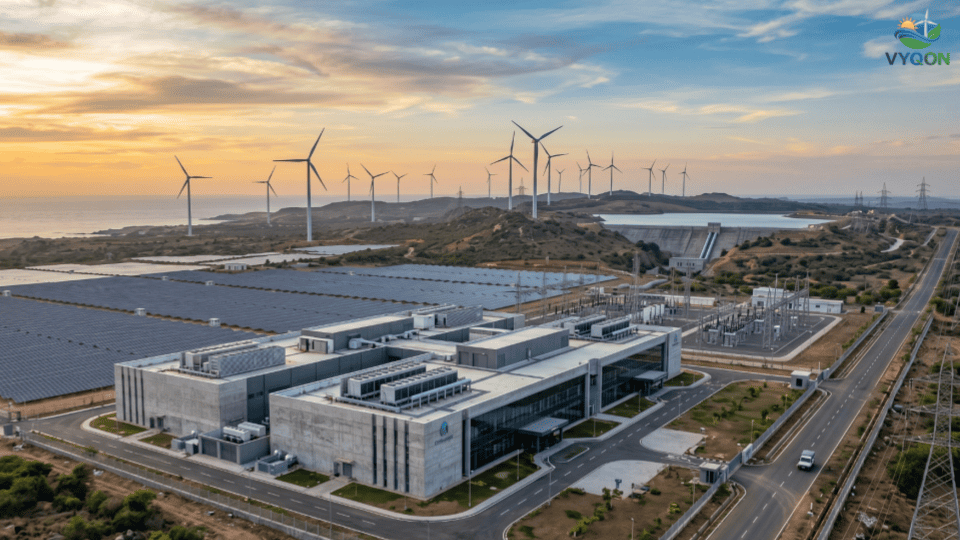
The Solar Energy Corporation of India Limited (SECI) has issued a Request for Selection (RfS) to select Renewable Energy Power Developers (RPDs) for assured peak supply of 4,800 MWh (1,200 MW × 4 hours). The power will come from Inter-State Transmission System (ISTS)-connected renewable energy projects in India. The tender, SECI-FDRE-X (RfS No. SECI/C&P/IPP/13/0012/26-27), was published on October 7, 2026. It requires developers to pair an energy storage system with renewable generation to supply power during peak hours. Online bids are due by 6:00 PM on October 29, 2026.
Tender Schedule and Bidding Process
The tender (Tender ID SECI000289) follows a single-stage, two-envelope e-bidding procedure on the ISN-ETS portal, followed by an e-Reverse Auction for eligible bidders. Key dates:
- Pre-bid meeting: 3:00 PM on October 14, 2026.
- Online bid deadline: 6:00 PM on October 29, 2026.
- Earnest Money Deposit (EMD) originals: must reach SECI by 6:00 PM on November 2, 2026.
- Techno-commercial bid opening: 10:00 AM on November 3, 2026.
The RfS document costs ₹50,000 plus GST. The bid processing fee is ₹20,000 per MW plus GST, capped at ₹20 lakh. Micro and Small Enterprises with valid UDYAM registration are exempt from these charges and the EMD, subject to conditions.
Policy Framework and Contract Structure
The RfS follows the Ministry of Power’s guidelines for tariff-based competitive bidding for firm and dispatchable power from grid-connected renewable energy projects with energy storage, notified on June 9, 2023.
- Ownership model: Projects will be developed on a Build-Own-Operate basis.
- PPA term: SECI will sign Power Purchase Agreements (PPAs) valid for 25 years from the Scheduled Commencement of Supply Date (SCSD).
- Offtake: SECI acts as intermediary procurer and will sell the power to Buying Entities through back-to-back Power Sale Agreements. The Buying Entities will be announced later.
- Financial assistance: No separate Central Financial Assistance is envisaged.
- Eligible projects: Developers with commissioned or under-construction projects that have untied capacity may also participate.
Mandatory Storage, Open Technology
Every project must include an Energy Storage System (ESS), while project selection remains technology-agnostic.
- Co-location: The renewable generation and ESS components of a project must be co-located.
- Charging source: Storage charged from non-renewable sources will not qualify as renewable power.
- Ownership: The developer may own the ESS or contract it from a third party.
- Technology changes: The ESS technology may be changed during the PPA term, at the developer’s own risk and cost.
Installed renewable capacity may be lower than, equal to or greater than the Contracted Capacity. Guaranteed offtake, however, is limited to the Contracted Capacity. Each bidder, including its group companies, must quote between 50 MW and 600 MW.
Peak Supply Obligations
The Buying Entity will pick four hours each day within the Peak Hours window. This window runs from the evening non-solar hours of one day to the morning non-solar hours of the next, as defined by Grid-India for the project’s state.
- Continuity: At least one hour of supply must be continuous.
- Daily quantity: Developers must deliver 4,000 kWh per MW of Contracted Capacity each day, at 1 MWh per MW in each scheduled hour.
- Default schedule: If no schedule is received by 6:00 AM, the previous day’s schedule applies.
- Shortfall penalty: Monthly shortfalls of up to 10% are permitted. Beyond that, a penalty of 1.5 times the PPA tariff applies.
- Renewable sourcing: All supplied energy must be renewable, though up to 5% of annual energy may be sourced from green market or bilateral arrangements.
- Market sales: Outside Peak Hours, developers may use the ESS for market sales. Selling to third parties while PPA obligations remain unmet attracts an additional penalty.
- Compliance benefits: The power qualifies for Renewable Purchase Obligation compliance. The storage capacity may count towards Energy Storage Obligations, where applicable.
Grid Connectivity
ISTS interconnection must be at a minimum of 220 kV. Before bidding, bidders must already have applied for connectivity with non-solar-hour access for at least the offered capacity, and must submit proof with their bid.
Delivery points must be chosen from one of four categories:
- existing substations with available margin;
- substations under augmentation;
- substations in the Central Transmission Utility’s updated plan;
- substations identified in the Central Electricity Authority’s 500 GW transmission plan.
Intra-state connection is allowed only if the project and the Buying Entity are in the same state and both agree.
Financial Commitments
| Instrument | Solar capacity | Wind or other renewable capacity | ESS capacity |
| EMD | ₹9.68 lakh per MW | ₹13.68 lakh per MW | ₹2.40 lakh per MWh |
| Performance Bank Guarantee (PBG) | ₹24.20 lakh per MW | ₹34.20 lakh per MW | ₹6 lakh per MWh |
Bank guarantees, Payment on Order Instruments from PFC or REC, and insurance surety bonds are accepted. Selected bidders must also pay success charges of ₹1 lakh per MW plus taxes. They may opt for SECI’s Payment Security Mechanism by offering a tariff discount of ₹0.02/kWh.
Execution Timelines and Compliance
- Commencement of supply: The SCSD is 18 months from the PPA’s Effective Date.
- Financial closure: Must be achieved six months before the SCSD.
- Delays up to six months past the SCSD: The PBG is encashed on a pro-rata basis.
- Delays beyond six months: The Contracted Capacity is reduced to the capacity already supplying power.
- Part commencement: Accepted in blocks of at least 50 MW.
- Domestic sourcing: At commissioning, developers must certify that solar cells and modules come from MNRE’s ALMM list and wind turbines from its RLMM list.
Leave a Comment