
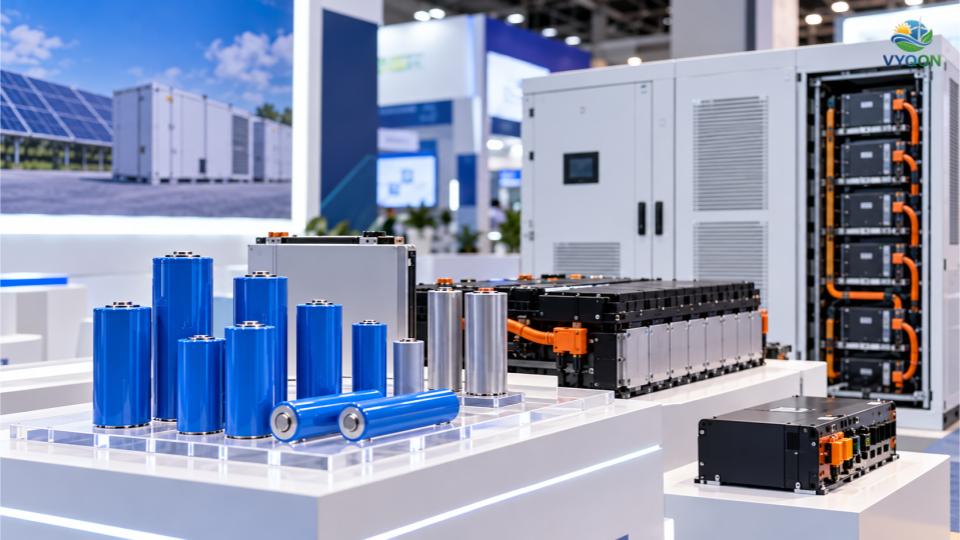
Bengaluru-based battery manufacturer NASH Energy participates in The Battery Show India 2026 in Greater Noida, highlighting domestic LFP cell manufacturing, battery-pack engineering and integrated energy storage technologies.
Greater Noida, 22 October 2026: NASH Energy, an Indian manufacturer of lithium-ion battery cells and energy storage solutions, is participating in The Battery Show India 2026, being held from 22 to 24 October at India Expo Mart & Centre in Greater Noida, Uttar Pradesh.
The company’s participation has been confirmed through the exhibition organiser’s official exhibitor directory, which identifies NASH Energy Private Limited at Hall 5, Booth 5.34.
The three-day event brings together battery manufacturers, technology developers, component suppliers, equipment providers and energy storage companies, providing a platform to examine developments across the battery value chain.
For NASH Energy, the exhibition offers an opportunity to present its domestic battery technology capabilities to an industry increasingly focused on localised cell production, reliable battery-pack integration and energy storage applications.
The company operates within the NASH Group and has manufacturing activities in Bengaluru, supported by research and development capabilities in Japan.
Its business covers lithium iron phosphate (LFP) battery cells, battery packs and related electrical and electronic components for applications ranging from electric mobility to stationary energy storage.
The development represents an industry exhibition and technology presentation, not the commissioning of a new battery manufacturing plant or the announcement of a confirmed energy storage project.
NASH Energy’s India-Made LFP Battery Technology
A central element of NASH Energy’s product portfolio is its cylindrical lithium iron phosphate battery technology.
According to the company’s official website, its NEI32140E LFP cell has been developed with support from its Japanese research and development capabilities and is manufactured in Bengaluru.
The company identifies the NEI32140E as a mass-manufactured cylindrical LFP battery cell intended for applications requiring rechargeable energy storage.
Its official product specifications list a nominal cell capacity of 15 Ah, with a cylindrical 32140 form factor.
The company’s technical literature also identifies a nominal voltage of 3.2 V for this cell.
These specifications are relevant because the electrical characteristics of an individual battery cell influence the design of the modules and packs in which it is used.
Battery-pack engineers must determine how cells should be connected in series and parallel to achieve the voltage, energy capacity and current-handling requirements of a particular application.
The official NASH product portfolio includes additional cylindrical cell variants and a prismatic LFP cell model.
However, the existence of a product model or technical roadmap does not establish the quantity currently being manufactured, the number of commercial customers or the volume of batteries deployed in operating projects.
Those factors require separate production and commercial disclosures.
Why LFP Chemistry Matters for Energy Storage
Lithium iron phosphate technology has become an important battery chemistry for applications requiring repeated charging and discharging.
LFP cells use a lithium iron phosphate cathode and are commonly considered for applications where thermal stability, durability and operating life are important selection criteria.
For stationary electricity storage, these characteristics can support applications such as renewable energy shifting, commercial electricity management and backup power.
However, battery chemistry alone does not determine the safety or economic performance of an installed storage system.
Cell manufacturing quality, electrical protection, thermal management, equipment integration and operating conditions influence the reliability of the completed installation.
System designers must also evaluate the expected charging and discharging profile, temperature exposure, installation environment and maintenance requirements.
These considerations are particularly relevant for solar-plus-storage projects, where batteries may be charged during periods of renewable generation and discharged when electricity demand increases or solar production decreases.
For commercial and industrial users, LFP-based storage systems can also be evaluated for backup supply, peak-demand management and improved utilisation of on-site renewable generation.
The commercial benefits depend on the customer’s electricity consumption pattern, applicable tariffs, storage duration and equipment performance.
NASH Energy’s participation in the exhibition reflects the growing importance of connecting domestic battery-cell development with the engineering required for practical energy storage applications.
From Battery Cells to Complete Battery Packs
Manufacturing cells represents one stage of the battery value chain.
To create a usable battery pack, individual cells must be integrated with electrical connections, protective equipment, mechanical structures and monitoring systems.
NASH Energy states that it designs, develops, manufactures and supplies battery packs and Battery Management Systems according to customer requirements.
The company’s official battery-pack portfolio identifies applications in electric two-wheelers, three-wheelers, passenger vehicles, commercial vehicles, industrial equipment, telecommunications and stationary energy storage.
Each application presents different technical requirements.
Electric mobility batteries may need to support changing power demands, vibration and frequent charging.
Telecommunication batteries are generally designed around dependable backup operation and compatibility with existing power infrastructure.
Stationary energy storage installations may require sustained cycling, appropriate thermal management and communication with external electrical systems.
Consequently, a battery pack suitable for one application cannot automatically be assumed to meet the requirements of another.
Product selection must consider nominal energy capacity, operating voltage, discharge capability, available power, protection settings and applicable technical standards.
NASH Energy’s involvement in both cell development and pack engineering is relevant to these integration requirements.
However, individual product ratings must be evaluated through current manufacturer datasheets and application-specific technical documentation before being adopted for a commercial project.
Battery Management Systems and Operational Reliability
Battery Management Systems are an important component of modern rechargeable battery installations.
A BMS monitors operating parameters such as cell voltage, temperature and current, while implementing protection functions according to the system design.
It may also estimate state of charge, identify abnormal operating conditions and provide information to supervisory equipment.
For larger battery installations, communication between battery packs, power conversion systems and energy management equipment can influence system operation.
These functions are important because battery performance depends on maintaining operation within appropriate electrical and thermal limits.
NASH Energy identifies BMS development and battery-pack integration among its capabilities.
Such technologies can support a wide range of applications, including mobile equipment and stationary electricity storage.
Nevertheless, a company’s general BMS capability should not be interpreted as proof that every battery product has been certified for grid-scale deployment.
Commercial buyers must verify the actual system architecture, relevant safety certifications, warranty provisions and compatibility with their intended electrical installation.
The exhibition provides an opportunity for manufacturers and prospective customers to discuss these practical requirements.
Manufacturing Capabilities and Technical Development
NASH Energy’s official company information identifies Bengaluru as an important location for its battery-cell manufacturing activities.
The company also describes an engineering and manufacturing development ecosystem supported by research activities in Japan.
Its manufacturing information highlights work involving different lithium-ion cell formats, including cylindrical and prismatic designs.
The company identifies development capabilities relating to cell engineering, production processes and associated battery technologies.
These activities are relevant to India’s domestic energy storage sector because cell availability is an important component of battery supply-chain development.
Battery manufacturing involves technical stages such as material preparation, electrode processing, cell assembly, electrolyte filling, formation, ageing and quality inspection.
Production consistency is important because variations between cells can affect the performance and reliability of larger battery assemblies.
Manufacturing facilities must therefore manage product quality, testing procedures, process stability and safety requirements.
Local manufacturing can potentially strengthen equipment availability and technical support for Indian customers.
However, manufacturing capability and announced factory capacity should not be confused with verified annual production output or customer deliveries.
The Battery Show India appearance does not independently establish a new manufacturing-capacity expansion by NASH Energy.
Any subsequent increase in capacity or commencement of an additional production line should be evaluated against a separate company announcement.
Importance for India’s Solar and BESS Industry
India’s renewable energy expansion is increasing interest in battery systems that can support electricity supply beyond the hours of direct solar generation.
Solar photovoltaic installations generate electricity according to available sunlight, while wind output varies with resource conditions.
Battery energy storage can help manage these variations by absorbing electricity when generation is available and delivering it later, subject to the system’s rated capacity and operating requirements.
The value of storage depends on both its power rating and energy capacity.
Power rating, typically expressed in kW or MW, describes how quickly a battery installation can supply or absorb electricity.
Energy capacity, usually expressed in kWh or MWh, indicates the amount of energy available under defined operating conditions.
These characteristics determine the approximate duration over which a system can operate at a specified output.
Battery pack design, inverter selection, operating limits and usable state-of-charge range also influence the services an installation can provide.
For Indian solar and energy storage developers, domestic battery suppliers represent one part of the wider technology ecosystem required to implement such projects.
However, participation in a technology exhibition does not establish that a supplier has secured a new solar-plus-storage contract or delivered a particular grid-scale battery installation.
Those commercial milestones require specific customer or project announcements.
Exhibition Participation and Future Opportunities
According to the official event organiser, The Battery Show India 2026 features manufacturers and technology suppliers across battery materials, components, manufacturing equipment, testing, battery management and energy storage applications.
NASH Energy is included in the organiser’s exhibitor directory and technology-partner coverage.
Its participation offers an opportunity for technical discussions with equipment buyers, system integrators, engineering companies and other participants in the battery value chain.
Such interactions may support future commercial cooperation, but exhibition attendance should not be interpreted as a confirmed investment agreement or product supply order.
For evaluating the company’s future development, important indicators would include independently documented product testing, commercial manufacturing output, customer deliveries and project-level performance.
Detailed system specifications and verified operating references would also help prospective customers assess the suitability of different battery products.
Official Sources and References
1. The Battery Show India 2026 — Official Exhibition Website
Dates, venue and event information.
https://www.thebatteryshowindia.com/expo
2. The Battery Show India 2026 — Official Exhibitor Directory
NASH Energy Private Limited, Hall 5, Booth 5.34.
https://www.thebatteryshowindia.com/exhibitors-profile-2026?page=19&task=exhibitors-profile-2026
3. The Battery Show India — Official Technology and Exhibitor Overview
Participating battery manufacturers and technology suppliers.
4. NASH Energy — Official LFP Battery Cell Portfolio
NEI32140E cell and other LFP product specifications.
https://www.nashenergy.in/Product_LiFePO4-cell.php
5. NASH Energy — Official Battery Pack Portfolio
Battery-pack engineering, BMS and application information.
https://www.nashenergy.in/Product_BatteryPacks.php
6. NASH Energy — Official Manufacturing Capabilities
Manufacturing engineering and battery technology development.
Leave a Comment