
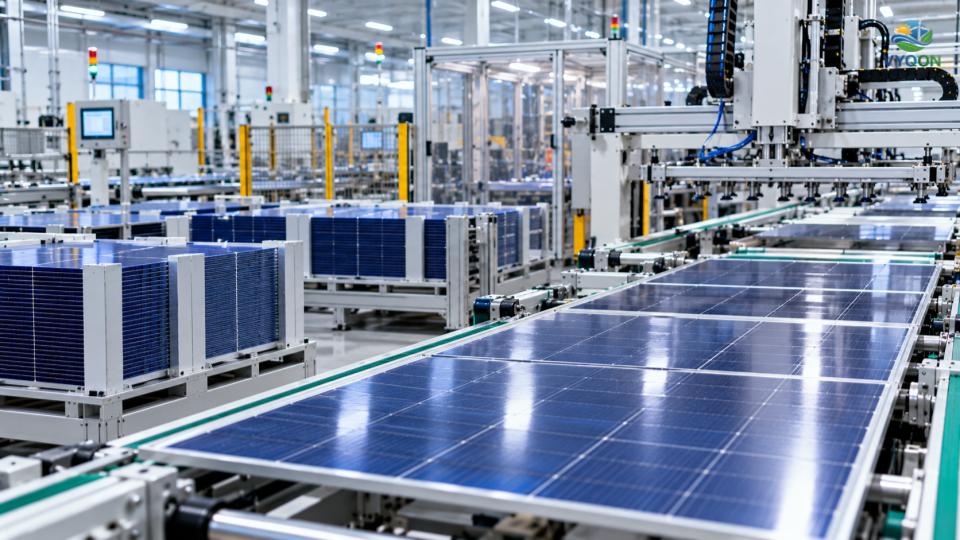
Swiss impact investment manager responsAbility has announced growth capital of up to US$20 million for Navitas Solar, supporting the Indian manufacturer’s backward integration into solar cell production. The investment is linked to a proposed 2.2 GW facility, while the relationship with Navitas’s previously announced 3.6 GW expansion plan remains to be clarified.
Surat, 23 October 2026: Indian photovoltaic manufacturer Navitas Solar has secured a growth-capital investment commitment of up to US$20 million from Swiss impact asset manager responsAbility, marking a new financing milestone in the company’s expansion into domestic solar cell manufacturing.
The development was reported on 22 October 2026 and subsequently confirmed through an official communication from responsAbility Investments AG.
According to the investment manager, the financing will support Navitas’s expansion into solar cell production, including a planned 2.2 GW manufacturing facility in India.
The investment is being made through responsAbility’s Asia Climate Fund, which supports private-sector businesses and infrastructure contributing to climate-related development across Asian markets.
For Navitas, the transaction represents an opportunity to strengthen its manufacturing supply chain by expanding beyond photovoltaic module production into the manufacturing of solar cells.
However, the financing announcement does not establish that the proposed factory has entered commercial operation or that the entire US$20 million commitment has already been disbursed.
Institutional Climate Finance Supports Manufacturing Expansion
The involvement of responsAbility introduces an international climate-focused investment partner into Navitas’s solar manufacturing expansion strategy.
responsAbility is a Swiss investment manager specialising in financing businesses and infrastructure projects across emerging markets.
Its Asia Climate Fund provides financing to companies operating in sectors including renewable energy, electric mobility, energy efficiency and related climate infrastructure.
In August 2026, responsAbility announced the final closing of the fund at US$461 million, identifying private credit as an important mechanism for financing the energy transition in South and Southeast Asia.
The investment in Navitas represents an application of this financing strategy to India’s photovoltaic manufacturing sector.
Unlike a direct investment in an operational solar power plant, manufacturing finance supports the development of industrial facilities and capabilities required to produce renewable energy equipment.
Solar cell manufacturing is capital-intensive and involves specialised machinery, controlled processing conditions, electrical testing and strict product-quality requirements.
Institutional capital may help manufacturers finance equipment acquisition, factory development and the technical resources required for production.
Nevertheless, an announced investment commitment should be distinguished from completed financing disbursement or the achievement of commercial manufacturing milestones.
The publicly accessible primary information reviewed for this article does not establish the full disbursement schedule, financing structure, final project investment value or contractual return terms associated with the Navitas transaction.
Those details should not be assumed without additional disclosures.
Navitas Plans Deeper Integration into Solar Cell Manufacturing
Navitas Solar was established in 2013 and is headquartered in Surat, Gujarat.
The company manufactures photovoltaic modules using technologies including Mono PERC and high-efficiency N-type TOPCon.
According to its official corporate information, Navitas has an annual solar module manufacturing capacity of approximately 3 GW.
Its broader activities include solar encapsulant manufacturing through Navitas Alpha Renewables and engineering, procurement and construction services through Navitas Planet.
The company’s planned entry into solar cell production represents a further step in its backward integration strategy.
Solar cells are semiconductor devices that convert sunlight into electrical energy through the photovoltaic effect.
Individual cells are electrically interconnected and incorporated into finished solar modules, together with encapsulation materials, glass, supporting structures and electrical connections.
A manufacturer producing only completed modules may depend on external suppliers for the cells required in those products.
Developing domestic cell manufacturing capabilities could provide greater control over component sourcing, technical compatibility and manufacturing coordination.
However, solar cell production requires a different level of process complexity from module assembly.
Manufacturing involves silicon wafer cleaning, texturing, junction formation, passivation, contact formation, metallisation and electrical characterisation, depending on the technology.
High-efficiency technologies such as TOPCon place particular importance on process consistency, precise material properties and production quality.
The proposed expansion will therefore need to demonstrate technical performance and manufacturing reliability before it can contribute commercial volumes of domestically produced cells.
Clarifying the 2.2 GW and Earlier 3.6 GW Manufacturing Announcements
An important consideration in the latest funding announcement is the relationship between Navitas’s different publicly announced manufacturing capacity figures.
responsAbility’s new communication refers to financing associated with a planned 2.2 GW solar cell manufacturing facility.
However, Navitas previously announced a broader manufacturing expansion on 16 June 2026, describing a proposed 3.6 GW high-efficiency solar cell production facility alongside a pilot wafer and ingot line in Gujarat.
That earlier company announcement outlined an investment plan of approximately ₹1,500 crore, with development intended to take place in phases.
Navitas also stated that civil construction was underway and that the first phase was targeted for commissioning in 2027, subject to market conditions and project readiness.
The earlier announcement provides important context for understanding the company’s industrial development strategy.
Nevertheless, the available primary information does not establish whether the newly described 2.2 GW facility represents a particular phase of the earlier 3.6 GW project, an updated configuration or another component of the broader expansion programme.
Consequently, the two figures should not be added together to claim 5.8 GW of planned capacity.
Nor should the latest financing be presented as proof that the previously announced 3.6 GW project has been cancelled, replaced or fully funded.
The confirmed new development is an institutional investment commitment associated with a planned 2.2 GW solar cell facility.
Further clarification from Navitas or responsAbility will be needed to establish how that capacity fits within the company’s existing manufacturing roadmap.
Why Domestic Solar Cell Manufacturing Matters
India’s photovoltaic manufacturing ecosystem includes several interconnected stages, ranging from silicon ingots and wafers to solar cells, modules and complete electricity-generating systems.
Although module assembly is an important part of this value chain, domestic cell production requires additional equipment, materials and technical expertise.
Manufacturers seeking to improve supply-chain resilience must consider the availability of suitable wafers, production chemicals, processing machinery and quality-control systems.
Cell production also needs trained engineering personnel, stable utilities, production monitoring and reliable equipment maintenance.
For manufacturers such as Navitas, backward integration could reduce some dependence on externally purchased cells if the proposed facility is successfully commissioned and achieves competitive production performance.
However, domestic manufacturing does not automatically guarantee lower costs or higher profitability.
Commercial success will depend on cell conversion efficiency, manufacturing yield, equipment utilisation, electricity and material costs, product acceptance and market demand.
Regulatory requirements are also relevant.
India’s Approved List of Models and Manufacturers framework for solar photovoltaic cells creates compliance requirements for applicable project categories, subject to the relevant government notifications and transitional provisions.
A planned solar cell factory does not automatically qualify as an approved manufacturer under that framework.
Products and manufacturing facilities must satisfy the applicable requirements before they can be treated as eligible for specified procurement categories.
The proposed Navitas development therefore presents an industrial opportunity whose eventual contribution will depend on successful project execution and regulatory compliance.
Technology Development and Long-Term Strategy
Navitas has identified high-efficiency photovoltaic technologies as part of its longer-term manufacturing strategy.
The company currently supplies solar modules incorporating established photovoltaic cell architectures and has outlined plans to develop additional upstream manufacturing capabilities.
Its June 2026 expansion announcement also included a proposed pilot programme covering silicon wafers and ingots.
These activities reflect an intention to develop capabilities across more stages of the photovoltaic production chain.
In addition, Navitas has separately announced cooperation with Caelux relating to perovskite-TOPCon hybrid tandem photovoltaic modules.
Such technologies aim to improve the conversion of incident sunlight into electrical energy by using complementary photovoltaic materials and structures.
However, research partnerships, product-development programmes and manufacturing investment plans are separate activities.
The newly announced responsAbility financing should not be interpreted as confirming that commercial perovskite-tandem production, wafer fabrication or ingot manufacturing has already commenced.
Each manufacturing stage will require its own implementation, qualification and commercial-readiness milestones.
What Happens Before Commercial Production?
The most important next steps for Navitas will involve clarifying the manufacturing configuration supported by the new investment and progressing towards commercial production.
Factory implementation typically requires equipment procurement, machinery installation, utilities integration, process development and testing.
Solar cell production lines must also undergo qualification and ramp-up before achieving dependable commercial output.
Initial equipment installation does not necessarily indicate that a facility has achieved its stated annual manufacturing capacity.
Production capacity and actual output are separate indicators.
A factory may have a specified nameplate capacity while producing lower volumes during initial commissioning, process stabilisation or customer qualification.
The eventual operating performance of Navitas’s proposed facility will depend on equipment reliability, manufacturing yields, product quality and its ability to meet customer requirements.
Future company disclosures identifying the amount of capital deployed, commissioning dates, production volumes and customer supply arrangements would provide stronger evidence of commercial progress.
Clarification of the 2.2 GW and 3.6 GW capacity relationship will also be important for investors and industry stakeholders assessing the company’s expansion.
Outlook
Navitas Solar’s new financing arrangement with responsAbility Investments AG represents a meaningful development in its strategy to expand into domestic solar cell manufacturing.
The investment commitment of up to US$20 million, through responsAbility’s Asia Climate Fund, is intended to support the company’s next stage of backward integration, including a proposed 2.2 GW solar cell facility.
For India’s solar manufacturing sector, the transaction illustrates the growing relevance of international climate finance to industrial supply-chain development.
However, the proposed capacity remains under development, and the relationship between the latest 2.2 GW figure and Navitas’s earlier 3.6 GW manufacturing plan has not been fully clarified in the available primary announcements.
The project’s eventual importance will depend on actual investment deployment, factory commissioning, manufacturing quality and commercial production.
The confirmed news is the new growth-capital commitment—not the commissioning of 2.2 GW of operational solar cell manufacturing capacity.
Official Sources and References
1. responsAbility Investments AG — Official Investor Announcement, October 2026
Company-authored announcement confirming growth capital of up to US$20 million for Navitas Solar, the proposed 2.2 GW cell manufacturing facility and financing through the Asia Climate Fund.
https://www.linkedin.com/company/responsability-investments
2. Navitas Solar — Official Manufacturing Expansion Announcement, 16 June 2026
Navitas Solar Announces Rs. 1,500 Crore Integrated Manufacturing Expansion in Gujarat with 3.6 GW Cell Line and Pilot Wafer & Ingot Line.
3. responsAbility Investments AG — Official Asia Climate Fund Announcement, 18 August 2026
Asia Climate Fund Closes at USD 461 Million, Underscoring Institutional Opportunity in Asia’s Energy Transition.
4. Navitas Solar — Official Company Information
Current solar module manufacturing capabilities and company business activities.
Leave a Comment