
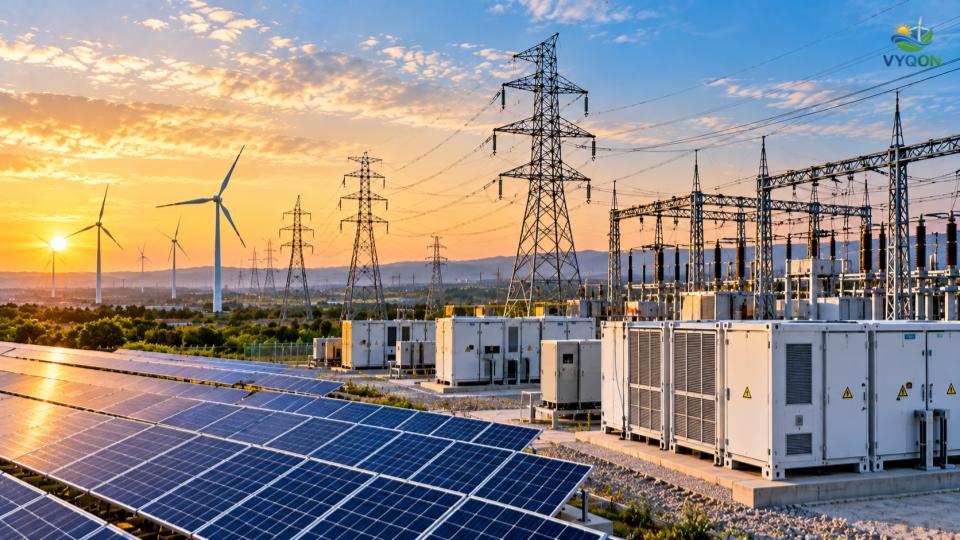
Adani Energy Solutions Limited reports higher operating earnings, 14.82 million cumulative smart-meter installations and new transmission project wins at Vizag and Satara, highlighting continued investment in India’s electricity infrastructure.
Ahmedabad, 23 October 2026: Adani Energy Solutions Limited (AESL) has reported a 51% year-on-year increase in operational revenue to ₹7,167 crore for the second quarter of FY2026–27, supported by growth across its power transmission, smart metering and energy solutions businesses.
According to the company’s official financial results announcement released on 22 October 2026, operational revenue increased from ₹4,740 crore in Q2 FY26 to ₹7,167 crore during the July–September 2026 quarter.
Operating EBITDA increased by 68% to ₹3,070 crore, compared with ₹1,825 crore in the corresponding period of the previous financial year.
The company reported total quarterly EBITDA of ₹3,548 crore, representing a 67% year-on-year increase, while profit after tax rose by 145% to ₹1,364 crore.
Alongside its financial performance, AESL highlighted continued expansion of its transmission infrastructure portfolio, the installation of nearly 15 million smart meters and progress in its integrated energy solutions business.
The announcement is particularly relevant to India’s renewable energy sector because transmission infrastructure, modern distribution networks and intelligent electricity management systems are essential for integrating increasing solar and wind generation.
However, the financial results cover AESL’s diversified electricity infrastructure businesses and should not be interpreted exclusively as earnings from renewable power projects.
Strong Quarterly Financial and Operational Performance
AESL’s latest results indicate continued growth across its principal operating segments.
For Q2 FY27, the company reported total income of ₹10,239 crore, compared with ₹6,767 crore during Q2 FY26, representing an increase of 51%.
Operational revenue reached ₹7,167 crore, while operating EBITDA increased to ₹3,070 crore.
The company reported profit after tax of ₹1,364 crore, compared with ₹557 crore during the corresponding quarter of the previous financial year.
For the first half of FY27, covering April to September 2026, operational revenue increased by 50% to ₹14,351 crore.
Operating EBITDA for the six-month period increased by 70% to ₹5,878 crore, while total EBITDA rose by 62% to ₹6,726 crore.
Profit after tax for H1 FY27 reached ₹2,600 crore, compared with ₹1,096 crore a year earlier.
These figures reflect AESL’s consolidated financial and operational performance.
The distinction between operational revenue, total income and EBITDA is important because the company’s financial reporting includes multiple activities, including electricity transmission, distribution, smart metering and energy solutions.
Total income also includes components associated with service concession arrangements, EPC activities, traded goods and other income.
Consequently, the reported growth should be evaluated using the definitions provided in the company’s official financial disclosures.
Vizag and Satara Transmission Projects Expand Development Pipeline
An important operational development during the quarter was AESL’s acquisition of two new transmission projects: Vizag Power Transmission Limited and Satara Power Transmission Limited.
According to the company’s official announcement, the additions strengthened its transmission development portfolio, taking its aggregate transmission construction pipeline to approximately ₹87,000 crore.
The pipeline comprises 15 projects under execution or development.
This figure represents the company’s wider transmission construction portfolio rather than the combined value of the two newly secured projects.
The company also identified a near-term transmission tendering opportunity of approximately ₹1.4 lakh crore across the Indian market.
That figure represents an estimated market opportunity and should not be confused with contracts already awarded to AESL.
Transmission infrastructure is essential for moving electricity from generating stations to major demand centres.
As India expands solar, wind and hybrid renewable capacity, transmission corridors, substations, transformers and associated electrical systems must be developed to accommodate new generation.
Large renewable energy projects are frequently located in areas with favourable solar irradiation or wind resources, which may be distant from industrial and urban electricity demand.
Strong transmission networks are therefore necessary to deliver renewable electricity reliably.
However, AESL’s latest results announcement does not confirm commercial commissioning of the Vizag or Satara transmission projects.
Their inclusion in the company’s portfolio represents project wins and future infrastructure development activity rather than completed transmission assets.
Transmission Capital Expenditure Reaches ₹5,542 Crore
AESL also reported a substantial increase in transmission capital expenditure during the first half of FY27.
According to the company’s official results, transmission capital expenditure reached ₹5,542 crore, compared with ₹3,343 crore during H1 FY26.
This represents approximately 1.7 times the investment recorded in the corresponding period of the previous year.
Capital expenditure in transmission infrastructure can support construction activities, equipment procurement, engineering, substations and associated project development requirements.
Such investments are important for strengthening electricity networks and enabling the connection of additional generating capacity.
However, capital expenditure should not be interpreted directly as newly commissioned transmission infrastructure.
Projects may require several stages of implementation before becoming operational.
These can include engineering design, statutory approvals, equipment procurement, civil construction, electrical installation, testing and grid energisation.
The company reported an average transmission system availability of approximately 99.8% during Q2 FY27, reflecting the operating performance of its existing transmission assets.
Its reported transmission network reached approximately 29,739 circuit kilometres at the end of September 2026.
These operational measures should be distinguished from the separate value of transmission projects currently under construction.
Smart Meter Installations Reach 14.82 Million
Smart metering remained another major growth area for AESL during the quarter.
The company reported 14.82 million cumulative smart-meter installations by the end of September 2026.
Its smart-meter implementation pipeline stood at 24.6 million meters, comprising ten projects with an associated revenue potential of approximately ₹29,519 crore.
These figures indicate the scale of the company’s ongoing participation in electricity distribution modernisation.
Smart meters provide utilities with improved access to electricity consumption information and can support automated meter reading, billing and network management.
Depending on the technical configuration, advanced metering systems can provide interval-level consumption data and support more detailed analysis of electricity demand.
This information can help utilities understand consumption patterns and improve certain operational processes.
Smart metering is also relevant to the long-term integration of distributed energy resources.
As rooftop solar, electric vehicles and decentralised electricity systems expand, distribution networks increasingly require better information about how electricity is consumed and, where applicable, injected into the network.
However, installing a smart meter does not independently establish improved electricity supply reliability or reduced distribution losses.
Such outcomes depend on the performance of the communication infrastructure, data systems and utility operations.
Similarly, the 24.6 million-meter pipeline represents work under implementation rather than installations already completed.
Energy Solutions Platform and Round-the-Clock Power Supply
AESL’s Energy Solutions Platform also contributed to the company’s quarterly performance.
The company reported operating revenue of approximately ₹2,197 crore from the segment during Q2 FY27, compared with ₹201 crore in the corresponding quarter of the previous year.
The results announcement also highlighted a 2,500 MW round-the-clock (RTC) electricity supply agreement with Maharashtra State Electricity Distribution Company Limited (MSEDCL) for a 25-year period.
According to AESL, its energy solutions activities involve electricity aggregation, supply optimisation and commercial arrangements designed to serve utilities, commercial and industrial consumers, and other electricity buyers.
The company also referred to supply tie-ups involving approximately 4.6 GW of solar and wind capacity and 3.5 GWh of battery energy storage in its wider energy supply arrangements.
These figures should not automatically be interpreted as newly commissioned AESL-owned generation or battery storage capacity.
They describe the company’s reported commercial supply arrangements and associated portfolio development.
Round-the-clock electricity supply arrangements are relevant as customers increasingly seek more predictable power delivery alongside renewable electricity procurement.
Solar and wind generation vary with weather conditions, while electricity consumption may remain substantial during periods of limited renewable output.
An appropriately structured energy supply portfolio can combine different generating sources and flexibility resources to meet contractual delivery requirements.
Battery energy storage can also support such arrangements by shifting electricity between periods, subject to installed capacity, operating conditions and contractual provisions.
However, the existence of an RTC power supply agreement does not independently confirm the commissioning status of every generation or storage asset associated with the wider supply portfolio.
Why Grid Infrastructure Matters for India’s Renewable Energy Transition
India’s renewable energy expansion requires coordinated development across generation, transmission, distribution and electricity system management.
Adding solar and wind capacity is an important part of the energy transition, but generating facilities require suitable infrastructure to deliver electricity to consumers.
Transmission networks must have adequate capacity to accommodate new electricity flows.
Distribution utilities must manage changes in demand, decentralised generation and the requirements of increasingly digital electricity systems.
At the same time, electricity supply arrangements must account for the variability of renewable generation and the need for dependable delivery.
AESL’s activities across transmission, distribution, smart metering and energy solutions illustrate how these functions interact within the wider power sector.
The company’s financial performance and project pipeline demonstrate continued business activity in the infrastructure supporting electricity supply.
However, the exact renewable energy contribution of individual transmission projects must be evaluated using their specific engineering scope and official commissioning records.
New project awards should not be described as completed electricity corridors, while smart-meter installations should not be confused with renewable generating capacity.
These distinctions are essential for accurately assessing progress in India’s grid infrastructure development.
Outlook: Project Execution and Digital Grid Expansion
Adani Energy Solutions Limited’s Q2 FY27 results highlight continued financial and operational expansion across its electricity infrastructure businesses.
The company reported ₹7,167 crore in quarterly operational revenue, ₹3,070 crore in operating EBITDA and ₹1,364 crore in profit after tax, alongside new transmission project wins and continued smart-meter deployment.
Its approximately ₹87,000 crore transmission construction pipeline and 24.6 million-meter implementation portfolio provide visibility into future execution activity, subject to the relevant project schedules and commercial arrangements.
The next significant milestones will include progress on the Vizag and Satara transmission projects, additional operational transmission infrastructure and the expansion of completed smart-meter installations.
For India’s renewable energy industry, the results reinforce the importance of developing the transmission networks, distribution systems and flexible electricity arrangements required to support growing solar and wind capacity.
The confirmed news is AESL’s financial and operational performance announced on 22 October 2026, together with its reported project-development progress—not the commissioning of new Vizag or Satara transmission assets.
Official Sources and References
1. Adani Energy Solutions Limited — Official Q2 and H1 FY27 Results Announcement, 22 October 2026
AESL Delivers Record Q2 Performance, Sustains Strong Growth Momentum.
Official company release covering operational revenue, EBITDA, profit after tax, transmission project wins, capital expenditure and smart-meter installations.
2. Adani Group — Official Q2 FY27 Announcement, 22 October 2026
Company-issued financial and operational performance statement.
3. Adani Energy Solutions Limited — Official Corporate Website
Investor relations, company disclosures and business information.
Leave a Comment