
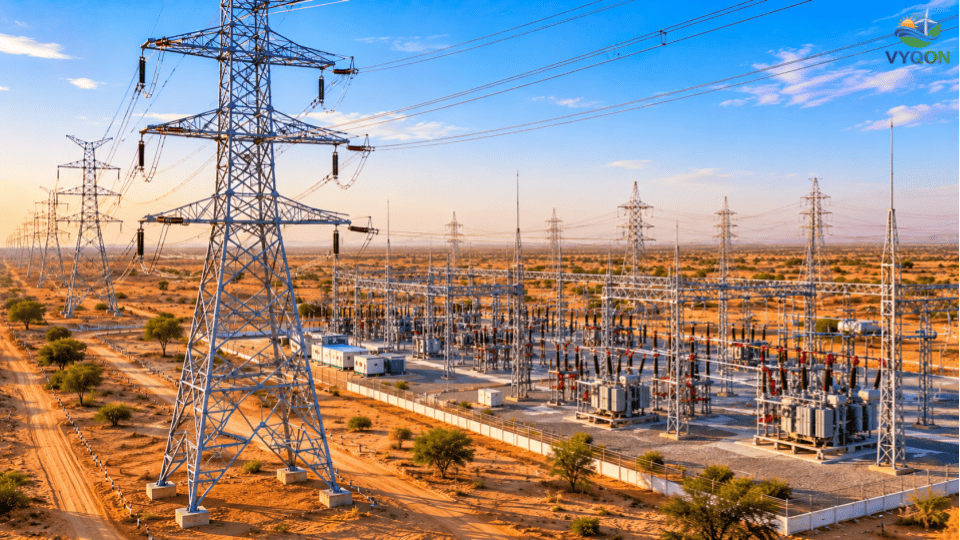
TGERC clarifies how co-located captive power plants are to be billed for November 2024 to March 2026
The Telangana Electricity Regulatory Commission (TGERC) has ruled that Grid Support Charges (GSC) on co-located captive power plants (CPPs) must be levied on the plant’s capacity, and not on the energy consumed by the load it serves. The order, dated 14 October 2026, was passed in I.A. No. 8 of 2025 in O.P. Nos. 16 & 17 of 2024 by a bench comprising Chairman Dr. Justice Devaraju Nagarjun, Member (Technical) Raghu Kancharla and Member (Finance) Cherukuri Srinivasa Rao.
Background of the Dispute
The application was filed by the Northern Power Distribution Company of Telangana Limited (TGNPDCL). It sought clarification of paragraph 6.16.7 of the Retail Supply Tariff Order (RSTO) for FY 2024-25, issued on 28 October 2024, which approved GSC at ₹16.32/kW/month and stated that “the levy shall be limited to only the power consumed by the co-located load.” TGNPDCL was concerned that consumers could read this as energy consumed rather than plant capacity, leading to disputes during implementation.
The wording traces back to the Commission’s order of 27 March 2024 in O.P. Nos. 80 & 81 of 2022, which relied on an Appellate Tribunal for Electricity (APTEL) judgment of 14 December 2023 holding that GSC cannot be levied on a plant’s entire installed capacity, as that would include capacity sold to third parties.
Notice was issued to 13 captive users, including Singareni Collieries, UltraTech Cement and ITC, of which six filed counter-affidavits. Four different readings were advanced. TGNPDCL read the provision as plant capacity net of third-party and PPA capacity, while respondents variously argued for energy net of exports and auxiliary consumption, actual drawal from the grid, or actual power used.
Why the Charge Is Capacity-Based
The Commission’s reasoning rested first on the unit of the charge. A rate expressed in rupees per kilowatt per month is a charge on capacity; an energy-based levy would have been expressed in rupees per kilowatt-hour. The method used to derive the rate confirmed this. For FY 2024-25, approved repairs and maintenance (R&M) expenses of TGSPDCL, TGNPDCL and TGTRANSCO totalling ₹443.84 crore were apportioned over 22,668.34 MW of contracted capacity connected to the state grid, giving ₹16.32/kW/month. For FY 2025-26, ₹492.81 crore apportioned over 22,221.58 MW gave ₹18.48/kW/month. A rate derived over a capacity base, the Commission held, can only be recovered against capacity.
It also rejected the argument that grid support is availed only to the extent of power actually drawn. As long as a co-located plant remains interconnected, the licensee must continuously maintain the voltage and frequency reference, fault level and protection coordination at the point of common coupling, and keep capacity available to replace the plant’s output during an outage. The service being compensated is availability, which is a function of capacity.
How Chargeable Capacity Will Be Calculated
The Commission prescribed the following method: chargeable capacity equals the installed capacity of the co-located CPP, less capacity supplied to third parties through open access, less capacity committed under a power purchase agreement (PPA) with a distribution licensee.
The open access deduction covers only capacity exported or supplied to third parties, on which transmission and wheeling charges are borne. It does not extend to power the plant owner imports through open access for its own consumption. Auxiliary consumption is not deducted, as it is met from the interconnected capacity itself. The Commission added that the chargeable quantum can be established from the plant’s installed capacity and the licensee’s open access and PPA records, without relying on meters located behind the point of supply.
GSC is leviable only while the plant remains interconnected with the grid. No charge applies for periods when a plant is completely shut down and electrically isolated, subject to verification by the licensee.
Procedural Objections Rejected
Respondents argued that the Commission had become functus officio, that the application was effectively a review filed beyond the 75-day limit under the Conduct of Business Regulations, 2015, and that the proper remedy was an appeal under Section 111 of the Electricity Act, 2003. The Commission rejected all three objections, holding that the application only sought to explain an existing direction, without altering the levy, the approved rate or the exclusions in the original order.
Period Covered and Billing Adjustments
Since the FY 2024-25 RSTO was a common order, the clarification applies to both TGNPDCL and the Southern Power Distribution Company of Telangana Limited (TGSPDCL). It governs the period from 1 November 2024 to 31 March 2026. The issue does not arise from FY 2026-27 onwards, as the RSTO dated 30 March 2026 already specifies the chargeable capacity in express terms.
Noting that the divergence arose from the language of the order rather than any default by licensees or consumers, the Commission directed that consequential adjustments be made without interest or penalty and spread over the ensuing billing cycles.
What It Means for Captive Users
The order creates no new liability and only declares the meaning of an existing provision; any captive user aggrieved by its application may seek relief before the appropriate forum. For the DISCOMs, the ruling provides a verifiable basis for assessing GSC over the 17-month period. For captive users, it confirms that capacity committed to third parties or to DISCOMs falls outside the charge, while capacity serving their own co-located load attracts the approved rate for every period the plant stays connected to the grid.
Official References
1. Telangana Electricity Regulatory Commission – Order in I.A. No. 8 of 2025 in O.P. Nos. 16 & 17 of 2024 (dated 14.10.2026) – https://www.tgerc.telangana.gov.in/file_upload/uploads/Orders/Commission%20Orders/2026/Order%20on%20GSC.pdf
2. TGERC – Retail Supply Tariff Order for FY 2025-26 (dated 29.04.2025) – https://www.tgerc.telangana.gov.in/file_upload/uploads/Tariff%20Orders/Current%20Year%20Orders/2025/RST%20Order%20FY%202025-26%20FINAL.pdf
3. Telangana Electricity Regulatory Commission – Official website – https://www.tgerc.telangana.gov.in/
Leave a Comment