
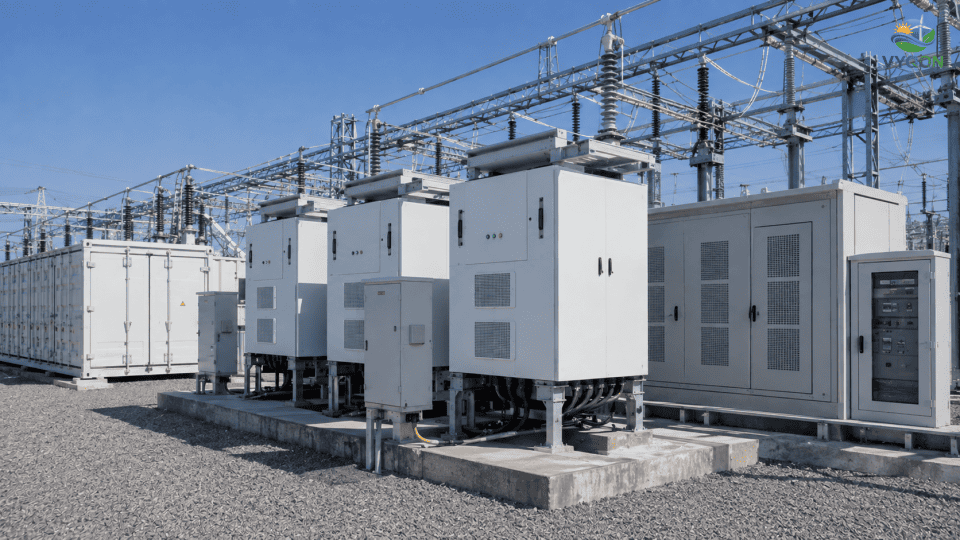
New Delhi-based WattPower Systems has launched its WP-506KTL-H2 grid-forming string inverter for utility-scale solar projects, unveiling the product on the opening day of Renewable Energy India (REI) Expo 2026 on 22 October at India Expo Mart, Greater Noida. The company has positioned the 506 kW inverter for EPCs and developers building solar plants that must remain stable in weak-grid conditions and through severe grid disturbances, a requirement gaining weight as India’s grid absorbs a rising share of inverter-based renewable generation.
Key Specifications
According to WattPower’s product documentation, the WP-506KTL-H2 delivers a maximum AC active power of 506 kW with a maximum efficiency of up to 99.1%. It is built on a high-voltage architecture supporting up to 1,600 V DC and 1,000 V AC, and the company claims up to 40% higher power density. The enclosure carries IP66 protection. WattPower describes the 506KTL as a single platform that brings together higher power, smarter intelligence and advanced grid-forming capabilities for the next generation of utility-scale solar plants.
Grid-Forming and Grid-Support Functions
WattPower said the 506KTL’s grid-forming architecture includes virtual inertia support and power oscillation damping, which provide stability and frequency regulation in weak-grid environments. The company stated that these capabilities help EPCs and developers reduce project risk, minimise solar curtailment and improve long-term operational performance. The launch announcement lists further grid-support features:
- Black-start function: During construction, the inverter can supply AC power for plant commissioning, reducing reliance on diesel generators.
- Low SCR operation: Designed for continuous, stable operation on grids with low short-circuit ratios.
- Night reactive power recovery: After a night-time grid outage is cleared, the inverter’s AC-side relay resets automatically and resumes supplying reactive power to meet grid requirements.
Hardware, Protection and Diagnostics
The inverter uses a Smart Hybrid Cooling System for thermal management and an anti-icing fan that keeps cooling reliable at low temperatures. Its Smart String-Level Disconnection 2 (SSLD2) technology detects and isolates affected strings to protect the inverter, while Smart IV Curve Diagnosis supports string-level fault identification. WattPower also highlights AI-enabled monitoring for real-time plant optimisation and fault prediction, and says the design is aimed at lowering operation and maintenance requirements.
Why the Higher-Voltage Design Matters
WattPower explains that the 1,600 V DC rating allows longer PV strings and lower current for a given power level, reducing the number of strings, associated DC cabling and resistive losses, while also enabling more efficient use of connections and other DC balance-of-system components. On the AC side, the 1,000 V output delivers high power at lower current, creating scope to optimise conductor sizing and AC infrastructure. Combined with higher per-unit capacity, this reduces the total inverter count on a project, which the company says can lower balance-of-system (BoS) costs and the levelised cost of energy (LCOE), with actual savings depending on plant design and site conditions.
Regulatory Push for Grid-Forming Technology
The launch comes as grid-forming capability moves towards becoming a regulatory requirement in India. In September 2026, the Central Electricity Authority (CEA) published the draft CEA (Technical Standards for Construction of Electric Plants and Electric Lines) 2nd Amendment Regulations, 2026. The draft proposes that renewable energy plants commissioned after 1 July 2027 have at least 15% of their inverters equipped with grid-forming control, and that all power conversion systems of battery energy storage systems have grid-forming control. It also proposes co-located storage equal to at least 10% of installed capacity for new ground-mounted solar and onshore wind plants, with a minimum two-hour duration that rises to four hours for projects commissioned between July 2029 and June 2031.
Separately, the CEA’s draft Technical Standards for Connectivity to the Grid Regulations, 2026, issued for stakeholder comments, introduce a formal definition of grid-forming (GFM) control and dedicated technical provisions for inverter-based resources. Once finalised, these standards would make grid-forming capability a compliance requirement for a defined share of new renewable capacity rather than an optional feature.
WattPower’s Portfolio and Manufacturing Base
WattPower traces its origins to Germany in 2013 and began operations in India in 2022. Its products are manufactured at the company’s facility in Chennai, Tamil Nadu, which has an annual production capacity of 12 GW, runs round-the-clock operations and employs more than 150 engineers and specialists. The company reports 24 GW of shipments supplied globally, support for more than 100 utility and commercial projects, and a global failure rate below 0.5%. Having refined its technology across India’s diverse operating conditions, the company is now expanding across Europe and the United Kingdom.
The 506KTL joins WattPower’s utility portfolio alongside the WP-330KTL-H1 smart PV inverter and the WP-TERRA3000 battery energy storage system. For commercial and industrial customers, the company offers the WP-150KTL inverter, together with smart array controllers, data loggers and liquid-cooled EV fast chargers.
Outlook
With the CEA proposing a grid-forming requirement for plants commissioned from July 2027, inverter selection for upcoming utility-scale projects is likely to factor in grid-support capability alongside cost and efficiency. WattPower’s 506KTL combines higher unit capacity with grid-forming functions in a string-inverter format, offering developers a single platform that addresses both BoS optimisation and anticipated compliance needs. Field deployments and alignment with the final CEA standards will determine how quickly the product gains traction in India’s utility-scale solar market.
Official Sources
- WattPower – WP-506KTL Grid-Forming String Inverter (Product Page): https://wattpower.in/Inverter-WP-506KTL.html
- WattPower Blog – 506KTL: Powering the Next Generation of Utility-Scale Solar (7 September 2026): https://wattpower.in/blog-details.aspx?id=1
- WattPower – About Us (Company History and Chennai Manufacturing Facility): https://wattpower.in/about-us.html
- WattPower – Official Website (Solutions Portfolio and Company Figures): https://wattpower.in/
- Central Electricity Authority – Draft Regulations: https://cea.nic.in/regulations/draft-regulations
- Central Electricity Authority – Draft Technical Standards for Connectivity to the Grid Regulations, 2026: https://cea.nic.in/wp-content/uploads/2021/03/Draft_CEA_Connectivity_to_Grid_Reg._1.pdf
Leave a Comment