
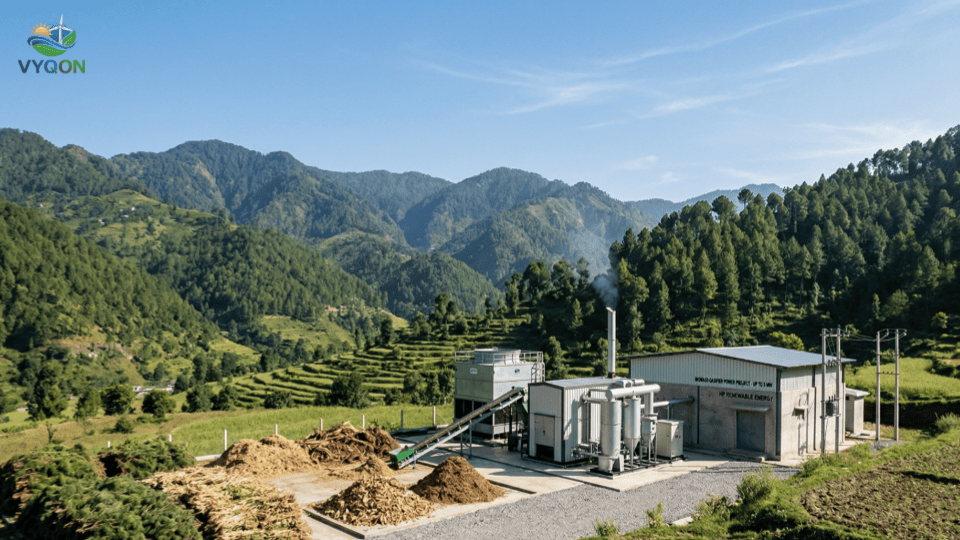
On March 25, 2026, the Himachal Pradesh Electricity Regulatory Commission (HPERC) issued a suo-motu order initiating the determination of the generic levelised tariff for Biomass Gasifier Power Projects for the FY 2026-27 control period. The draft proposal establishes the regulatory and financial benchmarks for grid-connected projects up to 5 MWe. This proceeding aims to provide a transparent tariff structure for renewable energy developers ahead of the new fiscal cycle commencing April 1, 2026.
HPERC FY 2026-27 Regulatory Framework and Revenue Requirements
The determination of these generic tariffs is situated within the broader financial “truing up” of the state’s power sector. For the FY 2026-27 period, the Commission has approved an Annual Revenue Requirement (ARR) of ₹8,636.16 crore for the Himachal Pradesh State Electricity Board Limited (HPSEBL). This figure, an increase from the previous year’s ₹8,403.25 crore, accounts for past financial performance and adjustments for the 2023-24 period.
Despite the expanded ARR, HPERC reports a marginal reduction in the estimated average cost of electricity supply, which is projected to fall to ₹6.75 per unit from the previous ₹6.76 per unit. Consequently, the Commission has mandated a uniform reduction of 0.01 paisa per unit in energy charges across all consumer categories, effective from the start of the 2026-27 financial year.
Key Technical Parameters and Operational Norms
The Commission has defined specific normative parameters to ensure technology-specific efficiency and grid compatibility for biomass gasifier installations. Using the 1.2 MWe project at Plot No. 1, Chanaur Industrial Area (Tehsil Dadasiba, Kangra) as a technical reference, the following standards apply:
- Technology Standards: Projects must utilize 100% producer gas engines coupled with gasifier technologies approved by the Ministry of New and Renewable Energy (MNRE).
- Capacity Suitability: The regulatory framework is intended for small power plants with an electrical output up to 5 MWe.
- Grid Interconnection: For standard 1.2 MWe projects, interconnection is mandated at 11 kV or 33 kV voltage levels, depending on the technical feasibility of the local distribution network.
- Variable Load Response: Engines must demonstrate a variable load response capability ranging from 20% to 100% of the rated load to maintain system stability.
Capital Cost and Financial Assumptions
The draft proposal outlines the financial benchmarks used to calculate the levelised tariff. These assumptions are designed to ensure project bankability while maintaining consumer affordability.
- Capital Cost Categories: The normative capital cost includes initial spares, Interest During Construction (IDC), financing charges, and Incidental Expenditure During Construction (IEDC).
- Fixed Cost Components: The tariff structure is designed to recover:
- Return on Equity (ROE): Set at a normative rate of 16% (post-tax).
- Interest on Loan Capital: Calculated based on the average SBI MCLR plus a spread of 300 basis points.
- Depreciation: Spread over the useful life of the project.
- Operational Expenses: Normative Operation and Maintenance (O&M) expenses and Interest on Working Capital.
- Banking Charges: Aligning with regional standards, the Commission has modeled banking charges at 8% of the energy banked, with settlement permitted on a monthly basis.
Biomass Fuel Specifications and Integrated Handling
Reliability in biomass power generation is contingent upon a robust fuel supply chain. In Himachal Pradesh, bamboo serves as a primary raw material, supported by the National Bamboo Mission across the Kangra, Hamirpur, and Mandi districts.
- Integrated Processing: The Commission emphasizes the requirement for integrated fuel processing systems rather than simple handling. This includes a dedicated bamboo preparation and chipping system, residue storage, and pellet production facilities to ensure high-quality producer gas.
- Consumption Benchmarks: Based on the 1.2 MWe reference model, the project is estimated to require a daily intake of approximately 30 Metric Tonnes (MT) of biomass waste.
- Resource Availability: Forested areas cover roughly 26.37% of the state’s geography, with bamboo plantations accounting for approximately 3% of that land, providing a sustainable feedstock for decentralized gasification.
Public Consultation and Stakeholder Engagement
The issuance of this draft order marks the commencement of the public consultation phase of the suo-motu proceeding. HPERC has invited comments, objections, and suggestions from stakeholders, including developers, HPSEBL, and consumer advocacy groups.
Following the model of previous regional regulatory cycles, the Commission will analyze written submissions and conduct evidentiary hearings to record oral testimonies. This process ensures that the final generic levelised tariffs for FY 2026-27 reflect current market conditions, technical advancements, and the specific geographic challenges of the North India power market. All feedback must be submitted according to the timelines specified by the Commission before the final regulations are notified.
Leave a Comment