
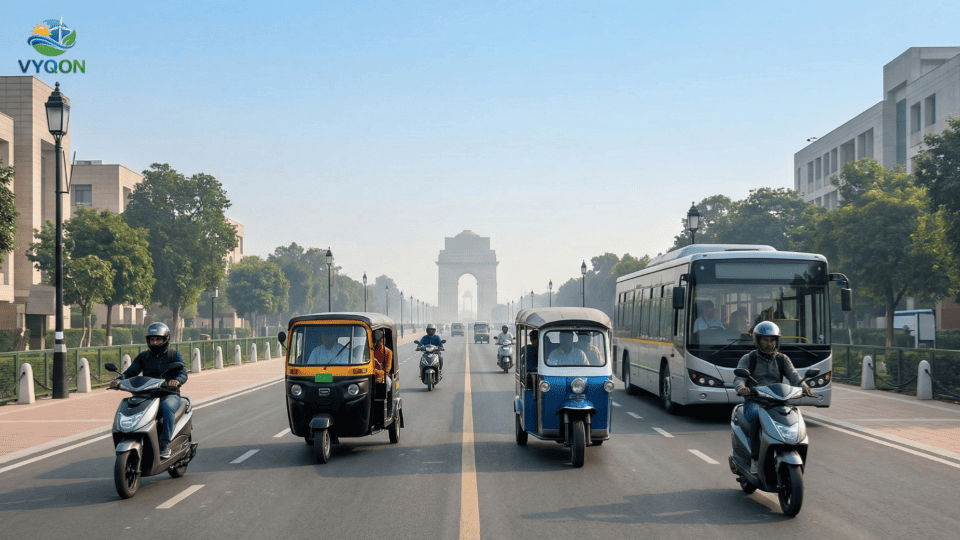
Introduction to the Draft Policy
On April 11, 2026, the BJP-led government of the National Capital Territory (NCT) of Delhi, under Chief Minister Rekha Gupta, released the Delhi Draft Electric Vehicle Policy 2026-2030 (EV Policy 2.0). The framework is designed to accelerate the transition to electric mobility to mitigate urban air pollution and establish a comprehensive support ecosystem for zero-emission vehicles.
Following the release, the government initiated a 30-day public feedback window, concluding on May 10, 2026. Stakeholders and citizens are encouraged to submit suggestions to the Transport Department via designated digital and postal channels before the policy is formally notified.
Financial Outlay and Budget Allocation
The policy is supported by a total financial outlay of ₹3,954.25 crore. This budget is allocated across three primary pillars to incentivize adoption and facilitate infrastructure growth:
- Purchase Incentives: ₹1,236.25 crore for direct subsidies to vehicle buyers.
- Scrapping Incentives: ₹1,718 crore to encourage the decommissioning of older, high-emission internal combustion engine (ICE) vehicles.
- Charging Infrastructure Development: ₹1,000 crore for the expansion of public and private charging and battery-swapping networks.
Mandatory Registration Deadlines and Phase-Outs
The draft policy introduces non-negotiable registration cutoffs to systematically phase out ICE vehicles from the capital’s fleet.
Three-Wheelers
Effective January 1, 2027, all new registrations for three-wheelers and auto-rickshaws will be restricted to electric models only. This mandate applies to new permits and the replacement of existing CNG-powered vehicles.
Two-Wheelers
A strategic focus has been placed on the two-wheeler segment, which currently comprises 67% of Delhi’s total vehicle fleet. To address this significant emission source, the policy mandates that only electric two-wheelers will be eligible for new registration starting April 1, 2028.
Commercial Fleets (N1 Category and 2W)
For aggregators and delivery service providers (e.g., Ola, Uber, Zomato, Swiggy), the transition begins on January 1, 2026. The draft prohibits the addition of new ICE two-wheelers or light goods vehicles (N1 category, up to 3.5 tonnes) to these fleets. A transitionary grace period allows existing BS-VI two-wheelers to remain in commercial service until December 31, 2026, after which these fleets must be fully electrified.
Government and Public Transport
All new vehicle purchases or leases by government departments must be electric from the date of policy notification. Furthermore, the draft stipulates that 30% of school buses must be electric by March 2030, with incremental targets of 10% by Year 2 and 20% by Year 3. New intra-state public buses will transition to electric power, with the policy allowing for the future adoption of cleaner alternatives such as hydrogen as technologies mature.
Industry Response
The Emission Controls Manufacturers Association (ECMA) has expressed concerns regarding these “blanket bans,” particularly the 2027 and 2028 deadlines. The association suggests that a sudden transition may impact the livelihoods of gig workers and small traders while straining the existing mobility ecosystem.
Tax Exemptions and Road Tax Waivers
To lower the total cost of ownership, the policy provides substantial fiscal relief for vehicles priced within mainstream market thresholds.
| Vehicle Type | Price Threshold (Ex-showroom) | Tax/Fee Benefit |
| Electric Vehicles (including cars) | Up to ₹30 lakh | 100% road tax and registration fee waiver |
| Strong Hybrids | Up to ₹30 lakh | 50% road tax and registration fee waiver |
| Luxury EVs | Above ₹30 lakh | No exemption/waiver |
Note: All waivers and exemptions listed above are valid until March 31, 2030.
Purchase and Scrapping Incentives
The draft utilizes a sliding scale for subsidies to encourage early adoption, alongside a tiered scrapping bonus system for replacing BS-IV or older vehicles.
Direct Purchase Subsidies
Subsidies for two-wheelers and three-wheelers will decrease annually over the first three years of the policy:
- Electric Two-Wheelers: Eligibility is restricted to vehicles with an ex-factory price not exceeding ₹2.25 lakh.
- Year 1: ₹10,000 per kWh (Maximum ₹30,000)
- Year 2: ₹6,600 per kWh (Maximum ₹20,000)
- Year 3: ₹3,300 per kWh (Maximum ₹10,000)
- Electric Three-Wheelers (Auto-rickshaws):
- Year 1: ₹50,000 fixed incentive
- Year 2: ₹40,000 fixed incentive
- Year 3: ₹30,000 fixed incentive
- Electric Light Commercial Vehicles (N1 category): Incentives begin at ₹1,00,000 in Year 1, reducing to ₹75,000 in Year 2 and ₹50,000 in Year 3.
Scrapping Bonuses
Owners scrapping BS-IV or older Delhi-registered vehicles and purchasing an EV within six months are eligible for:
- Electric Cars: ₹1,00,000 incentive for the first 1,00,000 applicants (vehicle price must be under ₹30 lakh). This benefit is tied to the PM E-DRIVE scheme rules.
- Two-wheelers: ₹10,000.
- Three-wheelers: ₹25,000.
- Goods vehicles (N1 category): Up to ₹50,000.
Infrastructure and Environmental Compliance
The policy framework shifts from a purely incentive-driven model to one emphasizing infrastructure and lifecycle management.
- Charging Infrastructure: Delhi Transco Limited is the nodal agency for network expansion. A single-window clearance system will be implemented to expedite approvals for new charging stations. Additionally, all Original Equipment Manufacturers (OEMs) are mandated to install at least one public charging station at every dealership they operate in Delhi.
- Battery Management: The Environment Department and the Delhi Pollution Control Committee (DPCC) will enforce the Battery Waste Management Rules, 2022. This includes Extended Producer Responsibility (EPR) and the establishment of battery collection centers via public-private partnerships.
- Traceability and Recycling: A battery traceability system based on unique identifiers will be introduced to track batteries throughout their lifecycle, facilitating refurbishment, second-life use, and responsible recycling.
- Emission Tracking: The Environment Department is mandated to develop a transparent methodology to periodically quantify the actual reductions in air pollution achieved through EV registrations under this policy.
Public Feedback Mechanism
Stakeholders may submit suggestions and comments on the draft policy until May 10, 2026.
- Email: evpolicy2026@gmail.com
- Postal Address: Joint Commissioner (EV), Transport Department, GNCTD, 5/9 Underhill Road, Delhi – 110054.
Leave a Comment