
The four-day Bharat Renewable Energy (BRE) Summit & Expo 2026 closed at Bharat Mandapam in New Delhi on Thursday, 5 November 2026. Inaugurated by Prime Minister Narendra Modi on 2 November, the event brought together participants from 135 countries and recorded more than 75,000 visitors, over 400 exhibitors and more than 627 speakers across 113 sessions. Union Minister Pralhad Joshi presented the outcomes at a media briefing on the final day.
Scale of the event
According to the Press Information Bureau (PIB), around 800 delegates took part, including representatives of partner countries, International Solar Alliance (ISA) members, international organisations and diplomatic missions. High-level participation included 32 international ministers, six chief ministers and 10 state energy ministers. The summit combined three major renewable energy events, among them the Fourth International Conference on Green Hydrogen and the Ninth Session of the ISA Assembly.
Prime Minister: rooftop solar and household energy
In his inaugural address, the Prime Minister said sustained renewable energy investment had strengthened India’s resilience to disruptions arising from the COVID-19 pandemic and the West Asia crisis. He called on startups, IITs, innovators and entrepreneurs to build solutions and business models that meet a greater share of household energy needs through clean energy.
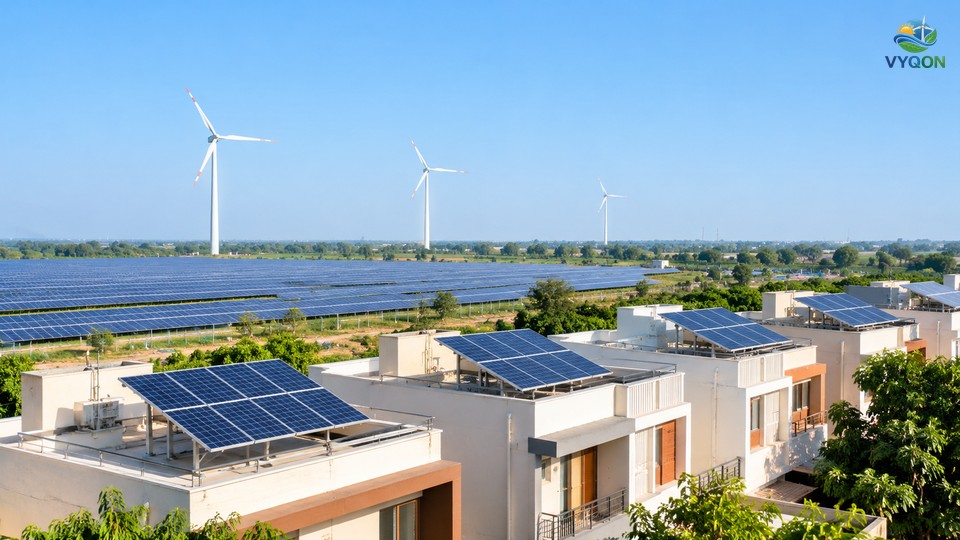
On rooftop solar, he said the PM Surya Ghar Muft Bijli Yojana, launched in February 2024 with a target of rooftop panels on one crore homes, has drawn more than 65 lakh homes in the past 24 to 25 months. Quoting Minister Joshi, he said that every six days, one lakh new homes become part of this solar movement. He added that one study shows electricity bills for these 65 lakh households have fallen by nearly 76 percent, and that many families are earning income by selling surplus power back to the grid.
Investment and finance
According to the Ministry, India requires approximately $220 billion in investment to achieve its target of 500 GW of non-fossil fuel capacity. Discussions at the summit indicated strong investor interest that extends beyond the immediate requirements for 2030, with pension funds, institutional investors and providers of long-term capital taking part alongside traditional strategic investors.
Deliberations focused on bankable power purchase agreements, predictable arrangements for purchasing electricity, clearer allocation of risks and deeper bond markets. Infrastructure Investment Trusts and blended finance were also discussed as ways to mobilise funds. At a CEO-level clean energy investment roundtable chaired by Joshi, participants identified coordinated planning of generation, transmission, storage and demand centres as a priority, and asked for greater certainty over land availability, approvals and project execution.
Storage, grid readiness and round-the-clock power
The discussions pointed to a shift from adding installed renewable capacity towards building a reliable, flexible and integrated power system. With demand rising from industry, cooling, electric mobility and data centres, participants stressed energy storage, transmission infrastructure, grid flexibility, forecasting and demand response. Artificial intelligence-based systems to forecast wind and solar output were also discussed.
Round-the-clock renewable energy and Firm and Dispatchable Renewable Energy contracts drew interest from international delegates. A tariff of ₹5.25 per unit discovered in a recent Solar Energy Corporation of India (SECI) tender was among the examples discussed. The Ministry said more than a quarter of India’s annual electricity consumption came from renewable sources in the last financial year.
Manufacturing and innovation
Participants called for India’s clean energy manufacturing to move beyond assembly towards domestic production of materials, components, equipment and advanced technologies. Shared laboratories, pilot manufacturing lines, demonstration facilities, and testing and certification infrastructure were identified as necessary support. Technologies discussed included next-generation solar cells, perovskites, recyclable wind turbine materials, long-duration storage, electrolysers, fuel cells and floating solar.
Green hydrogen and international solar cooperation
The green hydrogen conference focused on dependable domestic demand, long-term purchase agreements, exports, standards, certification, testing and safety frameworks. SECI and Rotterdam-based Power2X signed an MoU to advance the supply and offtake of green molecules from India to international markets; the first tranche indicated a potential volume of three lakh tonnes of green methanol annually.
At the ISA Assembly, a proposed $200 million Africa Solar Facility was announced to improve access to finance and accelerate solar deployment across African countries. The ISA also advanced its ambition to deploy one million solar pumps globally, its Small Island Developing States Platform aims to facilitate up to 500 MW of solar capacity by 2030, and the SUNRISE photovoltaic and battery circularity network has expanded to 35 countries.
Agreements and reports
A total of 10 MoUs and framework agreements were signed, covering technology, research, capacity building, manufacturing and project implementation. The event also released 37 reports, assessments, guidebooks and digital platforms, including Ease of Doing Solar, the Renewable Energy State Assessment Framework, the National Hydrogen Survey and a skilling blueprint for the top 100 renewable energy districts. The Ministry said these resources would help policymakers, investors, developers and utilities identify barriers, strengthen domestic supply chains and plan faster deployment.
What it means for India’s clean-energy sector
The summit’s message was that the next phase of India’s renewable build-out depends as much on storage, transmission, bankable contracts and domestic manufacturing as on new generation capacity. The $220 billion investment need cited by the Ministry underlines why contract certainty and approvals were raised repeatedly by investors. Specific commitments and the terms of the 10 agreements were not detailed in the official summary.
Official references
- Press Information Bureau text on the closing of BRE Summit & Expo 2026, carried by DD India, 5 November 2026 – ddindia.co.in
- Prime Minister of India: address at the inauguration of Bharat Renewable Energy Summit & Expo in Delhi – pmindia.gov.in
Leave a Comment