
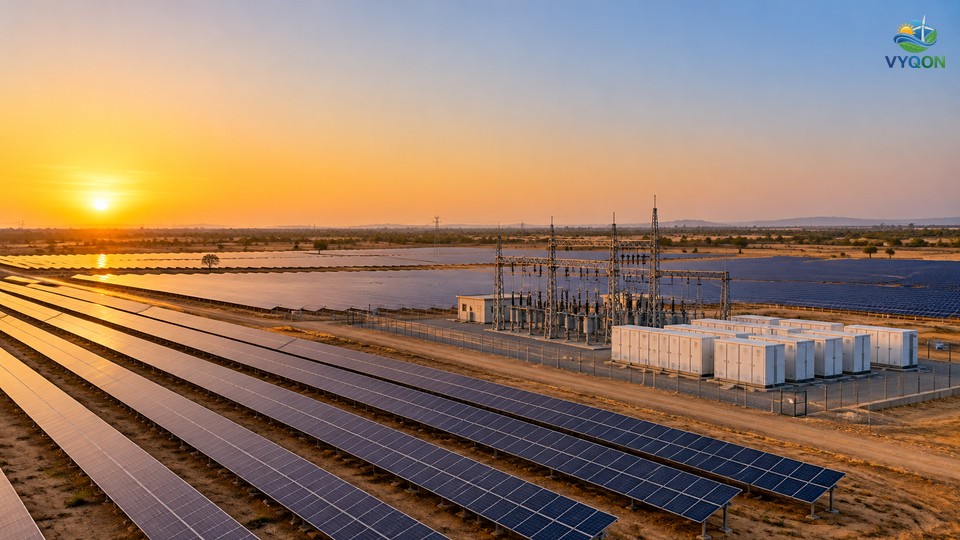
The Central Electricity Regulatory Commission (CERC) has adopted tariffs of Rs 4.82 to Rs 4.91 per kWh for 448 MW of firm and dispatchable round-the-clock (RTC) renewable power procured by SJVN Limited through competitive bidding. In its order dated 26 October 2026 in Petition No. 233/AT/2026, the Commission accepted the prices discovered for five developers, although SJVN had tendered 1,200 MW and received bids for only 560 MW.
The adoption is subject to SJVN tying up the capacity through Power Purchase Agreements (PPAs) and Power Sale Agreements (PSAs). SJVN acted as the Intermediary Procurer and Renewable Energy Implementing Agency (REIA) designated by the Ministry of New and Renewable Energy (MNRE).
What the Commission adopted
The five winning developers, their capacities and tariffs are as follows:
- ReNew Solar Power Private Limited: 100 MW at Rs 4.82/kWh
- EG Energy Development Private Limited: 60 MW at Rs 4.83/kWh
- Dineshchandra R Agrawal Infracon Private Limited: 100 MW at Rs 4.86/kWh
- Serentica Renewables India Private Limited: 100 MW at Rs 4.89/kWh
- Tata Power Renewable Energy Limited: 88 MW at Rs 4.91/kWh
The capacity-weighted average works out to about Rs 4.86/kWh (VYQON calculation from the order). SJVN also asked the Commission to approve a trading margin of Rs 0.07/kWh, payable by the distribution companies.
How the auction played out
SJVN issued the Request for Selection (RfS No. SJVN/CC-Delhi/REIA/2024/FDRE-3) on 31 July 2024 for 1,200 MW of ISTS-connected firm and dispatchable power on a build-own-operate basis, with a 25-year contract term. The bid deadline was extended three times and finally closed on 29 November 2024. Technical bids were opened on 3 December 2024.
Five bidders responded with a combined 560 MW, less than half of the capacity tendered. Tata Power Renewable Energy bid 200 MW, while Dineshchandra R Agrawal Infracon, ReNew and Serentica each bid 100 MW and EG Energy bid 60 MW. All five met the technical and commercial criteria. Their first quoted tariffs ranged from Rs 4.82 to Rs 5.09 per kWh. The financial bids were opened and the e-reverse auction was held on 27 February 2025.
Under clause 5.4.2 of the RfS, the capacity eligible for award is limited to 80 per cent of the qualified capacity when the total is below the tendered quantum. Applied to 560 MW, this gave 448 MW. The entire 448 MW was awarded and Letters of Award were issued on 1 May 2025. Tata Power Renewable Energy, for instance, received 88 MW against its 200 MW offer.
Developer obligations
The Letter of Award reproduced in the order requires developers to pay success charges of Rs 1 lakh per MW plus 18 per cent GST and to furnish a Performance Bank Guarantee of Rs 30.65 lakh per MW before signing the PPA. They must start supplying the full contracted capacity within 24 months of the PPA’s effective date, and the tariff stays fixed for the whole PPA term.
Delay and buyers
The Commission noted that SJVN approached it later than the 15-day timeline prescribed under clause 11.4 of the competitive bidding guidelines, and directed SJVN to follow the timelines strictly in future cases. SJVN explained that, after the auction, it held talks with several distribution companies and buying entities to test the marketability of the tariffs before filing the petition.
At the hearing on 9 July 2026, the Commission asked SJVN to explain the delay, the status of the PSAs and why only 448 MW of the 1,200 MW was awarded. In an affidavit of 21 July 2026, SJVN said the Himachal Pradesh State Electricity Board Limited (HPSEBL) had given its in-principle approval on 11 February 2026 to buy 448 MW of RTC power during October to March each year. A PSA with HPSEBL was being finalised, and the board had approached the State Commission for approval.
The trading margin decision
The Commission found the range of Rs 4.82 to Rs 4.91 per kWh consistent with similar firm and dispatchable schemes, such as the Rs 5.06-5.07 per kWh it adopted on 22 November 2025, and found the bidding followed the Ministry of Power guidelines.
On the trading margin, CERC said the Trading Licence Regulations let the contracting parties agree a margin on long-term contracts. If the distribution companies agree to Rs 0.07 per kWh, it will be treated as consistent with the regulations. If SJVN does not provide an escrow arrangement or an irrevocable, unconditional and revolving letter of credit to the developers, the margin is capped at Rs 0.02 per kWh. SJVN must file the PPAs and PSAs once signed.
What it means for India’s clean-energy sector
The order shows both the appeal and the limits of round-the-clock renewable power. Tariffs below Rs 5 per kWh for firm renewable supply sit close to the price range seen in comparable schemes. At the same time, the response to the tender was thin, with 560 MW offered against 1,200 MW tendered, and the final award covered only about 37 per cent of the original quantum.
The next steps matter more than the adoption itself. Developers cannot sign PPAs until SJVN signs PSAs with buyers, so the HPSEBL agreement and the State Commission’s decision will largely decide whether the 448 MW moves to construction. The 24-month supply deadline and the bank guarantee requirements begin only after the PPAs are in place.
Leave a Comment