
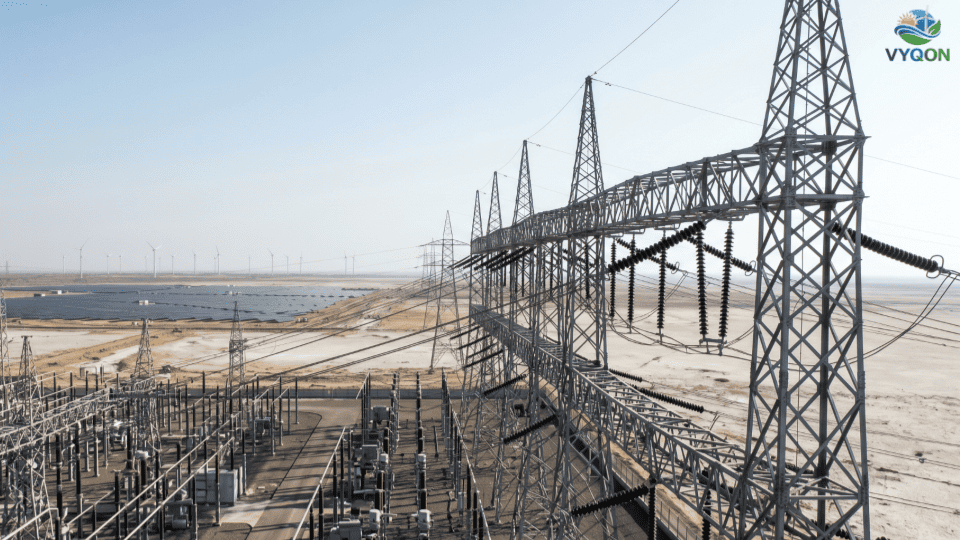
The Central Electricity Regulatory Commission (CERC) has formally adopted the annual transmission charges for the “Transmission System for Evacuation of Power from potential renewable energy zone in Khavda area of Gujarat under Phase-V (8 GW): Part C.” The project was awarded to Adani Energy Solutions Limited (AESL), which will execute the mandate through its subsidiary, KPS III HVDC Transmission Limited. This specific component of the Phase-V infrastructure is designed to provide an evacuation capacity of 2,500 MW, serving as a vital link for the broader 8 GW renewable energy cluster in the Khavda region.
Project Metrics and Financial Summary
The core technical and financial parameters of the Phase-V, Part C project, as cleared by the Commission, are summarized in the table below:
| Feature | Details |
| Project Name | Transmission System for Khavda Phase-V (8 GW): Part C |
| Successful Bidder | Adani Energy Solutions Limited (via KPS III HVDC Transmission Limited) |
| Evacuation Capacity | 2,500 MW (within the broader 8 GW Phase-V) |
| Approved Annual Transmission Charges | Rs. 23,917.69 million (approx. Rs 23.92 billion) |
| Implementation Model | Build, Own, Operate and Transfer (BOOT) |
| Project Duration | 48 months from the date of SPV transfer |
| Target Commissioning Date | December 12, 2029 |
Bidding and Execution Logistics
The project was awarded under Section 63 of the Electricity Act, 2003, following a tariff-based competitive bidding (TBCB) process. PFC Consulting Limited served as the Bid Process Coordinator (BPC) for the selection of the transmission service provider. The Commission concluded that the bidding process met the transparency requirements of the government guidelines.
The selection involved a rigorous competitive e-reverse auction that spanned 49 rounds. Adani Energy Solutions Limited emerged as the successful bidder, competing against Power Grid Corporation of India Limited, Enerica Infra 1 Private Limited, and Resonia Limited. The adoption of the discovered tariff by the CERC follows the verification of the bidding logistics and the evaluation of the final quoted annual transmission charges.
Technical Scope and Cost Justifications
The technical scope for Part C involves the establishment of terminal stations at KPS3 and South Olpad, interconnected by a ±500 kV High Voltage Direct Current (HVDC) Bipole transmission line. During the regulatory proceedings, the Commission noted that the quoted annual transmission charge of Rs. 23,917.69 million is approximately 12% higher than the standard levelized tariff estimates.
The CERC Cost Committee justified this deviation based on several technical and geographical factors:
- Advanced VSC Technology: The project utilizes Voltage Source Converter (VSC) technology, representing the first time this system is being implemented through the TBCB route in India. The committee cited higher technical risks and specific component costs associated with this advanced technology as primary drivers of the increased tariff.
- Geographical Constraints: The Khavda region’s terrain, classified as wasteland, necessitates the use of specialized pile foundations for the transmission infrastructure, which increases civil engineering costs.
- Macroeconomic Factors: The project costs were influenced by external variables, including prevailing inflation rates and import duties applicable to specialized technical components required for the HVDC system.
Regulatory and Charge Sharing Framework
The recovery of the adopted transmission charges is governed by the “CERC (Sharing of Inter-State Transmission Charges and Losses) Regulations, 2020.” Under these regulations, charges will be shared among Designated ISTS Customers (DICs).
The billing for the AC System Component (ACC) will utilize the “Hybrid Methodology,” which is defined as a combination of the Marginal Participation Method and the Average Participation Method. Under this framework:
- AC-UBC (Usage-Based Component): Transmission charges at each drawal and injection node are calculated using the Marginal Participation Method, which analyzes how power flows through specific lines are modified by 1 MW changes in injection or drawal at a bus.
- AC-BC (Balance Component): This represents the balance of Yearly Transmission Charges for the AC System Component after apportioning charges for the AC-UBC.
- Slack Bus Identification: The methodology employs the Average Participation Method to identify slack buses, ensuring that the total yearly transmission charges are fully recovered from system users based on physical power flow tracing.
Order and Legal Context
The CERC formally adopted the transmission charges under the statutory provisions of Section 63 of the Electricity Act, 2003. In its final order, the Commission addressed and rejected procedural objections raised by local stakeholders in Gujarat regarding the adequacy of public notices and the omission of specific land survey numbers. The Commission clarified that the public notice complied with all licensing regulations and noted that land identification and route alignment issues are handled separately under the Section 164 process of the Act.
The adoption of these charges is a prerequisite for the formal grant of a transmission license to KPS III HVDC Transmission Limited. The charges will remain applicable for the duration specified in the Transmission Service Agreement (TSA). A follow-up hearing regarding the formal grant of the transmission license is scheduled for May 19, 2026.
Leave a Comment