
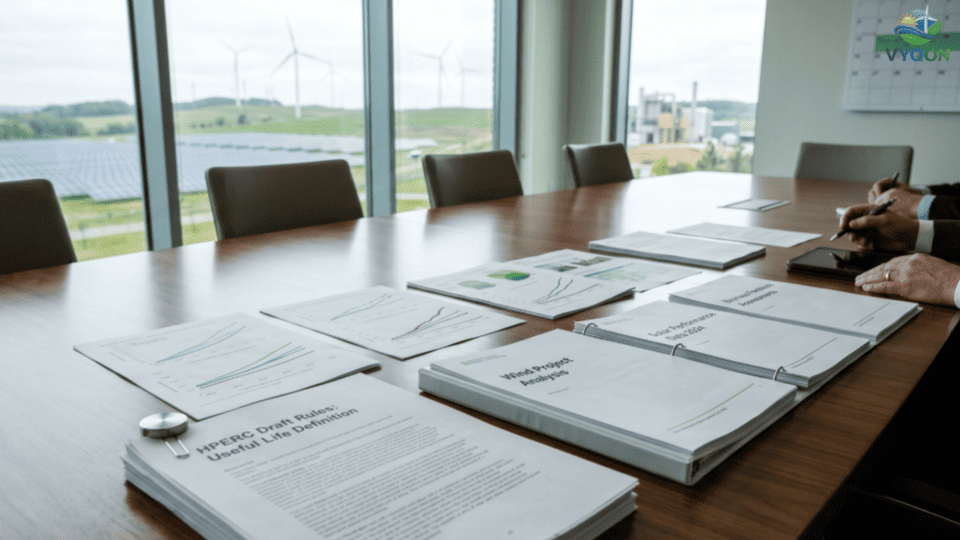
SHIMLA: In a proactive regulatory move to set the stage for the next financial year, the Himachal Pradesh Electricity Regulatory Commission (HPERC) has issued Suo-Motu Petition No. 14/2026, dated January 6, 2026. The Commission has proposed generic levellised tariffs for Solar PV and Biomass projects for the period beginning April 1, 2026, and ending March 31, 2027. This advance notification provides industry stakeholders with critical visibility into the financial frameworks governing renewable energy (RE) procurement for FY 2026-27. Stakeholders are invited to submit comments and suggestions on the draft proposals by February 10, 2026.
Defining Project “Useful Life” and Tariff Periods
Under the proposed framework, the “useful life” of Solar PV plants is defined as 25 years from the date of commencement of operations. This definition, which also serves as the applicable tariff period, is rooted in Regulation 10 and Regulation 2(1)(ac) of the HPERC (Promotion of Generation from Renewable Energy Sources and Terms and Conditions for Tariff Determination) Regulations, 2017 (RE Tariff Regulations, 2017).
Solar PV Project Categorization, Capital Costs, and Tariffs
To account for the State’s unique topography and encourage smaller-capacity installations, the Commission has maintained a four-category structure for Solar PV projects. Notably, HPERC has proposed higher normative capital costs—and consequently higher tariffs—for projects located in Urban and Industrial areas. This regulatory incentive is designed to promote installations in locations that allow the distribution licensee (HPSEBL) to utilize power in a more optimal manner.
| Capacity Category | Location Type | Normative Capital Cost (Rs. Lakh/MW) | Proposed Generic Tariff (Rs/kWh) |
| Category I: Up to 1.00 MW | Other Areas | 352.58 | 3.47 |
| Urban/Industrial Areas | 360.46 | 3.52 | |
| Category II: Above 1.00 MW to 3.00 MW | Other Areas | 344.19 | 3.40 |
| Urban/Industrial Areas | 351.87 | 3.46 | |
| Category III: Above 3.00 MW to 5.00 MW | Other Areas | 335.79 | 3.34 |
| Urban/Industrial Areas | 343.29 | 3.40 | |
| Category IV: Above 5.00 MW | N/A | Competitive Bidding / SECI Route | N/A |
Technical and Financial Parameters for Solar PV
The Commission derived these tariffs using updated financial and technical norms. A significant portion of the regulatory rationale focuses on the sensitivity of capital costs to global market conditions.
- Capital Cost Derivation Logic: The Commission benchmarked Solar PV Module prices at an average of 74,500 USD/MW (based on a Mono PERC and Poly Solar Module average). Applying an exchange rate of Rs. 88.15/USD, the base module cost was calculated at Rs. 65.67 Lakhs/MW. This was further escalated by 30% to account for DC/AC ratios, degradation factors, and import duties, resulting in a normative module price of Rs. 85.37 Lakhs/MW.
- Other Components & GST: Non-module components (land, civil works, evacuation) were set at Rs. 250.42 Lakhs/MW, reflecting a 3% escalation from the previous year. Crucially, the Commission adjusted these costs to reflect the reduction in GST on solar modules and equipment from 12% to 5%, effective September 22, 2025.
- Debt-Equity Ratio: 70:30, as per Regulation 23-C.
- Return on Equity (RoE): A normative 14% rate. This is grossed up by the Minimum Alternate Tax (MAT) to 16.805% for the first 20 years and by the Corporate Tax rate (27.82%) to 19.396% for the final five years.
- Interest on Loan: 10.80% per annum (based on the average SBI MCLR of 8.80% plus a 200 basis point spread).
- Interest on Working Capital: 12.30% per annum (SBI MCLR plus a 350 basis point spread).
- Depreciation: 4.67% per annum for the first 15 years, with the remaining 90% of the depreciable base spread over the residual life.
- Operational Norms: Capacity Utilization Factor (CUF) of 21% and O&M expenses of Rs. 10.96 Lakh/MW with a 3.84% annual escalation.
Biomass Project Tariff Proposal
In a parallel proposal for other RE technologies, the Commission has set a generic levelized tariff of ₹3.54/kWh for Biomass projects. This proposal aims to diversify the State’s renewable energy portfolio beyond hydro and solar.
Applicability and Key Conditions
The proposed tariffs are subject to the following regulatory conditions:
- Effective Window: Tariffs apply to joint petitions for PPA approval submitted between April 1, 2026, and March 31, 2027, provided the project is commissioned by March 31, 2028.
- Exclusions: These generic rates do not apply to projects under SECI procurement, competitive bidding under Section 63 of the Electricity Act, or rooftop solar/net-metering schemes.
- State Government Royalty: A royalty of 5 paise per unit is payable to the State Government. This amount is to be “worked out by the HPSEBL from the generation of the project” and is considered a pass-through cost over and above the approved tariff.
Stakeholder Participation and Timeline
The proposal was issued under the authority of Sh. Yashwant Singh Chogal (Chairman) and Sh. Shashi Kant Joshi (Member). The Commission emphasizes that these are draft figures, and final determinations will be made following the review of stakeholder feedback.
- Deadline for Submissions: February 10, 2026.
- Filing: Comments should refer to Suo-Motu Petition No. 14/2026.
Leave a Comment