
Rajasthan Amends Land Revenue Rules to Institutionalize Clean Energy Growth
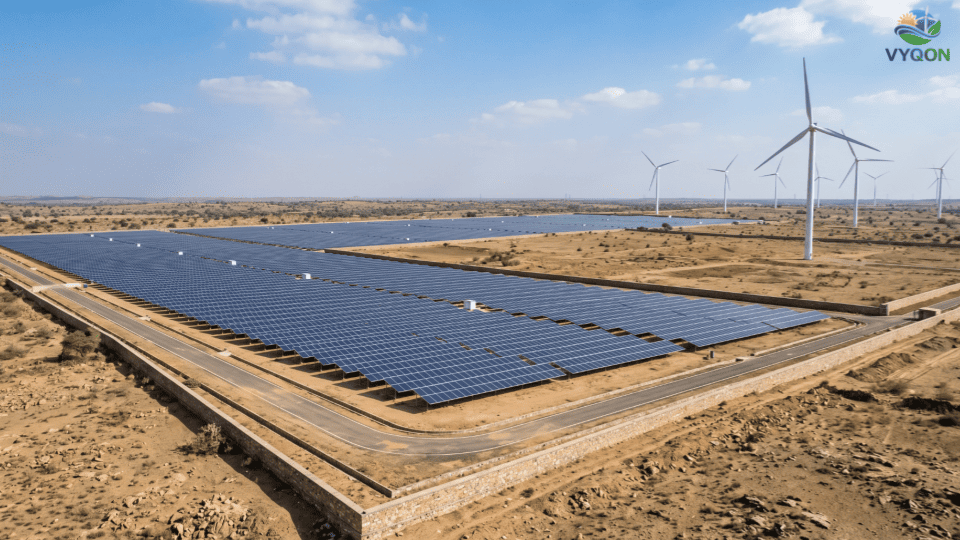
The Government of Rajasthan’s Revenue (Group-6) Department has officially notified the Rajasthan Land Revenue (Conversion of agricultural land for non-agricultural purposes in rural areas) (Amendment) Rules, 2026. Issued under notification number No. F.6(26)rev-6/14/28 on April 23, 2026, the amended framework came into force “at once” upon publication. This regulatory shift is the administrative cornerstone of the state’s Integrated Clean Energy Policy 2024, designed to provide the “teeth” necessary to realize the ₹28 lakh crore in MoUs signed during the Rising Rajasthan Global Summit. By integrating renewable energy projects into a formal land conversion structure, the state is addressing the historical disconnect between the Rajasthan Renewable Energy Corporation (RREC) and the Revenue Department’s regulatory ambit.
Broadened Definition of ‘Renewable Energy Projects’
The 2026 amendment introduces a vital new clause (nn) to Rule 2, providing a comprehensive legal classification for project types that now fall under this streamlined conversion umbrella. These include:
- Solar Farm, Solar Plant, and Solar Power Plant installations.
- Wind Farm and Wind Power Plant projects.
- Biomass-based Power Plants and Biomass Gasifier-based Power Plants.
- Biogas Power Plant, Bio CNG, and CBG (Compressed Bio-Gas) projects.
- Hydro Power Projects and Pump Storage Projects (PSP).
- Battery Storage Systems (mandating a technical threshold of minimum 85% charging by Renewable sources).
- Pooling Sub-stations dedicated to Renewable Projects.
In addition to expanding project types, the amendment adjusts critical spatial thresholds. Rule 2(p) now substitutes “4000 sq. meters” with “1000 square meters” as a classification marker, while the minimum land area for conversion regarding renewable energy projects has been rationalized to 10,000 square meters. This represents a substantial increase from the previous 4,000 sq. meter limit, reflecting the larger scale of modern utility-level deployments.
Regulatory Streamlining: Timeline Reductions and the 15-Day Escalation Rule
To eliminate the “cascading impact” of land delays on project completion, the state has slashed the land conversion processing deadline from 45 days to 30 days. Most critically for developers, a new efficiency mechanism has been introduced: if the Sub Divisional Officer (SDO) or Tehsildar fails to decide on an application within 15 days, the case is automatically forwarded to the District Collector for resolution.
Fee Rationalization and Tenant Exemptions
The state has implemented a significant policy shift regarding financial burdens:
- Industrial Rate Linkage: Rule 7 now sets the conversion rate for Renewable Energy Projects at 10% of the rate prescribed for industrial purposes.
- Non-SC/ST Extension: Previously, specific benefits were largely restricted to SC/ST tenants. The 2026 rules extend these to non-SC/ST Khatedar tenants, who are now exempt from conversion fees provided they give formal notice within one month of use.
- Application Fees: Under Rule 9, a non-refundable fee of Rs. 2,000/- applies to residential units, while Rs. 20,000/- is required for all other purposes, including renewable energy.
- Refund Policy: Under Rule 14 A, conversion charges are non-refundable except in cases where an applicant withdraws before the order is issued.
Prescribed Authorities for Conversion
The jurisdiction for issuing conversion orders is now strictly defined by the applicant’s status and land area. Under Rule 2(j), the authority for Renewable Energy Projects is as follows:
| Prescribed Authority | Jurisdiction / Applicant Status |
| Tehsildar | Irrespective of area for Khatedar tenants belonging to SC/ST categories. |
| Sub Divisional Officer (SDO) | Irrespective of area for non-SC/ST Khatedar tenants; also for other purposes not exceeding 10,000 sq. meters. |
| Collector | For land areas not exceeding 1,00,000 sq. meters; also authorized for Hydrocarbon exploration and Sports Complexes. |
| Divisional Commissioner | For land areas not exceeding 2,00,000 sq. meters. |
| State Government | Mandatory for areas exceeding 2,00,000 sq. meters, SEZs, and Integrated Townships. |
Policy Context: The 10% Logic The decision to set conversion charges at 10% of industrial rates is a strategic move to reflect technological evolution. With 2026-era solar modules and 3–5 MW wind turbines offering significantly higher efficiencies, the land-per-MW requirement has dropped (e.g., from 2.0 hectares to 1.62 hectares per MW). This fee rationalization ensures the state remains competitive while acknowledging that renewable land use is less intensive than traditional heavy industry.
Infrastructure, Connectivity, and Land Restrictions
The amendment to the fifth proviso of sub-rule (2) removes a significant bottleneck for private landholders. For renewable power projects held by a Khatedar, a recorded “approach way” is no longer a mandatory prerequisite for the conversion order. The Khatedar may now self-certify that an approach way exists, ending the bureaucratic delays that historically prevented SC/ST and marginalized farmers from leasing barren land for the solar boom.
However, stringent restrictions remain under Rule 4. Land cannot be converted if:
- It falls within areas restricted by the Forest Department or other state authorities.
- It is within a 50-meter buffer of schools, hospitals (10+ beds), residential areas, or water bodies.
- Specific Utility Buffers: For petrol pumps, the 50m distance is measured specifically from “fill points, dispensing units, or vent pipes.”
- Geographic Restrictions: In specific villages within the Abu-Road Tehsil (Sirohi District), prior State Government approval is mandatory due to environmental sensitivities.
Leave a Comment