
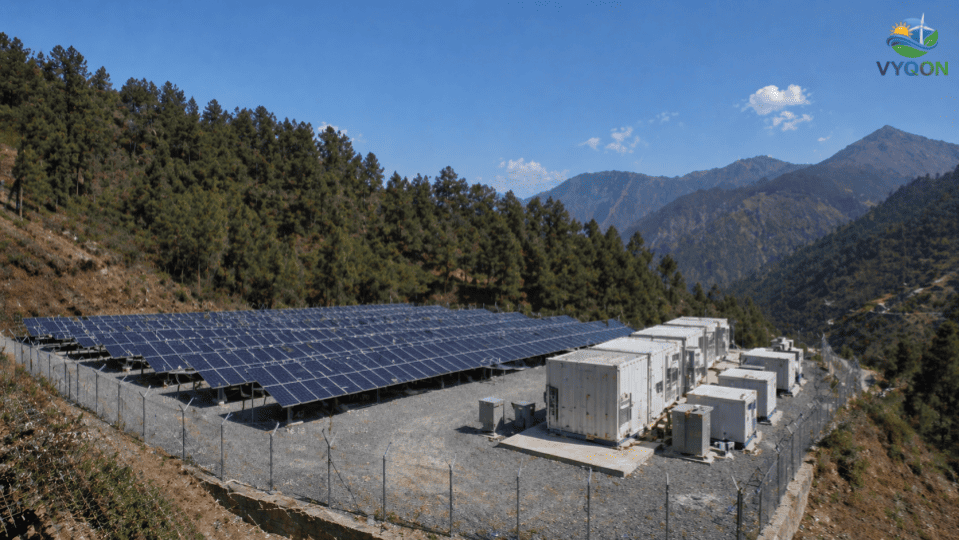
Himachal Pradesh Power Corporation Limited (HPPCL) has officially invited bids for the design, supply, and construction of the Dabhota-I Solar Power Project, a strategic installation aimed at bolstering grid stability and reducing solar energy fluctuations in the Solan district. Located in Dabhota, the project integrates 9 MW (AC) of ground-mounted solar capacity with a 3.15 MW / 6.3 MWh Battery Energy Storage System (BESS). This tender represents a significant step in HPPCL’s broader strategy to manage renewable intermittency through advanced energy storage. Interested developers must submit their proposals by the bid deadline of May 5, 2026 (14:00 HRS).
Project Technical Specifications
| Feature | Specification |
| Solar Capacity | 9 MW (AC) |
| BESS Power Capacity | 3.15 MW |
| BESS Energy Capacity | 6.3 MWh |
| Location | Dabhota, District Solan, Himachal Pradesh |
| BESS Technology | AC Coupled energy storage system with electrochemical type accumulator; Containerized (ISO 668 compliant) |
| Target Round-Trip Efficiency | >85% (System AC-DC-AC) |
| BESS Availability | 98% |
| Rated Number of Cycles | 8,000 cycles (Minimum at 80% DoD, 25°C, 0.5 C rate) |
| Design Life | 15 Years |
Scope of Work and Contract Terms
The Dabhota-I project is offered under a turnkey Engineering, Procurement, and Construction (EPC) model. The contractor assumes full responsibility for the plant’s delivery, from land preparation and equipment procurement to final grid synchronization.
- Turnkey EPC Responsibilities: Comprehensive accountability for Design, Engineering, Manufacturing, Supply, Erection, Testing, and Commissioning of the combined solar and BESS facility.
- BESS Subsystems Integration: The BESS must be delivered as a fully functional, grid-interactive system comprising five core subsystems:
- Accumulation Sub-system: Containerized battery packs/modules/racks with an integrated Battery Management System (BMS).
- Conversion Sub-system: Utilizing Bi-directional Power Conditioning Systems (PCS).
- Auxiliary Systems: Critical support infrastructure, including HVAC and fire suppression systems.
- Data Acquisition and Communication Sub-systems: High-speed telemetry and data logging for system monitoring.
- Energy Management System (EMS): Integrated control for autonomous and remote operation.
- Operation & Maintenance (O&M): The contract includes a mandatory 15-year comprehensive O&M period.
- Contractual Nuance: While the total O&M of the plant facilities rests with the AC package contractor, the BESS (DC package) supplier is required to enter into a Service Level Agreement (SLA). This SLA enforces strict performance guarantees regarding system availability, round-trip efficiency, and energy throughput.
Bidder Eligibility and Financial Requirements
HPPCL has mandated rigorous qualification standards to ensure technical and financial project viability:
- Earnest Money Deposit (EMD): A bid security of ₹1.5 Crore is required.
- Minimum Average Annual Turnover: Bidders must show a minimum average annual turnover of ₹29 Crore over the last three financial years.
- Technical Eligibility: Applicants must demonstrate proven expertise in developing ground-mounted solar and BESS projects. Technical qualification is contingent upon the number of completed contracts and their cumulative capacity, typically requiring experience with individual contracts of significant scale (benchmarked against historical HPPCL requirements for similar capacities).
Submission Guidelines and Timeline
The procurement follows a single-stage, two-envelope bidding system, requiring technical and financial proposals to be submitted simultaneously in separate electronic folders.
- Deadline for Submission: May 5, 2026 (14:00 HRS)
- Selection Process: Technical bids will be assessed for compliance with the detailed BESS and solar specifications. Qualified bidders will then proceed to the opening of financial proposals.
- E-Reverse Auction: The final selection will be determined through an e-reverse auction process to ensure the most competitive economic outcome for the state utility.
Leave a Comment