
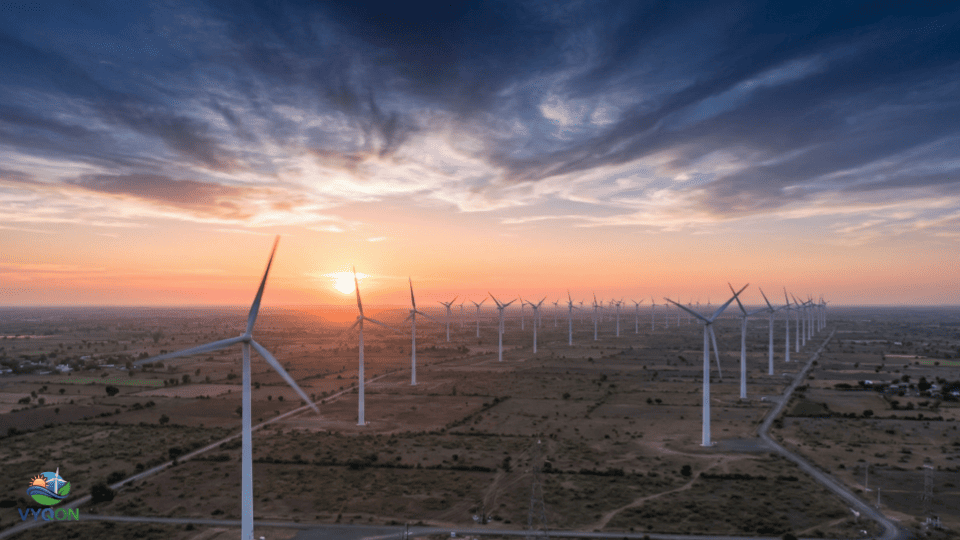
India installed a record 6.05 GW of wind power capacity in the fiscal year (FY) 2025–26, representing the highest annual addition in the history of the nation’s wind energy program. This milestone has pushed the country’s cumulative installed wind capacity beyond the 56 GW mark. The performance indicates a 46% increase compared to the 4.15 GW added in FY 2024–25, surpassing the previous historical peak of 5.5 GW set in FY 2016–17.
Comparative Growth Analysis
The expansion in wind capacity during FY 2025–26 was part of a broader surge in the renewable energy sector, which saw a total of 55.3 GW of non-fossil fuel capacity added during the same period. The Commercial and Industrial (C&I) and captive segments were the primary drivers of wind growth, contributing approximately 4.5 GW, or 75%, of the annual total. This segment growth is attributed to the stability of Green Energy Open Access rules and the discovery of competitive tariffs.
| Metric | Value/Context |
| FY 2025–26 Wind Addition | 6.05 GW |
| Previous Record Addition | 5.5 GW (FY 2016–17) |
| Year-on-Year Growth | 46% increase (compared to 4.15 GW in FY 2024–25) |
| Total Non-Fossil Capacity Added (FY26) | 55.3 GW (includes 44.61 GW solar) |
| Global Ranking in Wind Capacity | 4th |
| Global Ranking in Total Renewable Capacity | 3rd (Surpassed Brazil in FY 2025–26) |
Regional Performance: Leading Wind-Rich States
Capacity additions were concentrated in western and southern India, spearheaded by Gujarat, Tamil Nadu, and Karnataka. These states benefited from a growing pipeline of wind-solar hybrid projects and established transmission infrastructure.
- Gujarat: Remains the national leader with a cumulative installed capacity of 15,197.19 MW. The state recently saw the installation of India’s largest single wind turbine with a 5.2 MW capacity.
- Tamil Nadu: Ranks second with 12,102.76 MW of cumulative capacity. It hosts the Muppandal Wind Farm, the largest wind power plant in India with an installed capacity of 1,500 MW.
- Karnataka: Continues as a top contributor with 8,500.54 MW of cumulative capacity.
Policy Enablers and Regulatory Frameworks
Specific government initiatives and fiscal mechanisms have facilitated the acceleration of deployment and the strengthening of the project pipeline.
- ISTS Charge Waivers: A graded waiver of Inter-State Transmission System (ISTS) charges remains valid until June 2028. This supports the government’s target of 340 GW from solar and wind, specifically the 230 GW planned for connection to the ISTS.
- Customs Duty Concessions: Concessional customs duties are applied to select wind turbine components and raw materials to manage project costs.
- Wind RCO Framework: The dedicated Wind Renewable Consumption Obligation (RCO) mandates distribution companies to procure a specific portion of their energy from wind sources.
- Viability Gap Funding (VGF): The Union Cabinet approved a ₹7,453 crore VGF scheme for offshore wind projects. This includes ₹6,853 crore for the installation of 1 GW of offshore capacity (500 MW each off the coasts of Gujarat and Tamil Nadu) and ₹600 crore for port infrastructure.
- Technical Support: The National Institute of Wind Energy (NIWE) provides resource assessment, technical baseline support, and certification for turbine models included in the Approved List of Models and Manufacturers (ALMM).
Strategic Outlook: National and Global Positioning
The wind sector’s performance is aligned with India’s goal of reaching 500 GW of non-fossil fuel-based power capacity by 2030. In June 2025, India reached a milestone where non-fossil sources accounted for 50% of the nation’s cumulative installed power capacity, fulfilling a key Paris Agreement commitment five years ahead of schedule.
As of March 31, 2026, India’s total non-fossil fuel power capacity reached 283.46 GW, comprising 274.68 GW of renewable energy and 8.78 GW of nuclear capacity. This cumulative total has elevated India to 3rd place globally in installed renewable energy capacity, trailing only China and the United States.
Status of the Domestic Wind Sector
The domestic industrial ecosystem has matured significantly, with wind turbine manufacturing capacity reaching approximately 24 GW per year. The manufacturing base has achieved 70-80% indigenisation across key components.
Industrial analyst data provides the following breakdown of component-level manufacturing capacity:
- Nacelles: 20 GW
- Blades: 16 GW
- Towers: 15 GW
- Gearboxes: 29 GW
- Generators: 10 GW
Current turbine technology has advanced to unit sizes of up to 5.3 MW. The sector’s outlook remains predicated on the resolution of land acquisition challenges and the continued expansion of the transmission grid to accommodate the 48 GW of wind and hybrid projects currently under construction.
Leave a Comment