
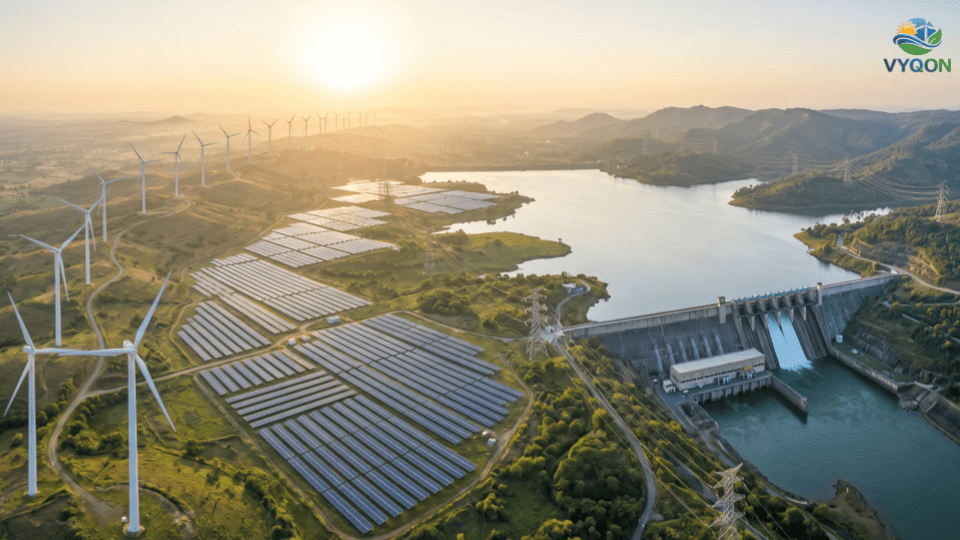
National Energy Overview: A Fundamental Shift in the Generation Mix
India has officially breached the 283.46 GW threshold for total non-fossil fuel installed capacity as of March 31, 2026. This cumulative figure represents a landmark integration of 274.68 GW from renewable energy (RE) sources and 8.78 GW from the nuclear power sector. The fiscal year (FY) 2025–26 was a period of unprecedented acceleration, recording an addition of 55.3 GW in non-fossil capacity—the highest annual increase in the nation’s history.
In a significant policy victory, India achieved its target of 50% cumulative installed electricity capacity from non-fossil sources in June 2025, reaching this 2030 Nationally Determined Contribution (NDC) milestone five years ahead of schedule. However, a technical “generation-capacity mismatch” remains: while non-fossil sources dominate capacity, coal continues to account for approximately 70–75% of actual electricity generation. This is due to the lower Capacity Utilization Factor (CUF) and inherent intermittency of solar and wind assets, highlighting the urgent requirement for baseload and storage synchronization.
Global Ranking and Comparative Standing
According to the Renewable Energy Statistics 2026 by the International Renewable Energy Agency (IRENA), India has surpassed Brazil to secure the 3rd position globally in renewable energy installed capacity. When utilizing the Wind-Water-Solar (WWS) metric—a standardized international benchmark—India’s 257.8 GW capacity reflects a buildout density of approximately 57 GW per $1 trillion of GDP. This far outstrips the United States, which currently adds roughly 12 GW of WWS per $1 trillion of GDP.
| Rank | Country | WWS (Wind, Water, Solar) Capacity* |
| 1 | China | ~2,276 GW |
| 2 | United States | ~380 GW |
| 3 | India | 257.8 GW |
*WWS capacity includes Wind, Solar, and Hydroelectric. India’s broader 283.46 GW non-fossil total also encompasses 25.7 GW from Nuclear, Bioenergy, and Small Hydro.
Sectoral Breakdown: Solar and Wind Dominance
The renewable surge is underpinned by solar and wind infrastructure, which now constitute the primary drivers of India’s energy transition.
- Solar Energy: India’s solar capacity reached 150.26 GW by March 31, 2026, bolstered by a record 44.6 GW added in FY 2025–26 alone. While solar constitutes the largest share of current capacity, it represents only a fraction of India’s estimated resource potential of 4,704,043 MW.
- Wind Energy: Cumulative wind capacity stands at 56.09 GW.
- Distributed Renewables: Decentralized energy added 16.3 GW in the last fiscal year. This growth is heavily supported by the PM Surya Ghar Muft Bijli Yojana, which has facilitated rooftop solar for 23.9 lakh households, and the PM-KUSUM scheme, aimed at solarizing the agricultural sector and reducing diesel dependency.
Hydroelectric and Bioenergy Segments
Providing critical baseline power, the hydroelectric and bioenergy sectors remain vital to grid stability:
- Large Hydro: Installed capacity stands at 51.41 GW.
- Bioenergy: Contributes 11.75 GW to the national mix.
- Small Hydro: Accounts for 5.17 GW.
Nuclear Energy: Advancing the Closed Fuel Cycle
Total nuclear capacity reached 8.78 GW, marked by a historic technical achievement on April 6, 2026. The 500 MWe indigenously built Prototype Fast Breeder Reactor (PFBR) at Kalpakkam attained first criticality, signaling India’s formal entry into Stage 2 of its three-stage nuclear power programme.
From a technical journalist’s perspective, the PFBR is a masterstroke of engineering. It utilizes Uranium-Plutonium Mixed Oxide (MOX) fuel and a closed fuel cycle where the core is surrounded by a blanket of fertile material. This allows for the transmutation of Thorium-232 into Uranium-233, eventually unlocking India’s massive thorium reserves for Stage 3. This milestone makes India only the second country globally, after Russia, to operate a commercial-scale fast breeder reactor.
Grid Integration and the Storage Gap
The rapid influx of intermittent renewables has exacerbated grid stability concerns, as penetration levels approaching 30% pose significant balancing risks. India currently faces a storage deficit, with less than 5 GW of capacity to buffer over 160 GW of intermittent solar and wind.
To bridge this, the government is implementing a USD 1.1 billion Viability Gap Funding (VGF) scheme to support the development of 4 GWh of Battery Energy Storage Systems (BESS) by FY31. The scheme targets a highly competitive Levelized Cost of Storage (LCOS) of Rs. 5.5-6.6/unit. This is aligned with the Central Electricity Authority’s (CEA) roadmap to integrate over 900 GW of non-fossil capacity by 2035-36, including a mid-term target of 47 GW of BESS by 2032.
Future Targets and Net Zero Roadmap
India remains on a fixed trajectory toward its COP26 commitment of 500 GW of non-fossil capacity by 2030. The strategic outlook for 2031–35 includes:
- A 47% reduction in emissions intensity relative to GDP.
- Achieving 60% of total power capacity from non-fossil sources.
- The creation of a 3.5–4 billion tonne carbon sink.
These milestones form the industrial and policy backbone required for India to achieve its ultimate objective of net-zero emissions by 2070.
Leave a Comment