
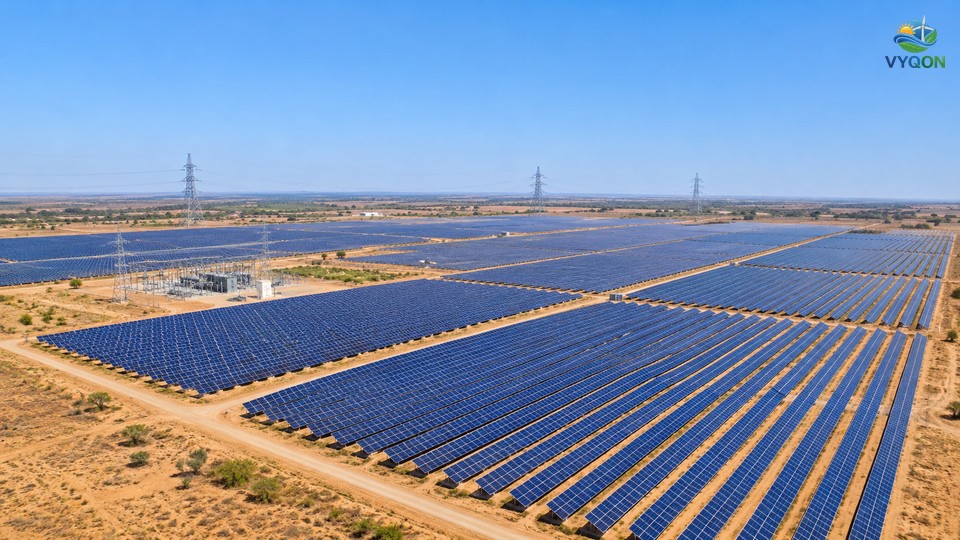
India’s solar capacity additions in calendar year 2026 are expected to surpass the record 38 GW installed in 2025, according to the International Energy Agency (IEA). The agency’s India Renewable Energy Market Report 2026 says India installed 32 GW of solar capacity between January and August 2026. The findings were reported on 23 November 2026, following the report’s launch on 3 November 2026 at the Bharat Renewable Energy Summit in New Delhi.
India solar capacity additions in 2026: what the IEA says
The IEA says annual solar additions in India reached a record 38 GW in 2025, and that India’s solar capacity additions in 2026 are expected to go beyond that mark. The 32 GW installed between January and August 2026 was supported by record auction volumes in 2024 and by developers rushing to commission projects before new domestic sourcing requirements for solar PV cells came fully into effect.
Looking further ahead, the IEA expects India’s solar PV capacity to increase by a factor of 2.5 by 2030, exceeding 350 GW. It credits sustained auction activity and growing rooftop and distributed solar deployment, alongside utility-scale projects.
Auctions and grid support
The IEA describes competitive auctions as a key enabling mechanism for utility-scale solar. Since 2010, India has awarded around 220 GW of utility-scale renewable capacity through auctions, including a record 60 GW allocated in 2024. The IEA’s launch statement adds that these competitive auctions have helped India achieve some of the world’s lowest solar PV generation costs and make it a global leader in procuring hybrid renewable projects.
The Green Energy Corridor programme has expanded the transmission needed to carry renewable power from resource-rich regions, and states such as Gujarat and Maharashtra are leading the growth. Growth is also spreading beyond large power plants, supported by rooftop solar, corporate electricity procurement and expanding domestic manufacturing.
The wider IEA report
The IEA’s launch statement says India’s renewable power capacity has almost quadrupled over the past decade and surpassed 300 GW in 2026. India is now the world’s second-fastest-growing renewables market and its second-largest manufacturer of solar PV modules. It reached its target of 50% non-fossil installed power capacity in 2025, five years ahead of schedule. By 2030, renewable capacity is forecast to reach around 530 GW, with solar PV accounting for more than 80% of new additions. VYQON has covered those headline numbers in its report on the IEA’s 530 GW forecast.
The IEA also says renewable electricity saved India more than USD 100 billion in coal and natural gas import costs between 2011 and 2025. Without the solar PV, wind and bioenergy capacity added since 2010, India’s coal imports in 2025 would have been around 110 million tonnes higher.
What it means for India’s clean-energy sector
A new annual record in 2026 would confirm solar as the main engine of India’s capacity growth. The pull-forward effect described by the IEA also matters for developers and equipment makers: part of the 2026 volume reflects projects that were commissioned early to meet the domestic cell sourcing rule, which is a point for module suppliers, cell manufacturers and project developers to watch.
The IEA also cautions that sustaining the expansion will require faster investment in electricity grids, storage and system flexibility, alongside stronger utility finances and fewer project delays. For India’s solar developers, the message is that transmission, storage and distribution-company finances are as important as new module capacity in keeping annual additions high.
Leave a Comment