
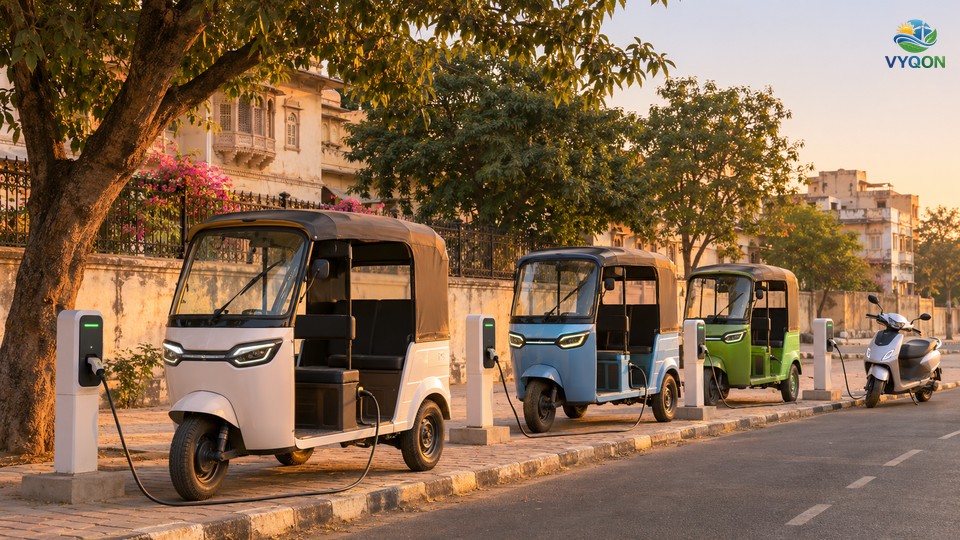
BloombergNEF (BNEF) says in its India Electric Vehicle Outlook 2026 that, apart from three-wheelers, no vehicle segment in India is on track to meet the country’s 2030 electrification targets. The finding was reported on 14 November 2026. The same outlook expects India’s road fuel demand to keep rising until 2034, when it peaks at more than 2.5 million barrels a day, even as electric vehicle (EV) adoption grows.
What the BNEF India EV Outlook 2026 says
The BNEF India EV Outlook 2026 notes that EV sales in India exceeded 2.4 million units last year. Even so, the analysts say that growth is not fast enough in most segments to reach the goals the government has set for 2030. Three-wheelers are the only segment that the outlook places on track.
The outlook also looks at fuel. An expanding vehicle fleet and higher fuel use by commercial transport are expected to keep oil consumption on the road rising until 2034. After the peak of more than 2.5 million barrels a day, demand is expected to decline gradually. By then, growing adoption of electric two-wheelers, three-wheelers and passenger cars is expected to outweigh the rise in fuel use by commercial vehicles.
BNEF also estimates that about USD 29 billion of investment will be needed by 2040 to build the EV charging infrastructure that the shift requires.
India’s 2030 EV targets
The government has set targets for EVs to account for 80% of two- and three-wheeler sales, 70% of commercial vehicle sales and 30% of private car sales by 2030, according to BNEF’s India Transition Factbook 2026, published on 13 October 2026. The factbook reaches the same conclusion as the outlook: BNEF modelling suggests India will fall short of most of these goals, with three-wheelers the exception.
The factbook lists the factors helping EV sales: lower total cost of ownership, greater model availability and a sustained policy push. It adds that higher fuel costs stemming from the conflict in the Persian Gulf could improve the economics of EVs, but that further measures will be needed if India is to hit all of its 2030 targets.
The wider energy picture
The factbook places EVs inside a larger transition. It says non-fossil technologies supplied one-third of India’s electricity demand in the first seven months of 2026, although coal still provided the majority of power, and that coal currently supplies about 68% of India’s electricity. This matters for EVs because the emissions benefit of an electric vehicle depends on how clean the grid that charges it is. The factbook also says India’s energy imports could fall to 3.1% of GDP in 2035 from 5.3% in 2025 under BNEF’s economics-led modelling, which is one reason road-transport electrification is closely watched.
What it means for India’s EV sector
For manufacturers, charging operators and policymakers, the BNEF India EV Outlook 2026 points to a gap between the pace of recent sales and the 2030 targets. Retail data already shows strong growth: FADA reported that EV retail in the 42-day festive season from 11 October to 21 November 2026 rose 52.62% to 5,09,667 units (see the festive EV retail report and the October 2026 EV retail report on VYQON). The BNEF analysis suggests that, even at this pace, most segments would still need further measures to reach their 2030 goals.
The USD 29 billion charging estimate shows that public and private charging networks will need large investment if EV use is to spread beyond two- and three-wheelers. The finding that road fuel demand will keep rising until 2034 also means that India’s oil import needs for transport will not fall quickly, even as electric two- and three-wheelers, and later cars, gain share.
The full BNEF outlook is a paid report. This article therefore uses only the findings that were publicly reported and the public BNEF factbook page, and does not include segment-level 2030 forecasts that could not be confirmed.
Leave a Comment