
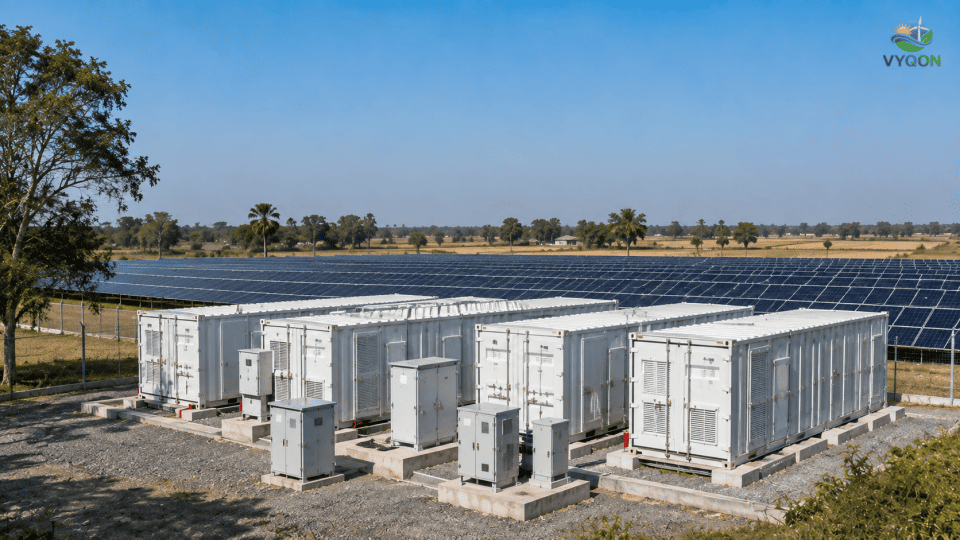
8 October 2026: India’s battery energy storage system (BESS) requirement is set to grow nearly seven-fold over the next five years, from 34.72 GWh in FY2026-27 to 236.22 GWh by FY2031-32. The projection comes from the Central Electricity Authority’s (CEA) National Electricity Plan (NEP) 2022-32. It is highlighted in a new BESS industry report by Rubix Data Sciences, released on 7 October 2026. The report estimates that meeting this requirement could need investment of up to Rs 3.49 trillion by FY2031-32.
Storage Requirement Under the National Electricity Plan
The NEP sets out India’s total energy storage requirement as rising from 82.37 GWh in FY2026-27 to 411.4 GWh by FY2031-32. In power terms, the BESS requirement is 8.68 GW (34.72 GWh) in the first period and 47.24 GW (236.22 GWh) by FY2031-32. The balance of about 175.18 GWh is to be met by pumped storage projects.
BESS is expected to carry a growing share of this load. Its share of required storage power capacity is projected to rise from about 54% to 64% over the period, while its share of total energy storage requirement is expected to increase from about 42% to 57%. Faster deployment timelines, modularity and falling battery costs explain this shift towards battery storage.
Pipeline of 176.66 GWh, but Operational Capacity Lags
According to the Rubix report, India’s BESS project pipeline stood at 176.66 GWh as of August 2026. This equals roughly 75% of the FY2031-32 requirement. The breakdown by stage is as follows:
- Operational: 9.08 GWh
- Under construction: 79.92 GWh
- Awarded: 24.13 GWh
- Under tendering: 63.53 GWh
Deployment has picked up sharply in 2026. India added about 8.2 GWh of new BESS capacity between January and June 2026, compared with less than 100 MWh in the same period of 2025. Even so, the 9.08 GWh operational today is well short of the 34.72 GWh required this year. The report also notes that about 28 GW of capacity was tendered in the first half of 2026, but only about 9 GW was auctioned. Converting tenders and awards into commissioned projects is therefore the central challenge.
Tushar Bhaskar, President of Rubix Data Sciences, said storage has now become central to India’s grid stability, but stressed that the size of the pipeline should not be confused with capacity on the ground. In his view, conversion of tenders into built projects is what matters now, and until that happens the headline figures will continue to run ahead of actual grid capacity.
Gujarat and Rajasthan Lead Installations
Installed utility-scale BESS capacity is highly concentrated. Gujarat holds 44.0% and Rajasthan 43.7%, together accounting for nearly 88% of the national total, followed by Maharashtra at 5.1%. Both leading states have large solar and wind bases, which create the strongest need for storage to manage variability and shift daytime renewable energy into the evening peak.
Demand Drivers
Electricity demand growth and renewable expansion remain the key drivers. Peak demand is projected to rise from 289 GW in FY2026-27 to 459 GW by FY2035-36, while annual energy requirement is expected to grow from 1,929 BU to 3,365 BU. India also added about 29 GW of solar and wind capacity in the first half of 2026, increasing the need for flexible, dispatchable capacity to balance supply and demand.
Policy Support
Several government measures underpin the market. The Energy Storage Obligation notified by the Ministry of Power rises from 1% in FY2023-24 to 4% by FY2029-30. A proposed mandate could require new solar and onshore wind projects to include storage of at least 10% of project capacity for two hours from July 2027. Viability gap funding currently supports about 43.2 GWh of targeted capacity, and the ISTS charges waiver applies to co-located storage projects commissioned by 30 June 2028.
On the manufacturing side, 40 GWh of the 50 GWh target under the Production Linked Incentive (PLI) scheme for Advanced Chemistry Cell (ACC) batteries has been awarded to four companies, with 10 GWh earmarked in July 2026 for grid-scale storage. The recently approved PM-DHARA scheme includes a dedicated allocation of Rs 500 billion for deploying 50 GWh of BESS by FY2032-33.
Key Challenges
The sector still faces significant risks. Imports of lithium-ion batteries and accumulators rose from USD 3.0 billion in FY2025 to USD 4.7 billion in FY2026, with China supplying about 84% of FY2026 imports. Tariffs have fallen sharply, with the lowest two-hour BESS tariff reaching Rs 1.48 lakh/MW/month in 2025. The report classifies nearly 75% of allocated two-hour BESS capacity as “at risk”, reflecting pressure on project viability. Financing constraints, execution delays and grid connectivity bottlenecks add further uncertainty.
Outlook
India’s storage market has moved from pilot scale to a large, policy-backed pipeline. Whether it meets the NEP target will depend on how quickly the 168 GWh of non-operational capacity reaches commissioning. Domestic cell manufacturing, realistic tariff bidding and timely grid connectivity will be decisive in turning the pipeline into storage capacity on the grid. Developers, EPC contractors and equipment suppliers that can deliver on schedule are likely to benefit most as the market scales.
Official References
- Central Electricity Authority – National Electricity Plan (Generation)
- Ministry of Power, Government of India – Energy Storage Obligation, VGF Scheme and National Framework for Energy Storage Systems
- Ministry of Heavy Industries – PLI Scheme for Advanced Chemistry Cell Battery Storage
- Ministry of New and Renewable Energy
- Press Information Bureau, Government of India
Leave a Comment