
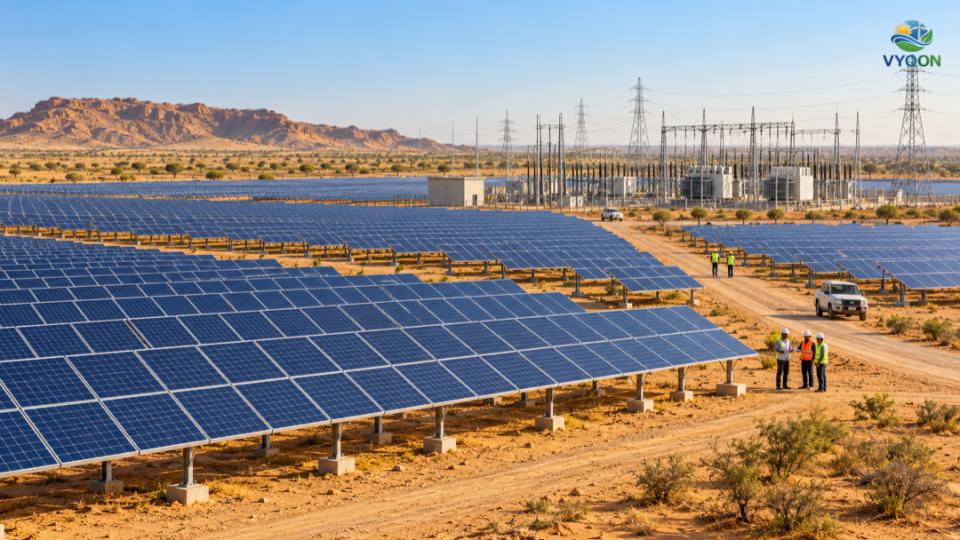
The latest commissioning advances ACME Solar’s 300 MW solar development in Rajasthan, part of a larger 400 MW solar-wind hybrid project backed by a power purchase agreement with NTPC.
ACME Solar Holdings Limited, through its subsidiary ACME Renewtech Private Limited, has commissioned an additional 66.68 MW of solar power capacity at Kelan village in Bikaner district, Rajasthan. The new capacity was commissioned on 5 October 2026, with the commercial operation date (COD) designated as 7 October 2026.
With this addition, the project’s cumulative commissioned solar capacity has reached 133.36 MW out of its planned 300 MW solar capacity, representing approximately 44.45% completion of the solar component.
The development forms part of ACME Solar’s first hybrid renewable energy project, comprising 300 MW of solar and 100 MW of wind capacity. A power purchase agreement (PPA) has been signed with NTPC Limited, while long-term project financing has been arranged through Power Finance Corporation (PFC).
The latest milestone reflects continued progress in the phased execution of utility-scale renewable energy infrastructure in Rajasthan.
Second 66.68 MW Solar Phase Achieves Commercial Operation
The October commissioning follows the project’s initial 66.68 MW solar phase, commissioned in September 2026. Together, the two phases account for 133.36 MW of operational solar capacity.
Rather than commissioning the entire solar installation simultaneously, ACME Renewtech is developing and operationalising the capacity in stages.
Phased commissioning is widely used in large renewable energy projects because it allows completed sections to undergo testing, grid synchronisation and commercial operation while construction continues elsewhere.
For project developers, this approach can provide several operational advantages. Completed generating units may begin supplying electricity and potentially generating revenue earlier, subject to their contractual and regulatory arrangements.
It also enables project teams to evaluate equipment performance, communication systems and protection settings progressively before integrating additional generating capacity.
However, successful commissioning requires coordination between solar modules, inverters, electrical collection networks, substations, metering equipment and the grid connection infrastructure.
The declaration of commercial operation is therefore an important project milestone, indicating that a defined capacity block has reached the applicable operational requirements.
A 400 MW Solar-Wind Hybrid Project Backed by NTPC
The Kelan solar development is part of ACME Solar’s broader hybrid renewable energy portfolio.
According to the company’s earlier project announcement, the hybrid configuration consists of:
- Solar generation capacity: 300 MW
- Wind generation capacity: 100 MW
- Total planned hybrid generation capacity: 400 MW
- Power purchase agreement: NTPC Limited
- Long-term project financing: Power Finance Corporation
The combination of solar and wind generation offers an opportunity to create a more diversified renewable electricity supply profile.
Solar power generation is concentrated primarily during daylight hours, whereas wind generation depends on local wind conditions and may contribute during other periods.
Combining these resources can help reduce dependence on a single renewable generation source. However, the actual improvement in electricity supply consistency depends on resource availability, project configuration, forecasting accuracy and grid conditions.
In September 2026, ACME Solar indicated that it expected to commission the complete 300 MW solar component by the end of the third quarter of FY2026–27.
The latest commissioning marks further progress towards that stated target, although completion of the remaining capacity will depend on subsequent construction, testing and regulatory clearances.
Distinguishing the Hybrid Project from the Separate BESS Development
ACME Solar is also developing battery energy storage infrastructure at Kelan through another subsidiary, ACME Greentech Seventh Private Limited.
Although the storage facilities and solar development are associated with the same geographical location, they belong to separately identified projects with different commercial arrangements.
The battery storage capacity is associated with a Firm and Dispatchable Renewable Energy (FDRE) project, developed through ACME Greentech Seventh.
The FDRE development has a power purchase agreement with SJVN Limited, while REC Limited is providing long-term project financing.
In September 2026, ACME Solar announced the commissioning of an initial 53.63 MW/300 MWh battery storage phase under this separate development. Additional storage commissioning milestones followed in September and October.
These developments highlight ACME Solar’s expanding activities across renewable electricity generation and battery energy storage.
However, the BESS commissioning should not be interpreted as part of the NTPC-contracted solar-wind hybrid project without a separate confirmation of such integration.
This distinction is important when assessing project capacities, contractual commitments and commissioning progress.
Phased Commissioning Supports Project Execution and Risk Management
Utility-scale renewable energy projects involve numerous interconnected construction and engineering activities.
Solar module installation, inverter commissioning, electrical cabling, transformer installation, communication networks and grid-interconnection systems must be completed and tested before commercial operation.
A phased commissioning strategy can reduce execution risks by allowing individual sections to be independently assessed.
For example, commissioning an initial solar block provides practical operating information about inverter behaviour, plant-level controls, electrical protection and monitoring systems.
Experience gained from initial operations can help engineering teams refine procedures for subsequent phases.
At the same time, operating a partially completed project requires strict safety management.
Energised equipment must be appropriately isolated from ongoing construction activities, and operating procedures must account for changes in the electrical configuration as new capacity is connected.
Maintaining accurate commissioning records, electrical drawings, equipment test reports and monitoring data is essential for reliable long-term operation.
For ACME Renewtech, these considerations will remain important as further solar capacity is added to the Kelan development.
Rajasthan’s Role in India’s Utility-Scale Renewable Energy Expansion
Rajasthan continues to play an important role in India’s large-scale solar power development because of its strong solar resource, availability of suitable project locations and growing renewable energy infrastructure.
Bikaner district has emerged as an important region for utility-scale renewable energy projects.
However, successful project delivery involves more than installing solar modules and connecting generating capacity.
High ambient temperatures, dust accumulation, equipment degradation and variability in weather conditions can influence the performance of photovoltaic power plants.
Effective operations and maintenance practices, including module cleaning, inverter monitoring, thermographic inspections and performance analysis, are therefore essential.
As additional generating blocks become operational, consistent monitoring standards can help operators identify performance deviations, compare different plant sections and optimise maintenance schedules.
Grid availability and transmission infrastructure are equally important, particularly in regions experiencing rapid growth in renewable generation capacity.
For the wider Indian renewable energy industry, phased commissioning milestones provide measurable evidence of project execution, moving capacity from planned development into operational generation.
Conclusion
ACME Renewtech’s commissioning of an additional 66.68 MW of solar capacity at Kelan marks another step in the development of ACME Solar Holdings’ NTPC-backed hybrid renewable energy project.
The latest addition increases commissioned solar capacity to 133.36 MW out of the planned 300 MW, while the broader hybrid project also includes 100 MW of wind generation capacity.
The milestone demonstrates how phased commissioning can support gradual capacity addition, operational testing and more structured project execution.
With further solar capacity still to be commissioned, attention will now turn towards the completion of the remaining project phases, integration of the hybrid generation portfolio and reliable long-term electricity generation.
The development also reinforces Rajasthan’s importance in India’s expanding utility-scale renewable energy sector.
Original References:
ACME Solar – Official BSE disclosure, 5 October 2026 –https://www.bseindia.com/stockinfo/AnnPdfOpen.aspx?Pname=11e876a0-26bf-4ebb-8c0e-2f671017ec86.pdf
ACME Solar – Official September 2026 press release-https://www.acmesolar.in/assets/press-release-acme-solar-commissions-66-68-mw-solar-capacity-and-300-mwh-bess-capacity-in-rajasthan
Leave a Comment