
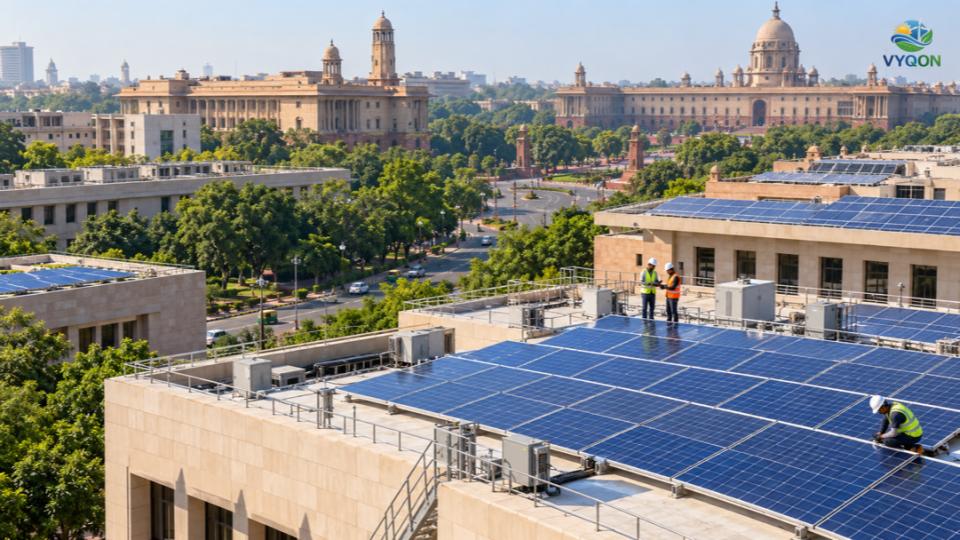
The tender proposes approximately 3.68 MW of grid-connected solar capacity across New Delhi Municipal Council facilities under a 25-year RESCO arrangement, with a ceiling tariff of ₹5.13 per kWh and developer-led financing, installation and maintenance.
The Solar Energy Corporation of India (SECI) has invited bids for the development of approximately 3,680 kW (3.68 MW) of grid-connected solar photovoltaic projects at New Delhi Municipal Council (NDMC) buildings under the Renewable Energy Service Company (RESCO) model.
Published on 7 October 2026, the tender aims to select a solar power developer through tariff-based competitive bidding. The procurement, identified as RTSPV Tranche XV, represents another initiative to expand renewable energy generation across public-sector facilities in India’s national capital.
Under the proposed arrangement, the selected developer will be responsible for financing, designing, installing, operating and maintaining the solar power systems, while NDMC will procure the generated electricity under a long-term Power Purchase Agreement (PPA).
The project offers an opportunity to utilise available spaces at municipal facilities for clean electricity generation without requiring NDMC to fund the initial installation directly.
Although the tender is primarily structured around rooftop solar deployment, its Request for Selection (RfS) also permits eligible ground-mounted solar PV installations at NDMC sites.
SECI Announces Tender for Approximately 3.68 MW of Solar Capacity
The procurement has been issued under Tender ID SECI000287, with reference number SECI/C&P/IPP/11/0010/26-27.
According to SECI’s official tender schedule, the pre-bid meeting is scheduled for 3 November 2026, followed by the online bid submission deadline of 17 November 2026.
The deadline for offline document submission is 19 November 2026, while bid opening is scheduled for 20 November 2026.
The tender documents include the Request for Selection, a draft Power Purchase Agreement and a standard format for seeking clarifications.
SECI has specified an estimated cumulative installation capacity of approximately 3,680 kW. However, this figure represents the proposed capacity rather than a guaranteed final installation.
The selected developer will be permitted to conduct detailed site assessments after receiving the Letter of Award. The final installed capacity will be determined when the PPA is signed between the developer and NDMC.
This provision recognises that the actual solar potential of individual municipal buildings depends on structural suitability, available installation area, electrical demand, shading conditions and grid-connectivity requirements.
Developers must therefore evaluate the proposed sites carefully before finalising the project capacity and contractual commitments.
RESCO Model Enables Solar Adoption Without Upfront Installation Investment
The project will follow the Renewable Energy Service Company (RESCO) model, under which the selected developer finances and operates the solar installations while supplying electricity to the participating organisation.
Unlike a conventional capital-expenditure-based rooftop solar system, where the building owner purchases the equipment, the RESCO approach allows public institutions to procure solar electricity through a contracted tariff.
Under the proposed arrangement, the developer will undertake engineering, procurement, construction, installation, testing and commissioning.
The developer will also be responsible for obtaining necessary grid-connectivity approvals, implementing net-metering arrangements and carrying out operation and maintenance throughout the PPA period.
The agreement will remain effective for 25 years from the project’s commercial operation date.
An important feature of the procurement is the ownership arrangement. Upon completion of the 25-year PPA term, ownership of the installed solar power assets and associated infrastructure will transfer to NDMC without additional financial liability.
This structure allows the municipal body to obtain renewable electricity during the contract period while ultimately acquiring the installed infrastructure.
However, the long-term arrangement also creates operational responsibilities for the developer, including equipment replacement, performance monitoring, preventive maintenance and compliance with applicable electrical safety standards.
SECI Sets Maximum Tariff at ₹5.13 per kWh
The tender specifies a ceiling tariff of ₹5.13 per kWh, with bids exceeding this limit subject to rejection.
The selection process will be based on tariff-based competitive bidding, with bidders required to quote a single fixed tariff applicable to the project capacity covered by the agreement.
According to the RfS, the quoted tariff must cover the developer’s obligations related to system design, equipment procurement, construction, commissioning, warranty, operation and maintenance.
The tariff must also account for grid-connectivity and net-metering expenses, along with applicable costs and charges specified in the tender.
Importantly, the quoted tariff will remain fixed throughout the 25-year PPA period, with no ordinary tariff escalation permitted. The tender separately provides for the treatment of statutory variations in taxes and duties.
This means developers must evaluate the entire project lifecycle when preparing their financial bids.
Equipment degradation, inverter replacement, module cleaning, insurance, financing expenses and long-term maintenance obligations will influence project economics.
The bidding structure aims to provide NDMC with predictable electricity procurement costs while encouraging developers to optimise system performance and operating expenditure.
The tender also specifies an earnest money deposit of ₹33.12 lakh and a bid processing fee of ₹6,000, including GST.
Project Commissioning and Long-Term Performance Requirements
SECI has established a defined implementation schedule for the selected solar developer.
The scheduled commissioning date for the complete project capacity will be 12 months from the effective date of the PPA.
The tender allows a further period of up to six months beyond the scheduled commissioning deadline, subject to applicable penalties and contractual provisions.
Delays beyond the permitted period can result in a reduction of the contracted capacity and termination of the PPA for the uncommissioned portion.
In addition to the construction schedule, the developer must satisfy performance requirements throughout the project lifecycle.
The RfS requires a declared annual Capacity Utilisation Factor (CUF) of at least 15%, together with specified tolerances for annual energy delivery.
These requirements make system design, solar resource assessment, equipment selection and maintenance planning particularly important.
The developer must also maintain appropriate monitoring systems, carry out periodic inspections and replace defective equipment within the contractual requirements.
A reliable operation and maintenance strategy will be essential because rooftop solar installations across multiple buildings can experience different operating conditions and accessibility constraints.
Aggregating Municipal Solar Sites Creates Opportunities and Challenges
The proposed 3.68 MW development combines solar installations across multiple NDMC facilities into a single procurement framework.
This approach can improve procurement efficiency by allowing common technical standards, contractual provisions and monitoring requirements to be applied across a portfolio of installations.
However, individual buildings may differ significantly in structural design, available roof area, electrical infrastructure and solar exposure.
Before installation, developers will need to examine structural load-bearing capacity, waterproofing arrangements, shading, safe maintenance access and available electrical connection points.
Solar mounting structures must also be designed to withstand applicable wind loads and site conditions while preserving roof drainage and building functionality.
Electrical engineering considerations include inverter placement, cable routing, earthing, surge protection, protection coordination and safe isolation arrangements.
Because many municipal facilities may remain operational throughout installation, construction teams must also manage public safety, equipment movement and working-at-height risks.
A phased implementation strategy may help developers coordinate construction activities across different locations while maintaining consistent quality and safety standards.
Urban Solar Generation Can Support Cleaner Municipal Electricity Consumption
Distributed solar installations offer several advantages in densely developed urban environments.
By using existing buildings and other suitable municipal spaces, rooftop solar projects can generate electricity without requiring the extensive land areas normally associated with utility-scale solar plants.
Electricity produced close to consumption points can reduce the amount of electricity drawn from the distribution network, depending on the building’s demand profile and metering arrangement.
For municipal buildings with significant daytime electricity consumption, rooftop solar can contribute to meeting loads associated with lighting, office equipment, air conditioning and other services.
The actual savings will depend on electricity consumption patterns, the contracted solar tariff, applicable grid charges and the treatment of exported electricity.
Solar adoption across public buildings can also demonstrate renewable energy technologies within urban communities.
At the same time, successful deployment requires coordination with distribution utilities to ensure compliance with grid-interconnection, metering and safety requirements.
As distributed solar capacity expands, accurate performance monitoring and well-maintained electrical infrastructure will become increasingly important for reliable operation.
The NDMC procurement could provide useful experience for other municipal authorities considering developer-financed solar projects across multiple public buildings.
Long-Term Operations Will Determine Project Success
While the tender’s initial objective is to develop approximately 3.68 MW of solar capacity, the project’s long-term value will depend on sustained electricity generation and effective maintenance.
Solar PV systems require continuous performance monitoring to identify faults, equipment degradation and generation losses.
Dust accumulation, partial shading, inverter failures, loose electrical connections and other technical issues can affect electricity output if they are not addressed promptly.
For a portfolio spread across several buildings, centralised monitoring can help operators track energy generation, identify abnormal performance and coordinate maintenance activities.
However, remote monitoring must be supported by qualified technicians capable of performing physical inspections, repairs and equipment replacements.
The project’s 25-year operating horizon also makes lifecycle planning particularly important.
Developers must ensure that financial models account for equipment replacement, long-term maintenance expenditure and contractual performance obligations.
The fixed-tariff structure increases the importance of accurate initial engineering and cost estimation because ordinary tariff escalation will not be available to compensate for rising operating expenses.
Strong technical planning, effective maintenance management and coordination between the developer, NDMC and distribution authorities will therefore be central to successful implementation.
Conclusion
SECI’s 3.68 MW rooftop solar tender for NDMC facilities represents an initiative to expand distributed renewable electricity generation across New Delhi’s public-sector infrastructure.
Through the RESCO model, the procurement allows solar projects to be developed without requiring upfront installation investment from NDMC, while establishing a long-term framework for electricity procurement and asset management.
The ₹5.13 per kWh ceiling tariff, 25-year PPA duration and transfer of project ownership to NDMC at the end of the agreement define the project’s key commercial features.
Although the final installed capacity will depend on site assessments and PPA finalisation, the tender demonstrates how aggregated municipal solar projects can support distributed clean energy deployment.
Successful implementation will require careful engineering, competitive project pricing, safe construction practices and reliable long-term performance.
If executed effectively, the initiative could serve as a useful model for expanding solar generation across other government and municipal facilities in India.
References:
SECI – Official Tender Notice (7 October 2026)-https://seci.co.in/tender-details/Ympw
SECI – Official Request for Selection (RfS)-https://www.seci.co.in/uploads/tenders/RfS2.pdf
SECI – Draft Power Purchase Agreement-https://www.seci.co.in/uploads/tenders/PPA.pdf
Leave a Comment