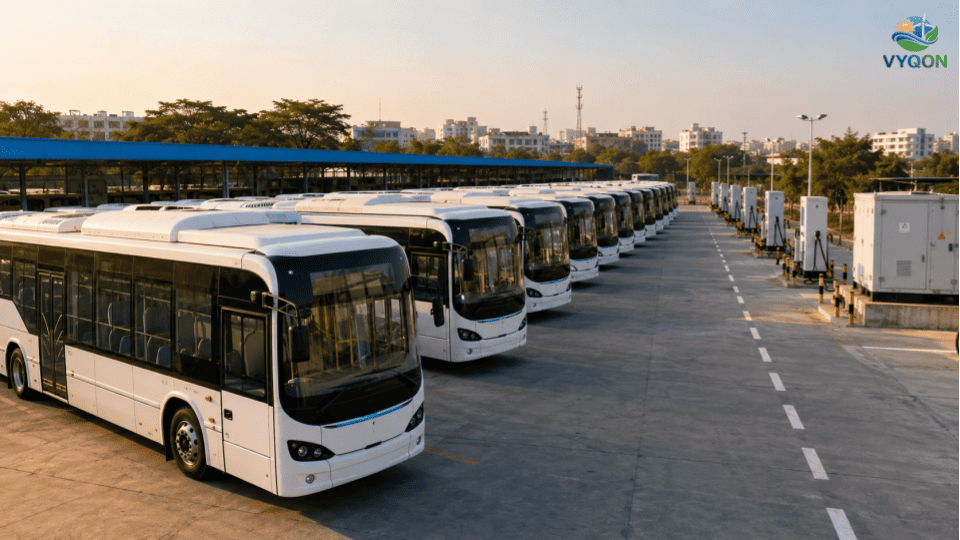
JBM Ecolife Mobility, the electric mobility subsidiary of JBM Auto, has secured a ₹750 crore strategic investment from Motilal Oswal Alternates (MO Alternates). Announced in June 2026, the capital is earmarked for the deployment of approximately 2,000 additional electric buses across India. The funding supports the company’s objective to expand its nationwide operational fleet from the current 3,400 units to nearly 5,000 units over the next 12 months.
Strategic Investment Breakdown
This ₹750 crore commitment represents the largest investment by an Indian investor in the domestic electric mobility sector to date. The capital is being deployed via a private credit framework, providing disciplined capital solutions to support JBM’s Gross Cost Contracting (GCC) model.
Under the GCC framework, JBM operates as a vertically integrated provider responsible for the manufacturing, ownership, operation, and maintenance of the fleet. This “Build-Own-Operate” model facilitates the transition to electric mobility for public transport authorities by eliminating upfront capital expenditures, with operators remunerated based on distance traveled.
Fleet Scaling and Deployment Targets
The fresh capital facilitates a 50% increase in JBM’s operational capacity within a one-year horizon. The expansion focuses on high-growth regions, including Gujarat, Maharashtra, and Haryana, where JBM has secured substantial contracts under the PM-eBus Sewa scheme.
| Fleet Metric | Statistic |
| Current Operational Fleet | Approximately 3,400 buses |
| 12-Month Operational Target | Nearly 5,000 buses |
| Immediate Deployment Goal | 2,000 additional e-buses |
| Total Order Book Visibility | 11,000+ buses (deployed or under execution) |
These deployments are anchored by long-term contracts with State Transport Undertakings (STUs) and public transport authorities. JBM’s current order book visibility includes a specific recent win of 1,390 buses out of a 2,155-unit tender conducted by Convergence Energy Services Limited (CESL).
Market Leadership and Manufacturing Capacity
JBM holds a market-leading position in the Indian electric bus sector, recording a market share of over 25% in FY26. Financial data underscores this trajectory; the company’s OEM division reported a 3.2x revenue surge in FY24, reaching ₹17.4 billion. Operations are supported by a 4 million-square-foot facility in the Delhi-NCR region, currently the world’s largest dedicated integrated e-bus manufacturing plant outside China.
- Annual Capacity: 20,000 units.
- Battery Infrastructure: In-house lithium-ion battery manufacturing with an annual capacity of 3 GWh, expanding to 5 GWh within the current year.
- Integrated Capabilities: The facility features state-of-the-art innovation centers, test labs, and the ability to deploy ultra-fast charging infrastructure.
- Policy Support: Growth is aligned with central government initiatives including FAME, PM E-Drive, and the PM e-Bus Sewa scheme.
Executive Perspectives
Leadership from both JBM Auto and Motilal Oswal Alternates provided context on the strategic partnership:
Nishant Arya, Vice Chairman and Managing Director, JBM Auto: “We are delighted to partner with Motilal Oswal as we enter our next phase of transformative growth at JBM Ecolife. With our market leadership in the electric bus market in India in FY26, this strategic partnership will act as a major catalyst towards further scaling our e-bus deployment to various states.”
Rakshat Kapoor, Head – Private Credit at MO Alternates: “India’s green energy mandate and urban mobility imperative are converging to create a structural investment opportunity of significant scale, and JBM Ecolife stands as its most credible institutional expression. Our ₹750 crore commitment is a high-conviction allocation, and we look forward to working alongside the JBM leadership to generate sustainable value.”
Sector Context and Policy Alignment
India is currently the world’s third-largest electric bus market. The transition is managed by implementing agencies such as CESL, which aggregates demand from various states to streamline large-scale procurement.
JBM’s expansion is central to its formal commitment to achieving Net Zero by 2040. By integrating high-energy-density batteries and fast-charging infrastructure, the company provides a sustainable alternative to internal combustion engine fleets, contributing to the broader decarbonization of India’s urban transportation networks.
Leave a Comment