
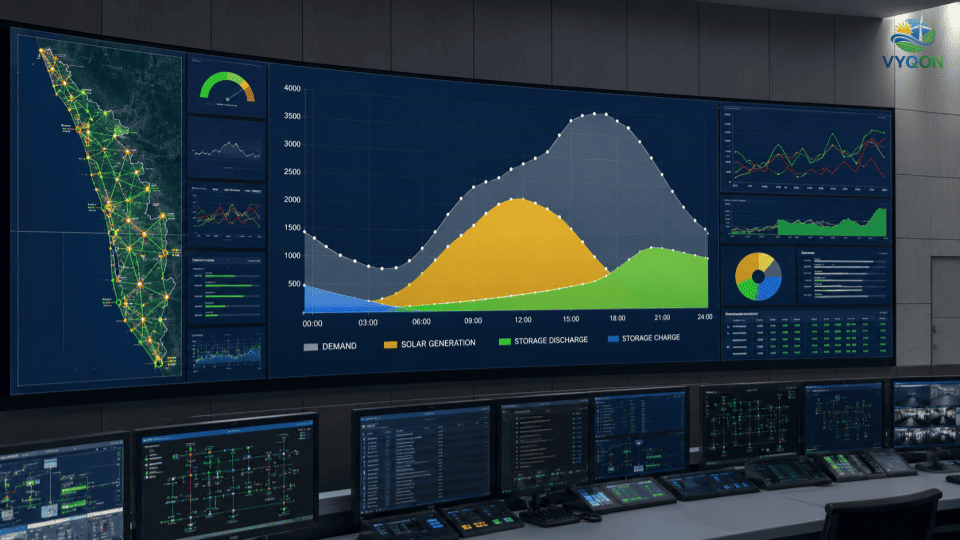
The Kerala State Electricity Regulatory Commission (KSERC) has granted approval to the Kerala State Electricity Board (KSEB) for a revised medium-term procurement framework to secure 300 MW of power specifically for evening peak hours. The order defines the procurement window as 6:00 PM to Midnight, spanning from January 2027 through December 2031. The commission’s decision focuses on modifying bid evaluation methodologies to accommodate Renewable Energy (RE) and Battery Energy Storage Systems (BESS) while ensuring competitive price discovery through a refined lumpsum tariff structure.
Revised Framework & ISTS Evaluation Mechanism
The commission has established a specific methodology for calculating landed cost at the Kerala periphery to allow for an objective comparison of bids from diverse sources. A critical requirement of this framework is that bidders must quote Interstate Transmission System (ISTS) charges and transmission losses as Rs 0.00 per unit for evaluation purposes. This normalization ensures that KSEB can apply a consistent benchmark to all bids regardless of the generator’s location.
KSEB will bear all ISTS charges and losses incurred from the Central Transmission Utility (CTU) interconnection point to the Kerala periphery. To determine the landed cost for ranking, the utility will utilize a calculation logic based on the most recent Central Transmission Utility of India Limited (CTUIL) invoice averages. This mechanism ensures that the evaluation reflects the actual cost to the state while the billing remains tied to the generator’s interconnection point.
Contrast of Evaluation and Billing Points
| Category | Location |
| Evaluation Ranking Points | Kerala Periphery (Landed Cost) |
| Billing Delivery Points | CTU Interconnection Point of the Generator |
Technical Bid Criteria & Lumpsum Tariff Structure
The procurement framework utilizes a lumpsum tariff model intended to increase competition among traders and renewable energy providers. The commission has mandated that the Base Fixed Charge and the Base Variable Charge must each constitute a minimum of 35% of the total quoted tariff. Under the lumpsum model, all generating costs, transmission charges, and transmission losses must be bundled into the Base Variable Charge to provide a single, transparent energy rate.
The technical and financial eligibility requirements for the tender include:
- Minimum Bid Capacity: 100 MW.
- Financial Capacity: A minimum net worth of Rs. 1 crore per MW of the capacity the bidder intends to provide.
- Performance Security: Rs. 10 Lakh per MW of contracted capacity, submitted as an irrevocable bank guarantee.
- Timelines: Suppliers are required to satisfy all conditions precedent within 30 days of the agreement date.
Background: Peak Demand Dynamics & Supply Constraints
The regulatory approval follows a detailed assessment of increasing grid pressures in Kerala, where a significant deficit exists during non-solar hours. Data from the licensee indicates that existing hydroelectric and long-term contracts are insufficient to meet specific evening loads. The rationale for the 300 MW tender is supported by several current grid pressures:
- Peak demand is projected to reach levels between 5900 MW and 6000 MW during high-demand summer months.
- Hydroelectric reservoir levels have seen a sharp decline, falling to 21% from the 60.93% recorded during the same period in the previous year.
- Consumption patterns have shifted due to external factors, including LPG shortages that have driven increased reliance on electric cooking gadgets.
- The transition from Round-the-Clock (RTC) procurement to peak-specific slots is necessary to address the specific deficit that remains after daytime solar generation ceases.
Regulatory Compliance & BESS Integration
KSERC has linked this procurement approval to strict mandates regarding Renewable Purchase Obligations (RPO) and Energy Storage Obligations (ESO). The commission highlighted that the successful integration of BESS is vital to mitigating peak shortages. Consequently, the regulator has issued specific directives to address delays in BESS projects at Pothencode, Mylatti, and Sreekantapuram.
KSEB is required to appoint dedicated officers to monitor these BESS projects and ensure their timely completion. The utility must also publish weekly progress reports on its official website to maintain accountability. Regarding financial settlements, payments will be based on actual delivered energy. While Letters of Credit (LC) will serve as the primary payment security mechanism, the commission has omitted the requirement for Default Escrow accounts for this specific framework.
Transparency & Reporting Mandates
To ensure public accountability and provide consumer protection during periods of power instability, KSERC has imposed several reporting mandates. KSEB must publish daily details on its website regarding all short-term and exchange-based power purchases, including the specific quantities and associated costs.
The commission has also established strict protocols for load management. In the event that emergency cyclic load shedding is required to maintain grid stability, KSEB is mandated to provide consumers with at least one hour of notice via SMS, print media, or television.
Order of the Commission
An immediate mechanism to watch the daily situation, and monitor the parameters and the efforts taken on a day to day basis and to bring the information to the highest level of the management of KSEBL including CMD till 31st May, 2026 or situation becomes normal, whichever is earlier. Within one week after the completion of the procurement, KSEBL shall submit the day wise details of the procurement including cost before the Commission.
Official Sources
Kerala State Electricity Regulatory Commission (KSERC)
- Order No. 32/2026 (16-07-2026): “Order on Petition seeking approval for revising the bid evaluation methodology framework and the bid documents for the procurement of 300 MW for a period of five years during 18:00 to 24:00 hours (peak hours) on lumpsum tariff basis.” View Order
- Order No. 19/2026 (25-04-2026): “Petition under Regulation 78 of the KSERC (Terms and Conditions for Determination of Tariff) Regulations 2021 seeking approval for the Mechanism proposed for short-term power procurement to meet contingency periods.” View Order
- Order No. 66/2023 (06-12-2023): “Petition under Regulation 77 of the KSERC (Terms and Conditions for Determination of Tariff) Regulations 2021 seeking approval for the deviations from the Model Bidding Document for procurement of 300 MW RTC power.” View Order
- Official Web Portal: Kerala State Electricity Regulatory Commission – Orders. Visit Website
Government of Kerala
- Department of Power: Official administrative oversight and policy formulation. Visit Website
- Revised Demands for Grants 2026–27: Official budget report. View PDF
Kerala State Electricity Board Limited (KSEBL)
- Official Website: State utility board responsible for generation, transmission, and distribution. Visit Website
Leave a Comment