
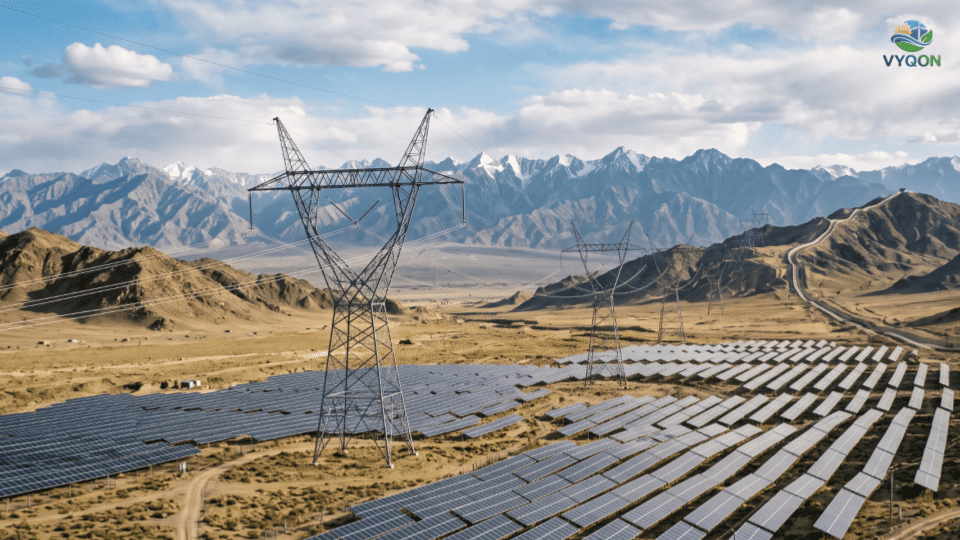
The Ministry of Home Affairs (MHA) has institutionalized a new national security clearance framework for solar, wind, and hybrid energy projects situated near India’s International Borders (IB), Line of Control (LoC), and Line of Actual Control (LAC). These protocols mandate strict spatial restrictions and infrastructure caps to safeguard frontier integrity as the nation aggressively expands its renewable energy footprint.
Spatial Restrictions and Security Zones
To maintain border security and operational visibility, the MHA has established three distinct regulatory tiers based on a project’s proximity to the zero line:
- 0–1 km Zone: An absolute prohibition is in effect. There is a blanket ban on all renewable energy project activity within this one-kilometer buffer.
- 1–50 km Zone: Formally designated as “Sensitive Areas,” any proposed development in this corridor requires mandatory case-by-case security clearance from the MHA.
- 1–20 km Zone: Projects within this inner perimeter face an additional layer of scrutiny, requiring a No Objection Certificate (NOC) from the Ministry of Defence (MoD) in addition to MHA clearance.
Approval Workflow and Application Timeline
Developers must utilize a “single-window” application route through the Ministry of New and Renewable Energy (MNRE). To ensure a centralized chain of communication, the MHA strictly prohibits developers from making direct contact with the MHA or MoD regarding clearance status or queries.
The Sequential Process Flow:
- In-Principle State Approval: Secure initial land allocation and approval from the respective State Government.
- MNRE Submission: Route the formal application through the MNRE for technical vetting.
- Ministerial Routing: The MNRE acts as the sole intermediary, forwarding applications to the MHA and MoD for final security clearance.
The MHA has established a 60-day processing target to provide a decision once an application is received from the MNRE. However, stakeholders should note that the 60-day window is a performance goal for the MHA itself; total lead times will be influenced by the preceding MNRE routing and vetting phases.
Operational and Infrastructure Mandates
Site Infrastructure & Civil Construction
To maintain military lines of sight, the MHA has implemented tiered civil construction height caps. Furthermore, all auxiliary infrastructure, such as staff housing and cafeterias, must be situated at least 5 km away from the international border.
| Distance from Border | Maximum Building/Structure Height |
| 1–8 km | 3 meters |
| 8–20 km | 5 meters |
| 20–50 km | 15 meters |
Security & Staffing Requirements
The framework introduces stringent personnel and asset protection protocols across the entire 50 km sensitive corridor:
- Employment Restrictions: Developers are prohibited from employing personnel from land-border nations—specifically Pakistan, China, and Bangladesh—without express prior authorization.
- Perimeter Security: Mandatory establishment of police posts and anti-drone setups is required for all projects within the 1–50 km zone.
- Equity & Land Transfers: Any sale of project stakes or land transfers to foreign entities requires mandatory MHA security vetting and approval.
Status of Existing Projects (Grandfathering)
While the new framework is primarily directed at future development, the guidelines serve as the new standard for the sector. Existing operational projects or those with prior clearances are generally grandfathered under their original terms. However, any significant modifications or new civil works on these sites will trigger the new vetting procedures.
Analyst’s Note: Developers with existing assets in these zones are strongly advised to perform an immediate spatial audit. Documenting current infrastructure heights and proximity to the 1 km “no-go” zone is essential to prevent future regulatory disputes or compliance violations during maintenance and upgrades.
India’s 2030 Energy Goals
These security mandates add a layer of complexity to India’s ambitious target of achieving 500 GW of non-fossil capacity by 2030. While border regions in states like Rajasthan and Gujarat offer immense solar and wind potential, they are already fraught with logistical challenges.
Industry data suggests a significant “grid-generation gap”: while renewable plants can be completed in 12–18 months, associated transmission infrastructure typically takes 36–60 months to deploy. In border regions, these delays are further exacerbated by environmental sensitivities. Specifically, in Rajasthan, the habitat of the Great Indian Bustard (GIB) has necessitated the expensive undergrounding of transmission lines to secure biodiversity clearances. Developers must now balance these ecological and grid-connectivity hurdles with the MHA’s new spatial and height restrictions.
Quick Reference Guide for Industry Stakeholders
| Distance from Border | Required Clearances | Primary Mandates & Infrastructure Limits |
| 0–1 km | Prohibited | Blanket Ban: No renewable energy activity allowed. |
| 1–20 km | MNRE, MHA & MoD NOC | 3–5m height cap; Anti-drone & police post requirements. |
| 20–50 km | MNRE & MHA Clearance | 15m height cap; Staff housing must be >5km from border. |
| Across 1–50 km | MNRE-Routed Vetting | Anti-drone setups; Employment bans (PAK/CHN/BNG). |
Official Government Sources & Portals
- Ministry of Defence (MoD), Press Information Bureau (PIB)
- Subject: Launch of Online Portal for issue of NOC for power, oil, and gas exploration projects.
- Hyperlink: https://pib.gov.in/PressReleasePage.aspx?PRID=1635116
- Ministry of Defence (MoD) – Online NOC Portal
- Subject: Official portal for MoD Security Clearance for Power Projects and RSEE activities.
- Hyperlink: https://ncog.gov.in/modnoc/home.html
- Ministry of External Affairs (MEA) – Clarifications on LoC
- Subject: Official delineation of the 740 km Line of Control ending at Pt NJ-9842.
- Hyperlink: https://mea.gov.in/in-focus-article.htm?19004/
- Ministry of External Affairs (MEA) – Simla Agreement (1972)
- Subject: Legal framework and treaty text establishing the Line of Control.
- Hyperlink: http://www.mea.gov.in/bilateral-documents.htm?dtl/5541/Simla+Agreement
- Ministry of Home Affairs (MHA) – National Security Guidelines (2026)
- Subject: Mandatory security protocols for renewable projects near the LoC, LAC, and International Border.
- Hyperlink (Official PDF reference): https://www.mha.gov.in/sites/default/files/GuidlineBorder_06082026.pdf
- Ministry of Home Affairs (MHA) – Office Memorandum
- Subject: Preliminary notification regarding the tightening of security nets around border renewable energy projects.
- Hyperlink (Official PDF reference): https://www.mha.gov.in/sites/default/files/OfficeMemorandum_25062026.pdf
- Ministry of New and Renewable Energy (MNRE)
- Subject: Central nodal agency for receiving and routing border-area renewable energy applications.
- Hyperlink: https://mnre.gov.in
Leave a Comment