
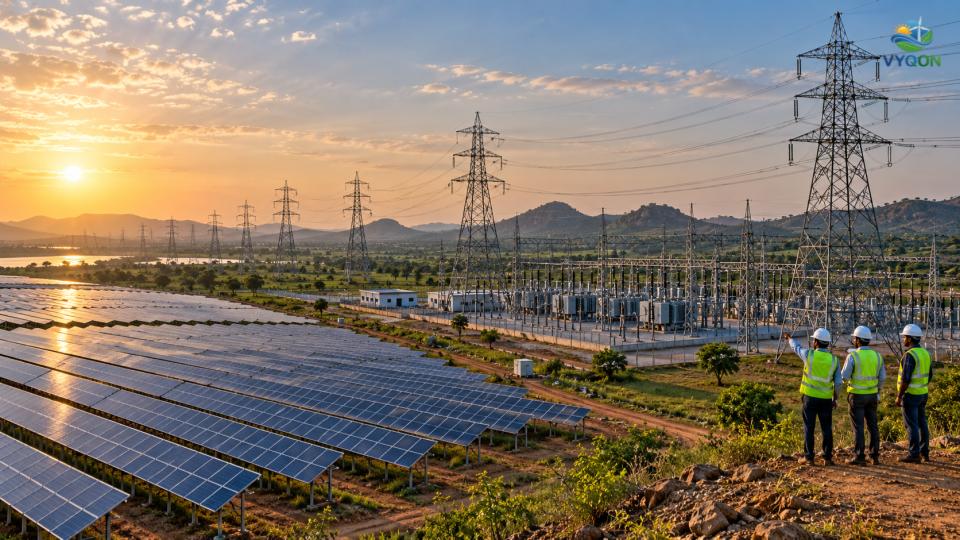
The Ministry’s Section 164 orders advance dedicated transmission infrastructure for SAEL Industries’ 300 MW solar project in Andhra Pradesh and Waaree Forever Energies’ proposed 700 MW development in Maharashtra, supporting grid connectivity for large-scale renewable energy projects.
New Delhi, 8 October 2026: India’s Ministry of Power has granted statutory authorisations for the development of dedicated electricity transmission lines associated with two solar power projects having a combined generation capacity of 1,000 MW (1 GW).
The authorisations, published in the Gazette of India on 7 October 2026, cover transmission infrastructure for SAEL Industries Limited’s 300 MW solar project in YSR Kadapa district, Andhra Pradesh, and Waaree Forever Energies Private Limited’s proposed 700 MW solar project in Solapur district, Maharashtra.
Issued under Section 164 of the Electricity Act, 2003, the orders grant the developers specified statutory powers for laying and maintaining overhead transmission lines required to connect their projects to the electricity transmission network.
The approvals represent an important regulatory milestone in developing the infrastructure necessary to evacuate electricity from utility-scale solar power installations.
However, these authorisations relate specifically to transmission-line development. They do not, by themselves, confirm that the associated solar generation capacity has been commissioned or that the transmission lines are ready for commercial operation.
SAEL Industries Receives Authorisation for 300 MW Solar Project in Andhra Pradesh
The Ministry of Power issued Order S.O. 5471(E), dated 5 October 2026, granting SAEL Industries Limited powers under Section 164 for the development of an overhead transmission line associated with its 300 MW solar project in Andhra Pradesh.
The transmission scheme will connect SAEL’s generation pooling station at Diguva Kalvatala village in Peddamudium mandal, YSR Kadapa district, to the Kurnool-III pooling station of the Inter-State Transmission System (ISTS).
The notified line will operate at a voltage level of 220 kV and have an approximate route length of 26.5 kilometres.
The connection is designed as a 220 kV single-circuit transmission line supported by double-circuit and multicircuit towers.
According to the notification, approximately 1–2 kilometres of the line near the Kurnool-III pooling station will use multicircuit tower structures.
The route passes through areas of YSR Kadapa and Nandyala districts, including Diguva Kalvatala, Kallutla, Jangalapalle, Bestavemula and Erragudi.
The Ministry had previously granted approval for the overhead transmission scheme under Section 68(1) of the Electricity Act on 20 January 2025.
Following the required public-notice process, SAEL submitted an affidavit dated 12 June 2026 stating that no observations or representations had been received within the prescribed period.
The latest Section 164 order provides the statutory authorisation needed to support further implementation of the transmission infrastructure.
Waaree Forever Energies Secures Transmission Authorisation for 700 MW Solar Project
In a separate notification, the Ministry of Power granted authorisation to Waaree Forever Energies Private Limited (WFEPL) for transmission infrastructure associated with its proposed 700 MW solar power project in Maharashtra.
The approval was issued through Order S.O. 5477(E), dated 6 October 2026.
The transmission scheme involves the development of a 400 kV single-circuit overhead line on double-circuit towers, with an approximate length of 21 kilometres.
The line will connect:
- Starting point: WFEPL’s generation switchyard at Salgar village, Akkalkot taluka, Solapur district.
- Termination point: RGESL PSS4 generation switchyard at Konhali village, Akkalkot taluka, Solapur district.
- Transmission voltage: 400 kV.
- Line configuration: Single circuit on double-circuit tower structures.
- Approximate route length: 21 km.
- Associated solar project capacity: 700 MW.
The transmission route will pass through several locations in Akkalkot taluka, including Salgar, Konhali, Akkalkot, Jeur, Hasapur and other surrounding villages.
Earlier project-notice material described the transmission infrastructure as being designed to evacuate at least 700 MW of electricity from the proposed solar development.
The Ministry had granted prior approval for the transmission scheme under Section 68(1) on 9 December 2025.
Following the publication of public notices, Waaree Forever Energies reported that one observation or representation had been received and subsequently examined, responded to and resolved.
The latest authorisation enables the developer to proceed with the transmission works in accordance with the applicable statutory conditions.
The 400 kV configuration is suited to transmitting large amounts of electricity over significant distances while limiting current and associated transmission losses compared with lower-voltage arrangements under otherwise comparable conditions.
Understanding Section 164 of the Electricity Act, 2003
Section 164 of the Electricity Act, 2003 provides a legal mechanism through which the government may confer specified powers upon authorised entities for the development of electricity transmission infrastructure.
Under the two notifications, the Ministry of Power has granted the developers powers corresponding to those historically exercised by a telegraph authority under the Indian Telegraph Act, 1885, for placing transmission lines and associated structures.
These powers can facilitate the construction and maintenance of overhead transmission infrastructure, particularly where transmission routes cross multiple land parcels and public infrastructure.
However, Section 164 authorisation does not eliminate other statutory requirements.
Both project developers must comply with conditions specified in their respective notifications.
These include obtaining necessary consents from relevant authorities, such as local bodies, railway authorities, National Highways and State Highways authorities, wherever applicable.
The developers must also comply with the relevant regulations and technical codes governing transmission infrastructure, operation, maintenance and electricity-system connectivity.
In addition, the lines may be operated only after obtaining the required approval from the Electrical Inspector or Chief Electrical Inspector of the Central Government.
Applicable clearances from authorities such as Civil Aviation and Defence must also be submitted to the Central Electricity Authority as required during the electrical inspection process.
Both Section 164 authorisations have been granted for a period of 25 years.
This is the validity period of the transmission authorisations and should not be interpreted as confirmation of the power purchase agreement duration for either solar project.
Why Transmission Infrastructure Is Critical for Solar Power Development
Solar power generation requires a reliable electrical transmission network to deliver electricity from the generating facility to the authorised grid connection point.
A utility-scale photovoltaic project generally includes solar modules, inverters, step-up transformers, electrical collection systems, a generation switchyard and associated protection and communication equipment.
Electricity generated by solar modules is converted from DC to AC through inverters before being collected and stepped up to an appropriate transmission voltage.
The electricity is then transferred through dedicated transmission lines to the designated receiving substation or grid connection point.
For large solar projects, timely completion of this infrastructure is essential.
Even if installation and testing of solar modules and inverters are completed, a project may be unable to export its full generation capacity if transmission lines, substations or interconnection facilities are not ready.
Such delays can affect project commissioning schedules, electricity supply commitments and overall project economics.
Therefore, solar project developers must coordinate the construction of generation infrastructure and transmission facilities to ensure that both systems are technically and operationally ready.
The latest Ministry of Power orders represent progress in this process for the associated SAEL and Waaree solar developments.
Engineering Requirements for 220 kV and 400 kV Transmission Lines
High-voltage electricity transmission systems require extensive engineering, planning and safety assessments before construction and operation.
The major activities typically include route surveying, tower-location selection, foundation construction, tower erection, conductor stringing and electrical testing.
Transmission-line design must account for conductor capacity, voltage regulation, electrical clearances, mechanical loading and environmental conditions.
For SAEL’s project, the planned 220 kV line will connect the generating facility to the Kurnool-III pooling station.
For Waaree Forever Energies, the planned 400 kV line will connect its generation switchyard to the RGESL PSS4 generation switchyard.
Using higher transmission voltages generally reduces the current required to transfer a given amount of electrical power, which can reduce resistive losses in transmission conductors.
However, the final engineering design must consider conductor selection, tower configuration, insulation requirements, system protection and overall network compatibility.
The use of double-circuit towers does not necessarily mean that two electrical circuits will initially be installed or operated.
In both notified schemes, the transmission configuration is described as a single circuit, with tower structures selected according to project and route requirements.
Before energisation, protection systems, communication arrangements, metering infrastructure and electrical equipment must be tested to ensure safe and reliable operation.
Transmission Readiness Supports India’s Renewable Energy Expansion
India’s ongoing renewable energy expansion requires substantial investment not only in electricity generation but also in transmission and grid-interconnection infrastructure.
New solar power projects are frequently developed in regions with strong solar resources, while electricity demand may be concentrated in distant industrial and urban centres.
A reliable transmission network is therefore essential for delivering renewable electricity from generation sites to consumers.
Dedicated transmission lines allow large solar installations to connect with pooling stations and the wider electricity transmission system.
Timely implementation of these connections can improve project execution by reducing the risk of completed generating capacity remaining unable to export electricity.
The SAEL and Waaree schemes together are associated with 1 GW of solar generation capacity across Andhra Pradesh and Maharashtra.
This figure represents the combined capacity of the two solar developments covered by the transmission authorisations, rather than additional commissioned capacity announced by the Ministry.
The authorisations also provide greater clarity on the notified transmission routes, helping developers plan construction activities and coordinate with grid authorities.
As India’s renewable energy portfolio grows, alignment between generation projects and transmission readiness will remain essential for improving renewable energy utilisation.
Land Access, Regulatory Compliance and Project Execution
Overhead electricity transmission lines frequently cross agricultural land, roads, existing utility corridors and other developed or undeveloped areas.
Careful route planning and coordination with affected communities are therefore important for project implementation.
Although Section 164 provides statutory powers for transmission development, developers must continue to comply with applicable legal requirements relating to land access, compensation and safety.
Transmission construction can also involve temporary disturbances during tower foundation work, transportation of construction materials and conductor stringing.
Effective project management should therefore include appropriate safety measures, communication with landholders and coordination with local authorities.
From an operational perspective, transmission infrastructure will require periodic inspections and maintenance after commissioning.
Activities may include monitoring tower foundations, checking insulators, inspecting conductor connections, managing vegetation and responding to electrical faults.
For solar projects, reliable transmission availability is especially important because an outage on a dedicated evacuation line may restrict electricity export even when the generating equipment is functioning normally.
Maintaining coordination between generation operators and transmission maintenance teams can help minimise avoidable interruptions.
Conclusion
The Ministry of Power’s latest Section 164 authorisations represent a regulatory milestone for transmission infrastructure associated with 1 GW of solar power developments in Andhra Pradesh and Maharashtra.
The approvals cover SAEL Industries’ 300 MW solar project, supported by a proposed 220 kV transmission line of approximately 26.5 km, and Waaree Forever Energies’ proposed 700 MW solar project, supported by a 400 kV transmission line of approximately 21 km.
Both authorisations are valid for 25 years and remain subject to applicable regulatory, technical and electrical safety requirements.
Importantly, the orders authorise specified transmission works; they do not establish that the associated 1 GW of solar generation has newly entered commercial operation.
Their significance lies in advancing the infrastructure required to connect large renewable energy projects to the electricity network.
As India expands its solar generation portfolio, timely completion of transmission lines, substations and grid-interconnection facilities will remain critical for converting project development into reliable electricity supply.
Reference:
Ministry of Power – SAEL Industries- https://egazette.gov.in/WriteReadData/2026/276906.pdf
Ministry of Power – Waaree Forever Energies- https://egazette.gov.in/WriteReadData/2026/276907.pdf
Leave a Comment