
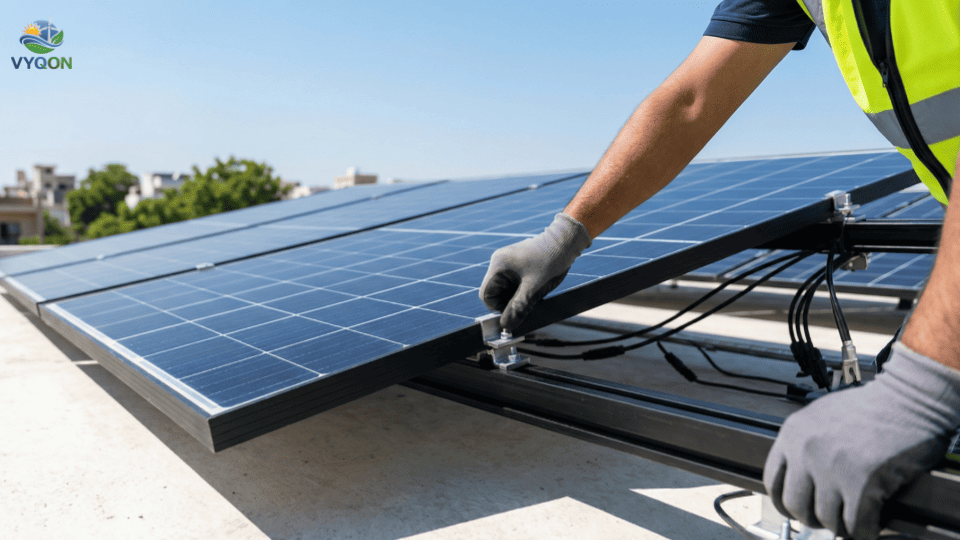
MNRE Announcement
The Ministry of New and Renewable Energy (MNRE) has implemented a strategic provision under the “Give It UP” mechanism of the PM Surya Ghar: Muft Bijli Yojana. This update provides residential consumers the flexibility to voluntarily forgo Central Financial Assistance (CFA)—the government subsidy—in exchange for the authorization to install non-Domestic Content Requirement (DCR) solar modules. This transition is facilitated through the scheme’s National Portal, allowing applicants to bypass domestic supply constraints to achieve faster project commissioning.
Analyst’s Note: Strategic Rationale This policy serves as a critical “pressure-valve” for the Indian solar market. Currently, nearly 80–90% of domestic DCR cell and module manufacturers have pivoted toward the U.S. export market, where profit margins reach 50%—double that of the domestic sector. This has resulted in a significant DCR supply crunch, threatening the government’s target of 1 crore household installations by March 31, 2027. By enabling the “Give It UP” path for non-DCR modules, the MNRE is ensuring that the program’s momentum is not derailed by manufacturing export priorities.
Understanding the “Give It UP” Mechanism
The “Give It UP” feature operates as a definitive choice within the National Portal (pmsuryaghar.gov.in). Its primary function is to allow consumers to prioritize technology choice and installation speed over financial incentives.
The timing and finality of this decision are crucial:
- Irreversibility for Non-DCR Applications: Once a consumer confirms an installation on the portal without submitting a DCR certificate, the “Give It UP” status is triggered. This decision is final and cannot be reverted to claim a subsidy.
- Flexibility for DCR Applications: In contrast, applications originally submitted with a valid DCR certificate retain the option to modify their subsidy preferences until the final e-token redemption stage.
Technical Distinction: DCR vs. Non-DCR Modules
The distinction between these categories is governed by stringent manufacturing and eligibility criteria as outlined in the table below:
| Feature | DCR Modules | Non-DCR Modules |
| Origin | Manufactured entirely within India. | Imported from global hubs (e.g., China, Malaysia, Vietnam). |
| Subsidy Eligibility | Eligible for CFA (up to ₹78,000 for systems \geq 3 kW). | Ineligible; consumer must forgo/forfeit all CFA. |
| Cell & Module Requirements | Both solar cells and modules must be manufactured in India. | Can utilize global standard cells manufactured outside India. |
| Technology Availability | Typically standard domestic crystalline modules. | Advanced tech: Bifacial and half-cut designs offering higher wattage-per-area. |
Operational Steps via the National Portal
Residential consumers choosing to forgo the subsidy to utilize imported or high-efficiency non-DCR modules must follow these steps:
- Portal Access: Log in to the official National Portal at pmsuryaghar.gov.in.
- Option Selection: Locate the “Give It UP” button within the consumer profile to indicate the intent to forgo CFA.
- Application Submission: Submit the installation details directly without attaching a DCR certificate. This specific action confirms the non-DCR status of the project.
- Final Confirmation: Confirm the installation for subsequent DISCOM inspection. Once confirmed without the DCR certificate, the decision is irreversible.
Target Audience and Market Context
The “Give It UP” provision is specifically beneficial for three primary consumer segments:
- Technology Enthusiasts: Users seeking high-performance modules (e.g., N-type TOPCon, bifacial, or half-cut) that offer superior efficiency but are currently scarce in the DCR-compliant domestic market.
- Time-Sensitive Applicants: Homeowners facing project stagnation due to the “DCR premium” supply crunch. For these users, the value of immediate energy savings outweighs the wait for domestic stock.
- Commercial/High-Usage Residential Users: For users with high electricity consumption, the Return on Investment (ROI) math is shifting.
- The ROI Factor: DCR-compliant modules currently command a “DCR Premium” of approximately ₹12 per watt. For a standard 3 kW system, this equals an additional upfront cost of ₹36,000. While forgoing the ₹78,000 subsidy (for \geq 3 kW systems) represents a significant loss, the combination of lower-cost imported modules and the efficiency gains of advanced technology can lead to faster long-term savings in high-tariff slabs.
Scheme Framework and Regulatory Compliance
While the “Give It UP” provision offers flexibility regarding DCR, it does not exempt stakeholders from broader regulatory mandates:
- ALMM Compliance: Even if a consumer opts out of the subsidy, the solar modules used must still be sourced from the Approved List of Models and Manufacturers (ALMM). This ensures that only high-quality, regulated equipment is integrated into the national grid.
- Implementation Timeline: All claims and installations under the PM Surya Ghar framework must be completed by the scheme’s sunset date of March 31, 2027.
Technical Benchmarks and Cost Data
Regardless of the module type selected, all installations under the PM Surya Ghar framework must adhere to the following technical and financial benchmarks:
- Estimated Non-DCR Module Costs (2025):
- Polycrystalline: ₹20–₹25 per watt.
- Monocrystalline: ₹25–₹30 per watt.
- Bifacial: ₹28–₹35 per watt.
- Performance Standards: All modules must meet the quality standard of >90% nominal power output for the first 10 years and >80% for the subsequent 15 years.
- Maintenance Mandate: All systems, whether DCR or Non-DCR, must be covered by a 5-year Comprehensive Maintenance Contract (CMC) provided by the registered vendor. This includes the free replacement of non-performing components during the warranty period.
Leave a Comment