
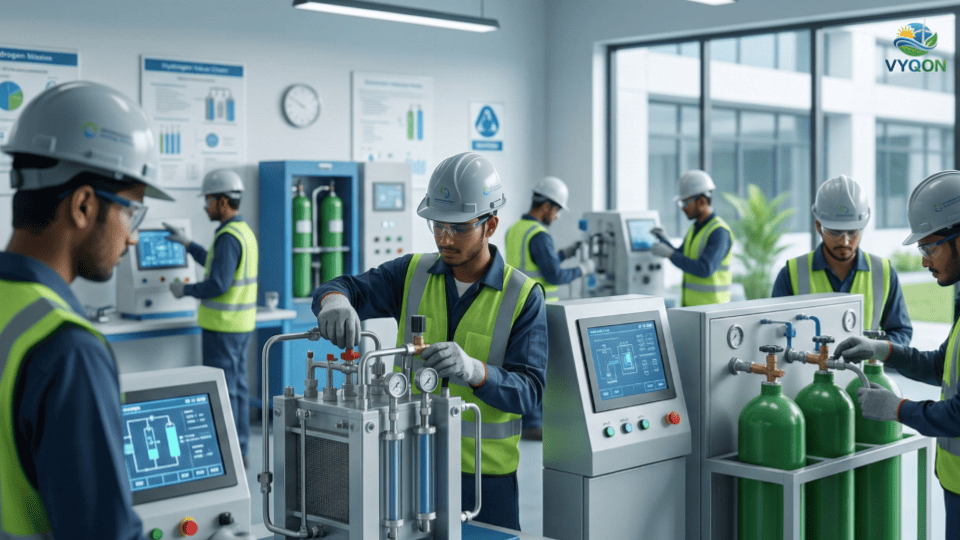
The Ministry of New and Renewable Energy (MNRE) has officially invited proposals from States and Union Territories to implement comprehensive skilling, upskilling, and reskilling programs. This initiative represents a core workforce development component of the National Green Hydrogen Mission (NGHM), aimed at securing the technical expertise required for India’s emerging hydrogen economy.
Strategic Objectives and Workforce Targets
The initiative is designed to align with the Strategic Interventions for Green Hydrogen Transition (SIGHT) program and India’s goal of producing 5 million metric tonnes (MMT) of green hydrogen annually by 2030. Key strategic targets include:
- Financial Allocation: A total outlay of ₹35 crore (₹350 million) has been designated for skilling activities through the year 2030.
- Workforce Goal: The mission aims to train 600,000 professionals by 2030. This builds upon the foundation laid by the Skill Council for Green Jobs (SCGJ), which has already trained over 615,000 individuals and certified 582,579 candidates across various green energy sectors.
- International Synergy: The program integrates with international efforts such as the India-Australia Renewable Energy Partnership (REP), launched in November 2024, which includes a commitment to train 2,000 young Indian technicians in specialized solar PV and hydrogen technologies.
- Value Chain Focus: Capacity building targets the full hydrogen lifecycle, including electrolysis-based production, storage, specialized transportation, and safety protocols.
Technical Training Pathways and Qualification Packs
Training costs and standards are governed by PMKVY 4.0 norms. The initiative utilizes specific National Skills Qualification Framework (NSQF) levels and Qualification Packs (QPs) to standardize technical expertise.
| Training Component | Duration/Scope | Target Audience | Key Features |
| Short-Term Training (STT) | 200 to 600 hours | New entrants (Aged 18–45) | Includes QPs like Green Hydrogen Plant Technician (420 hours) and Plant Entrepreneur (480 hours); mandatory On-the-Job Training (OJT). |
| Recognition of Prior Learning (RPL) | 30 to 132 hours | Existing workers (Aged 18–50) | Formal certification for current professionals; includes modules such as Fundamentals of Financing for Green Hydrogen Projects (30 hours). |
| Long-Term/Institutional | Curriculum-based | Schools, ITIs, Polytechnics, HEIs | Integration of hydrogen-specific NSQF curriculum into formal education; faculty capacity building. |
Establishment of Centres of Excellence (CoE)
The MNRE plans to establish up to five national-level Centres of Excellence to serve as technical knowledge hubs. These centers are subject to the following functional and financial requirements:
- Financial Support: Maximum funding is capped at ₹10 million per CoE, covering 70% of project costs (excluding land and buildings).
- Performance KPIs: Each CoE must train at least 500 candidates annually and maintain a functional duration of five years.
- Operational Role: CoEs are responsible for developing advanced hydrogen labs, designing high-level course content, and fostering industry partnerships to ensure training remains technology-current.
Implementation Framework and Eligibility Criteria
The administrative framework distinguishes between different mission components. While the Solar Energy Corporation of India (SECI) handles Detailed Project Reports (DPRs) for Green Hydrogen Hubs, the National Skill Development Corporation (NSDC) has been notified as the Scheme Implementing Agency (SIA) for the skilling component.
- Eligible Project Implementing Agencies (PIAs): State Renewable Energy Departments, Skill Development Missions, ITIs, and private firms. Private entities must have at least three years of legal existence and one year of proven experience in the hydrogen value chain.
- Financial Benchmarks: PIAs must demonstrate an annual turnover of at least 25% of the project cost and a positive net worth for the preceding two financial years.
- Digital Monitoring: All candidate progress, certifications, and post-training job placements (monitored for one year) must be tracked via the Skill India Digital (SID) platform.
- Selection Matrix: Proposals are evaluated based on Technical Expertise (30%), Financial Strength (20%), Compliance (20%), Innovation and Technology (20%), and Workforce Commitment (10%).
Submission Process and Guidelines
In accordance with the MNRE guidelines dated March 16, 2024, States and Union Territories must submit proposals that include rigorous workforce demand assessments and institutional readiness audits.
Submissions are coordinated through the Skill India Digital (SID) hub or designated State Nodal Agencies. Applicants should consult the official MNRE and NSDC portals for current submission windows and specific procedural updates. Proposals for technical executing agencies regarding hydrogen hubs remain separate and are managed via SECI’s ISN-ETS portal.
Leave a Comment