
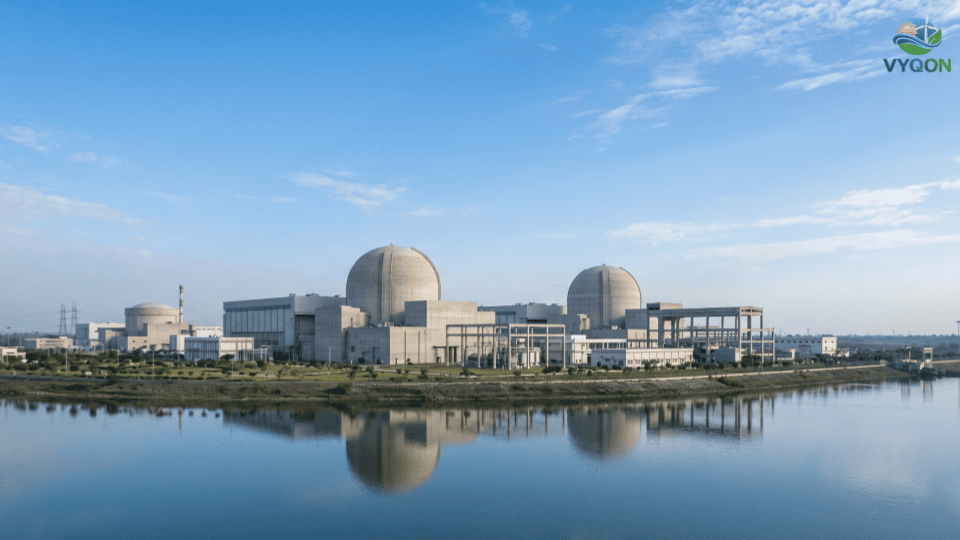
On April 8, 2026, NTPC Limited and Électricité de France (EDF) formalized a non-binding Memorandum of Understanding (MoU) in New Delhi to explore a strategic partnership in the development of large-scale nuclear power projects across India. The agreement was signed by Arnada Prasad Samal, Chief General Manager (Nuclear Cell) for NTPC, and Vakisasi Ramany, Senior Vice President for International Nuclear Development for EDF. The collaboration, which has received prior approval from relevant Indian ministries and government departments, establishes a framework for technical, economic, and operational feasibility assessments.
Strategic Context and NTPC Capacity Targets
This MoU marks a significant strategic pivot for NTPC as it transitions its energy mix away from a primary reliance on coal toward clean, reliable baseload power. Analysts highlight that this move positions NTPC as a central figure in India’s energy transition, with the potential to catalyze an investment of approximately ₹42,000 crore in upcoming nuclear infrastructure.
The agreement aligns with NTPC’s aggressive 2032 growth targets:
- Current operating installed capacity: 89 GW.
- Capacity currently under construction: 32 GW.
- 2032 total capacity target: 149 GW.
- 2032 renewable energy goal: 60 GW.
Technical Pillars of Collaboration
The roadmap for collaboration is structured around five technical pillars designed to mitigate technology and execution risks while maximizing domestic economic impact.
| Focus Area | Objectives/Scope |
| Technology | Comprehensive assessment of EDF’s EPR (Evolutionary Pressurized Reactor) technology and its specific suitability for Indian requirements. |
| Localization | Identifying opportunities to maximize domestic manufacturing and integrate local supply chains for large-scale deployment. |
| Economics | Evaluation of project viability, financial structures, and the formulation of robust tariff frameworks. |
| Infrastructure | Identification and technical evaluation of potential project sites and provision of mutual technical support. |
| Human Capital | Joint development of specialized skill-building and training programs to ensure competency in nuclear operations and maintenance. |
Regulatory and Legal Framework
The partnership leverages a modernized regulatory environment, primarily the Sustainable Harnessing and Advancement of Nuclear Energy for Transforming India (SHANTI) Act 2025. This landmark legislation has significantly opened the sector to private participation, authorizing non-state involvement in plant operations, power generation, equipment manufacturing, and critical niche activities such as nuclear fuel fabrication.
Furthermore, the collaboration will utilize Anushakti Vidhyut Nigam Ltd (Ashvini)—the joint venture created in 2024 between the Nuclear Power Corporation of India Ltd (NPCIL) and NTPC—as the established vehicle for the construction, ownership, and operation of these nuclear assets.
Technical Specifications of EPR Technology
The collaboration centers on the EPR, a Generation 3+ reactor designed to meet the highest international safety and efficiency standards for Light Water Reactors (LWRs).
EPR Technical Summary:
- Reactor Class: 1,600 MWe-class (approx. 1,650 MW net electrical power).
- Efficiency: 37% net efficiency, the highest achieved to date for an LWR.
- Design Generation: Generation 3+.
- Safety Architecture: Four separate, redundant safeguard trains located in physically separated divisions; full “bunkerization” of key buildings provides protection against external hazards, including aircraft crashes and earthquakes.
- Severe Accident Mitigation: Utilizes catalytic hydrogen recombiners and a dedicated corium spreading area featuring sacrificial concrete and passive cooling to protect the containment base mat.
- Design Life: 60-year technical service life.
Operational and Economic Considerations
Historical performance audits from the Kudankulam Nuclear Power Plant (KKNPP) emphasize why the “Economics” and “Human Capital” pillars are central to this MoU. Previous implementations suffered from significant financial setbacks that the NTPC-EDF framework seeks to avoid through “prefixed criteria” and “competency analysis.”
To ensure full economic recovery, the Department of Atomic Energy (DAE) requires the inclusion of several cost components in tariff fixation, such as return on equity, interest on debt, O&M costs, depreciation, fuel recovery, and a decommissioning levy. Technical analysts point to two critical historical failures as catalysts for the current MoU’s structure:
- Revenue Realization Gaps: Ad-hoc and discretionary tariff fixation for “infirm power” at KKNPP led to a revenue short-realization of ₹90.63 crore. The MoU’s focus on economic pillars aims to establish structured, prefixed criteria to prevent such losses.
- Competency and Shutdown Delays: A lack of initial technical competency in refueling resulted in a 162-day delay beyond the planned shutdown at KKNPP Unit I, causing a staggering revenue loss of ₹947.99 crore.
The new agreement specifically addresses these risks by mandating early competency mapping and specialized human capital development to ensure that maintenance and refueling operations do not lead to prolonged, avoidable outages.
The MoU between NTPC and EDF serves as a formal framework for the joint assessment of the feasibility and technical approach for nuclear development. Both parties will now proceed with detailed evaluations to determine the path forward for the integration of EPR technology into India’s national grid.
Leave a Comment