
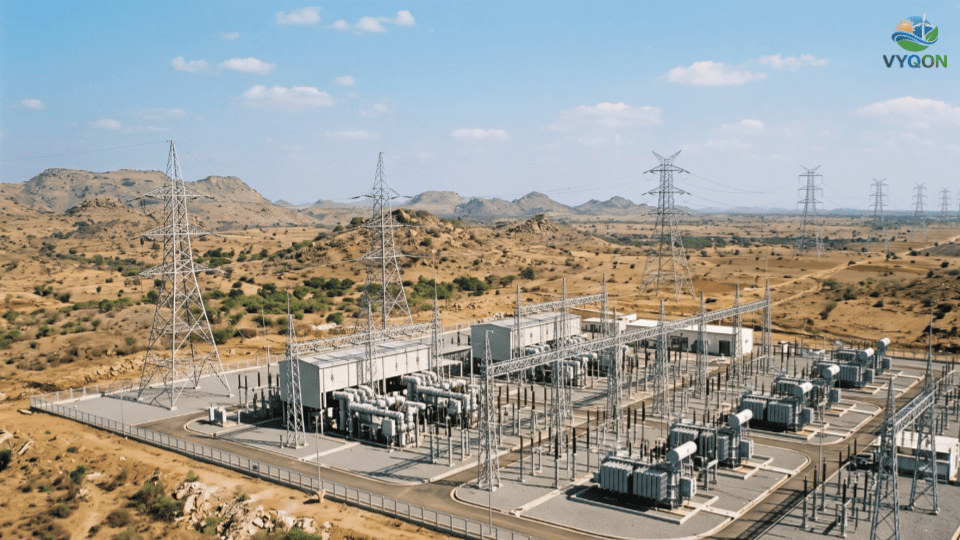
ANDHRA PRADESH, June 2026 — Power Grid Corporation of India Ltd (POWERGRID) has announced the full commissioning of the interstate transmission system (ISTS) scheme dedicated to the Solar Energy Zones (SEZ) in Ananthapuram and Kurnool. Boasting a total power evacuation capacity of 3,500 MW, the project achieved full commercial operation on June 24, 2026. This milestone marks POWERGRID’s first ISTS project won through Tariff-Based Competitive Bidding (TBCB) to be fully commissioned within the 2026-27 fiscal year (FY27).
Project Capacity and Regional Allocation
The transmission infrastructure is strategically designed to integrate large-scale renewable energy into the national grid, facilitating the evacuation of power from two high-concentration solar hubs in the Rayalaseema region. The capacity allocation is as follows:
- Ananthapuram Solar Energy Zone (Anantapur District): 2,500 MW
- Kurnool Solar Energy Zone: 1,000 MW
- Total Scheme Capacity: 3,500 MW
Technical Infrastructure Specifications
The commissioned assets represent a major expansion of the Southern Region’s high-voltage network, centered around a newly established greenfield pooling station.
| Infrastructure Element | Specification Details |
| Total Transmission Lines | 572 circuit kilometers (ckm) of 400 kV lines |
| Pooling Substation (PS) | 400/220kV Ananthapuram PS with 3,500 MVA capacity |
| Substation Configuration | 7×500 MVA Interconnecting Transformers (ICTs) |
| Line Bays | 02 Nos. at Kurnool-III PS; 02 Nos. at Cuddapah PS |
Detailed Line Components and Execution
The project’s 572 ckm network is divided into two primary double-circuit segments, both utilizing high-capacity Quad Moose conductors to maximize throughput.
- Ananthapuram PS – Kurnool III PS Line: This 171 ckm segment was executed by contractor Bajel Projects Ltd. Technical requirements included the erection of 222 high-tension towers and the complex management of 15 major overhead crossings, all completed under rigorous safety protocols to ensure grid stability.
- Ananthapuram PS – Cuddapah Line: Covering 371 ckm, this larger segment represents a significant engineering undertaking within the Anantapur and YSR Kadapa districts. Construction of this 400kV D/C Quad Moose line required the installation of approximately 490 foundations and the erection of over 423 towers to bridge the pooling station with the existing regional infrastructure.
Project Ownership and Corporate Restructuring
POWERGRID secured the project on September 27, 2023, under the Tariff-Based Competitive Bidding (TBCB) framework, submitting a winning bid for annual transmission charges of Rs. 1,288.88 million. The project was acquired from the bid process coordinator, PFC Consulting Ltd (PFCCL).
Originally incorporated as a Special Purpose Vehicle (SPV) under the name “Ananthpuram Kurnool Transmission Ltd,” the entity was later renamed “Powergrid Ananthpuram Kurnool Transmission Ltd.” Following a Ministry of Corporate Affairs order, the SPV was amalgamated into “Powergrid Khawda II-C Transmission Ltd” effective March 1, 2026. This restructuring was part of a broader corporate consolidation of POWERGRID’s TBCB subsidiaries.
Implementation Timeline and Operational Status
The scheme achieved full operational status in June 2026, following a phased implementation necessitated by regional construction challenges:
- Original Schedule: September 2025.
- Partial Progress: The 171 ckm Ananthapuram–Kurnool line and the first four 500 MVA ICTs were commissioned between January and March 2026.
- Final Commissioning: Full operation was achieved on June 24, 2026, following the completion of the 371 ckm Ananthapuram PS – Cuddapah line and the remaining three ICTs at the pooling station.
The Notification for Commercial Operation (DOCO) was issued on June 25, 2026, and received on June 26, 2026. The shift from the original September 2025 timeline was primarily attributed to Right-of-Way (RoW) issues encountered in the Anantapur and YSR Kadapa districts.
Current Status
With the full energization of these assets, the project successfully links the Rayalaseema region—a burgeoning hub for Indian renewable energy—to the national grid. The system is now fully operational, providing the robust 3,500 MW capacity required to transfer clean energy from these critical solar zones to load centers across the country.
Leave a Comment