
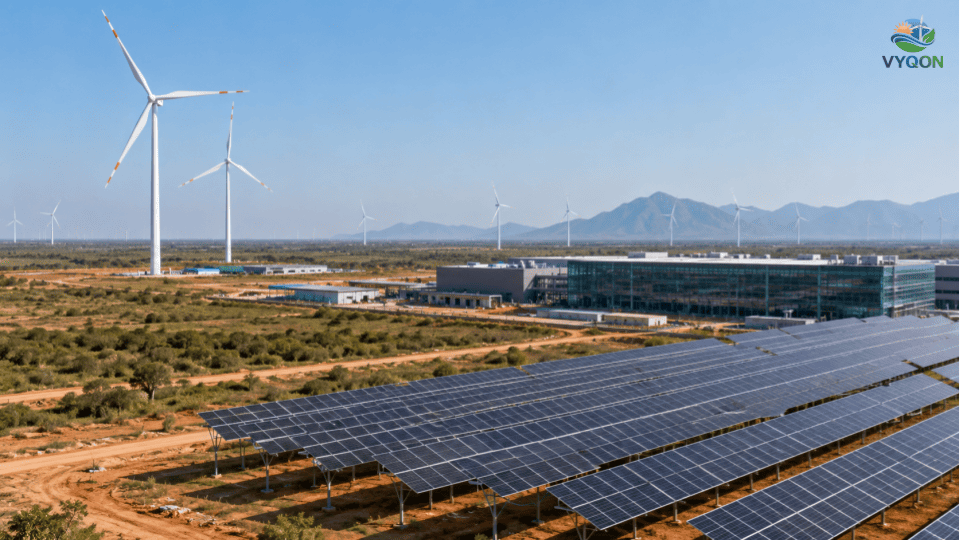
Saint-Gobain India has officially invited bids for the procurement of a long-term renewable power supply to support its extensive manufacturing operations in Tamil Nadu. The project is structured as a wind-solar hybrid initiative to be executed under a group captive framework, targeting power delivery to the company’s glass and industrial manufacturing hubs in Sriperumbudur, Perundurai, and Tiruvallur, including the high-capacity Oragadam plant. Prospective developers and Qualified Co-ordinating Agencies (QCAs) must submit their definitive bids by the deadline of July 18, 2026.
Project Specifications and Structural Framework
The initiative utilizes the “Group Captive” model, which has become the dominant strategy for large-scale industrial decarbonization in India. Under this framework, Saint-Gobain India will act as the Anchor Consumer within a Special Purpose Vehicle (SPV). To qualify for the legal benefits of this model, the project must adhere to the “26/51 Rule” mandated by Rule 3 of the Electricity Rules 2005:
- Equity Requirement: Captive consumers must collectively hold at least 26% of the equity in the SPV.
- Consumption Threshold: The equity-holding consumers must utilize at least 51% of the annual energy generated by the facility.
The transition to a “Wind-Solar Hybrid” configuration is a strategic response to the operational demands of 24/7 glass manufacturing. Unlike standalone solar or wind, a hybrid model provides superior load profile matching. Wind’s typical nocturnal peak complements solar’s diurnal peak, which significantly reduces the reliance on the grid and minimizes “banking leakage.” For Saint-Gobain, this structure facilitates a more stable power flow and allows for a significant financial advantage: the legal waiver of the Cross Subsidy Surcharge (CSS), which often constitutes a major portion of the landed cost of third-party power.
Site Scope and Industrial Demographics
The procurement targets Saint-Gobain’s critical manufacturing landscape in Tamil Nadu. These facilities are energy-intensive hubs where stable power is essential for glass furnace operations. Recent regulatory filings indicate that the Oragadam facility will be a primary beneficiary of this long-term procurement strategy as the company seeks to hedge against rising DISCOM tariffs, which currently range between ₹8–10/kWh.
The following table details the operational and regulatory landscape for this transition:
| Component | Detail |
| Primary Region | Tamil Nadu |
| Facility Focus | Glass and Industrial Manufacturing |
| Project Type | Off-site Wind-Solar Hybrid |
| Regulatory Framework | TNERC Green Energy Open Access (2025/2026) |
| Loss Factor | 8–11% (Estimated Transmission/Wheeling) |
The Tamil Nadu Regulatory Environment (TNERC 2026)
Bidders must navigate a tightened regulatory environment under the latest Tamil Nadu Electricity Regulatory Commission (TNERC) guidelines. These rules introduce “in-kind” deductions and accounting granularities that directly impact project sizing. Because banking charges and transmission losses are deducted physically—meaning less energy arrives at the meter than was generated—developers must accurately over-size the project capacity to meet Saint-Gobain’s net energy requirements.
Critical operational constraints under the 2026 framework include:
- In-Kind Banking Charges: An 8% “in-kind” charge is applicable to energy generated from hybrid projects. This is a physical deduction of units.
- TOD Banking Restrictions: Time-of-Day (TOD) restrictions now mandate that energy generated during “Normal” or “Off-peak” zones can only be adjusted against consumption within those same respective zones.
- Settlement Cycles: Banking settlement is mandatory on a monthly billing cycle. Any surplus unutilized energy at the end of the month is settled by the Distribution Licensee at only 75% of the applicable RE tariff.
- Accounting Granularity: Energy accounting is conducted on strict 15-minute time block settlement cycles.
- Forecasting Discipline: TNERC enforces permissible deviation-free bands of 10% for wind, 5% for solar, and 7% for hybrid systems to maintain grid stability.
Bidding Timeline and Requirements for Interested Parties
The final date for bid submission is July 18, 2026. Prospective developers must demonstrate a robust plan for managing the technical interface with the State Load Despatch Centre (SLDC).
Requirements for QCAs and Developers:
- QCA Appointment: Bidders must appoint a Qualified Co-ordinating Agency to handle forecasting and scheduling.
- Regulatory Categorization: QCAs must be registered under the new TNERC categories: “State-wide Wind,” “State-wide Solar,” or “PSS-wise” (Pooling Sub-Station) QCAs.
- Deviation Settlement: Bidders must adhere to the deviation settlement framework. Failure to comply or to appoint a QCA can result in penalties escalating from 150% to 200% of standard charges, with persistent defaults leading to potential grid disconnection.
Analytic Summary: Landed Cost and Savings Potential
Saint-Gobain’s move into group captive hybrid power reflects a broader market trend where industrial consumers transition away from third-party PPAs to achieve deeper savings. By fulfilling the equity and consumption mandates, the company effectively bypasses the Cross Subsidy Surcharge, achieving a net savings of approximately ₹2–3/kWh compared to the standard grid rate.
The following table compares the projected landed costs:
| Cost Component | DISCOM Grid (HT) | Third-Party PPA | Group Captive (Hybrid) |
| Energy Charge | ₹7.20–8.50 | ₹3.50–4.00 | ₹3.00–3.50 |
| CSS & Addl. Surcharge | Included | ₹1.25–2.00 | Exempt (₹0) |
| Wheeling & Transmission | Included | ₹0.90–1.10 | ₹0.75–0.95 |
| Banking & Losses (In-Kind) | N/A | High Leakage | ~18% Physical Deduction |
| Landed Cost (Estimated) | ₹8.00–10.00 | ₹5.50–7.00 | ₹4.00–5.00 |
While the “in-kind” deductions for banking (8%) and transmission losses (8–11%) require additional capital expenditure to over-size the plant, the elimination of the CSS provides a superior internal rate of return (IRR). This initiative positions Saint-Gobain India to meet its industrial decarbonization targets while securing a long-term hedge against volatile utility tariffs.
TENDER PORTAL: https://www.tenderdetail.com/Indian-tender/saint-gobain-tenders
Official References and Regulatory Sources
For official documentation on Saint-Gobain’s sustainability goals and the regulatory framework governing Group Captive and Open Access projects in Tamil Nadu, please refer to the following institutions:
- Saint-Gobain Group (Global): Official Website and Sustainability News
- Tamil Nadu Electricity Regulatory Commission (TNERC): Official Portal for State Tariff Orders and Grid Regulations
- Ministry of Power (MoP), Government of India: Electricity Rules 2005 and Policy Frameworks
- Central Electricity Authority (CEA): National Energy Statistics and Compliance Standards
Note for Bidders: While the bid invitation for the Oragadam plant has been announced through industrial news channels, the specific bidding documents and submission portal are typically accessible through Saint-Gobain’s internal procurement system or shared directly with qualified technical partners. Interested parties are encouraged to monitor the official TNERC and Ministry of Power portals for the latest updates on the Electricity Rules 2026 and hybrid project guidelines.
Leave a Comment