
SECI begins land arrangements for 10 MW of pilot capacity
Solar Energy Corporation of India Limited has published a notice for arranging approximately 20 acres of agricultural land near Issapur and Dhansa villages in Najafgarh, Delhi. The land is intended for two pilot Agri-PV projects of 5 MW each, creating a combined planned capacity of 10 MW in the Delhi-NCR region. SECI identifies itself as the project owner and proposes to obtain government or private land through lease or sublease arrangements.
The notice requires a minimum of 10 acres for each 5 MW project. Eligible participants will include landowners and land aggregators, with lease rates expressed in rupees per acre per year and aligned with prevailing government land policy. SECI indicated that detailed bidding documents were likely to become available from 3 September 2026 onwards. The land would be provided on a long-term lease for at least 27 years, extendable by mutual consent.
What makes an Agri-PV project different
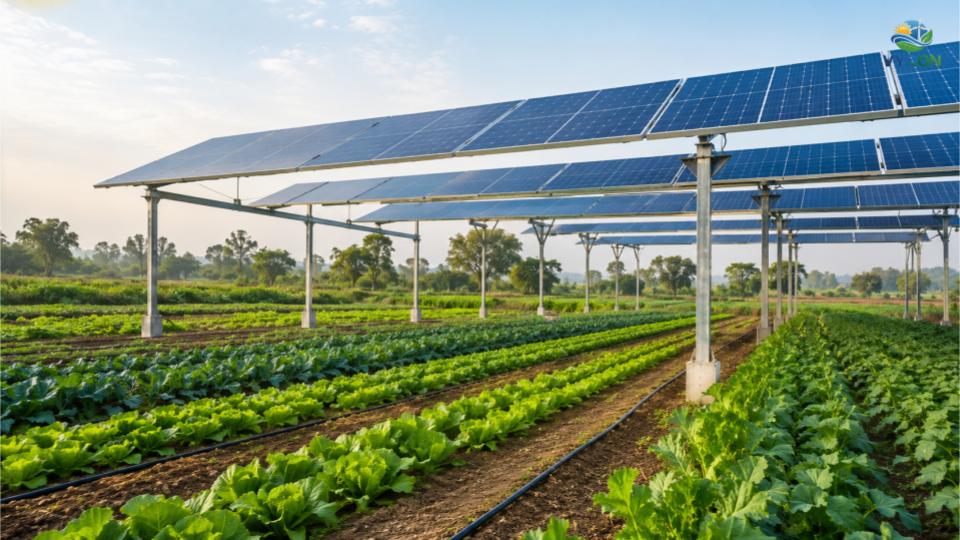
Agri-PV, also known as agrivoltaics, is the planned use of the same land for both agricultural production and solar electricity generation. Instead of treating farming and energy as competing land uses, the system is designed so cultivation can continue beneath or between solar structures. Designs may use elevated panels, wider row spacing, crop-specific layouts or controlled access for agricultural machinery.
The concept is simple, but successful implementation requires careful engineering. Panel height and spacing influence shade, rainfall distribution, wind loading, cleaning access and the movement of workers or equipment. Crop selection matters because different plants respond differently to partial shade and changes in soil moisture. A pilot project is therefore valuable only if it measures both electrical output and agricultural performance rather than considering megawatts alone.
Land and infrastructure requirements in SECI’s notice
SECI’s notice states that the land should be level or gently sloping, suitable for solar mounting structures and agricultural activity, and capable of supporting seasonal crops. The soil should not be waterlogged. The land must also be free from legal disputes, mortgages and acquisition notices. Approach-road access is required, along with proximity to distribution infrastructure rated at 11 kV or higher.
These conditions show why land selection is more complex than simply finding an open parcel. A site must have a clear title for a multi-decade lease, sufficient grid access, suitable soil, manageable topography and practical access for construction and farming. If any one element is weak, project costs or timelines can rise. For Agri-PV, agricultural suitability remains part of the engineering requirement rather than an activity added after the solar design is complete.
Why Delhi-NCR is an interesting test location
Land near a major urban region is valuable and subject to competing uses. This makes Delhi-NCR a meaningful place to test whether distributed or peri-urban solar can coexist with productive agriculture. Electricity can be generated close to demand centres, potentially reducing the distance between generation and consumption, while farmers or landowners may receive long-term lease income.
The location also presents challenges. Dust, high summer temperatures, monsoon conditions, land fragmentation and local development pressure can influence performance. Agricultural cycles must be coordinated with construction and maintenance. The project design will need to protect worker safety around electrical equipment while maintaining usable access to crops.
Questions the pilots should answer
The most useful outcome will be evidence that can guide future projects. SECI and project partners should be able to compare crop yield, water use, soil condition and farm income before and after installation. They should also measure solar generation, module temperature, cleaning requirements, structure costs and maintenance access. Different crops or panel arrangements could produce different results.
Commercial questions are equally important. The pilots can test how lease payments are structured, how agricultural responsibilities are assigned, who bears crop-loss risk, how farmers access the site and what happens when farming or solar maintenance temporarily restricts the other activity. Clear contracts will be as important as the physical layout.
Potential value for India’s solar expansion
India needs large quantities of land for renewable-energy growth, but land is also essential for food production, livelihoods, biodiversity and urban development. Agri-PV will not remove every land conflict and will not suit every crop or region. It can, however, expand the range of locations where solar is possible if agricultural production remains genuinely viable.
For farmers, the model may offer more stable land-related income alongside crop revenue. For developers, it may open sites that would otherwise face resistance to complete conversion. For governments, it creates an opportunity to combine clean-energy targets with rural-development objectives. These benefits must be demonstrated through transparent performance data, not assumed from the project label.
Conclusion
SECI’s plan for two 5 MW pilots is small compared with India’s utility-scale solar pipeline, but its policy value could be much larger than its capacity. The projects can provide practical information about land leasing, crop compatibility, structural design, grid connection and stakeholder participation near a dense urban market. The immediate next step is the detailed tender expected from September 2026. The longer-term test will be whether the projects produce credible agricultural and energy results that can be repeated in other parts of India.
Original documents and references
Source 1: Official SECI notice PDF
Source details: This is the original notice document. It sets out the approximate 20-acre requirement, two 5 MW pilot projects, minimum parcel size, land conditions, grid proximity and proposed long-term lease framework.
Direct page link: https://www.seci.co.in/uploads/news/1787662968_NIT_for_land_Arrangements_for_Agro-PV_Project_in_Delhi.pdf
Source 2: Official SECI press-release page
Source details: SECI’s official press-release page confirms the notice title and publication date and provides the organisation’s public announcement route for the Agri-PV proposal.
Direct page link: https://www.seci.co.in/press-release
Source 3: Official SECI latest-news listing
Source details: The official news index records the announcement as a press release dated 25 August 2026 and helps readers verify it against SECI’s current publication list.
Direct page link: https://www.seci.co.in/latest-news
Leave a Comment