
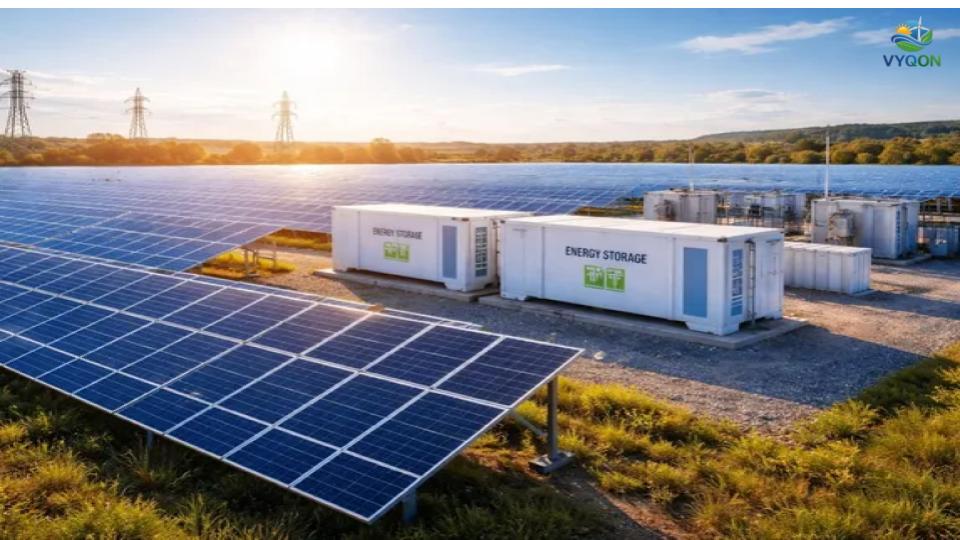
Japan’s Sumitomo Corporation has agreed to invest in a large-scale hybrid renewable energy project being developed by Hero Future Energies (HFE), the renewable energy arm of India’s Hero Group, in Bidar district, Karnataka. The project combines approximately 500 MWp of solar and wind generation capacity with a co-located 200 MWh battery energy storage system (BESS), and is designed to supply electricity around the clock using only renewable sources.
Both companies announced the transaction on 5 October 2026. Commercial operation of the project is planned for March 2027.
Deal structure
Sumitomo Corporation will acquire a 49% stake in Clean Solar Power (Baniyana) Pvt. Ltd., the special purpose vehicle (SPV) undertaking the project. The remaining 51% will stay with Hero Solar Energy Pvt. Ltd., an HFE subsidiary, keeping HFE as the majority owner and developer.
Nomura served as financial advisor to HFE on the transaction. Neither company has disclosed the transaction value or the total project cost.
Project at a glance
| Parameter | Details |
| Project company | Clean Solar Power (Baniyana) Pvt. Ltd. |
| Location | Bidar district, Karnataka |
| Generation capacity | Approx. 500 MWp (solar + wind combined) |
| Battery storage | 200 MWh, co-located |
| Offtaker | SJVN Limited (primary); surplus to power exchange |
| PPA tenure | 25 years |
| Scheduled COD | March 2027 (planned) |
| Shareholding | HFE, via Hero Solar Energy Pvt. Ltd. (51%); Sumitomo Corporation (49%) |
Offtake and revenue model
Electricity from the project will be sold primarily to SJVN Limited, a Government of India-owned power company, under a 25-year power purchase agreement (PPA). Some surplus generation will be sold on the power exchange market.
This structure gives the SPV long-term contracted revenue from a state-owned counterparty while leaving room to monetise energy produced above contracted volumes. For a foreign strategic investor, a central public sector offtaker and a quarter-century contract term substantially reduce counterparty and revenue risk.
Why combine solar, wind and storage
Solar generation is limited to daylight hours, while wind output varies with weather and season. According to Sumitomo, pairing two sources with different generation profiles and adding battery storage helps offset fluctuations caused by weather and time of day, enabling a continuous supply.
The BESS can store surplus energy during high-generation periods and discharge it when output from both sources falls. This gives the plant a firmer, more predictable supply profile than a standalone solar or wind project. The same design logic underpins HFE’s wider pipeline of hybrid, peak-power and firm and dispatchable renewable energy (FDRE) projects.
Strategic significance
For Sumitomo, the investment deepens an existing India renewables strategy. In September 2024, the company formed AMPIN C&I Power Pvt. Ltd. with AMPIN Energy Transition to supply renewable power to corporate customers, as part of a green power platform spanning generation to direct supply. The Bidar project extends that presence into utility-scale, storage-backed supply.
Jun Minase, General Manager of Sumitomo’s Overseas Energy Solution Strategic Business Unit, said the company sees significant potential in HFE’s growth ambitions as renewables take a rapidly rising share of India’s energy mix. He added that the partnership will strengthen Sumitomo’s renewable energy business platform in India. Sumitomo Corporation (TYO: 8053) operates through roughly 500 group companies and offices in more than 60 countries and regions.
For HFE, the deal brings in a strategic co-investor while it retains control. Founder and Chairman Rahul Munjal described the partnership as “an endorsement of HFE’s capabilities to execute complex renewable energy projects at scale.” Global CEO Srivatsan Iyer said it will strengthen HFE’s ability to execute its growing project pipeline.
Established in 2012, HFE reports a global portfolio of 7.7 GWp of renewable energy assets and 2.9 GWh of battery storage across India, Ukraine, Vietnam and the UK, covering operating and under-development projects. The company is backed by the International Finance Corporation (IFC) and KKR, and has commissioned wind and solar projects across seven Indian states.
India context
India’s electricity demand is expected to keep rising with population and economic growth, and the Government of India has set a target of 500 GW of non-fossil fuel-based capacity by 2030. As the share of variable solar and wind grows, the grid increasingly needs renewable supply that is firm and dispatchable rather than intermittent.
HFE noted that India’s renewable sector is attracting growing interest from global strategic and institutional investors. It added that deeper pools of long-term capital are building a stronger foundation for the market’s next phase of growth.
What to watch
With a planned COD of March 2027, the project has roughly five months to reach commercial operation. Several details remain undisclosed in the official announcements: the split between solar and wind capacity, the BESS power rating (MW) and storage duration, the tender under which the SJVN PPA was awarded, the tariff and the project cost. These will show how the plant is configured to meet its round-the-clock supply objective.
Official references
- Sumitomo Corporation: Participation in Large-Scale Renewable Energy Project in India in Partnership with Hero Group (5 October 2026)
- Hero Future Energies: HFE partners with Sumitomo Corporation for a renewable energy project in Karnataka (5 October 2026)
- Sumitomo Corporation: Establishment of AMPIN C&I Power with AMPIN Energy Transition (13 September 2024)
- Hero Future Energies: Company website and portfolio overview
Leave a Comment