
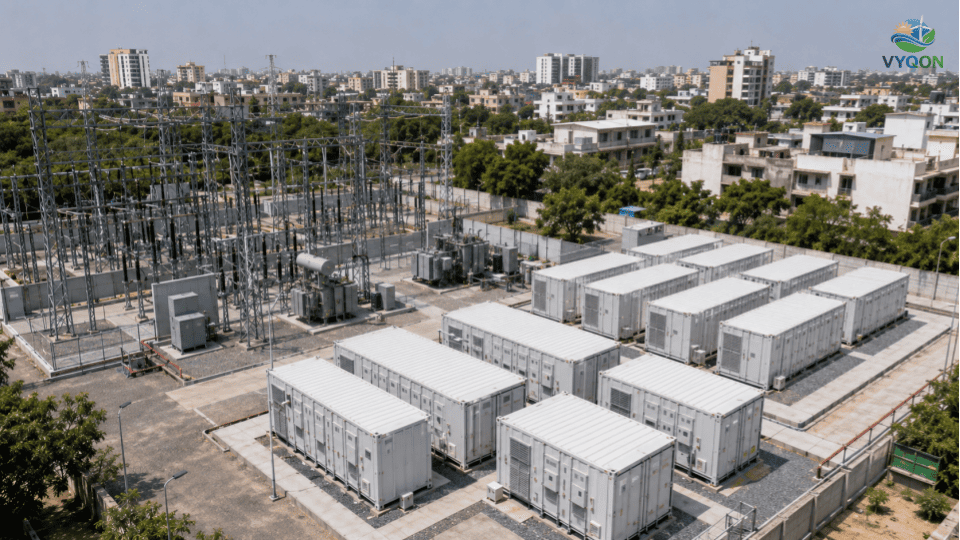
The Energy and Resources Institute (TERI) has issued a tender on behalf of BSES Rajdhani Power Limited (BRPL) for the development of a 57.5 MW / 115 MWh Battery Energy Storage System (BESS) project. This procurement initiative is aimed at facilitating renewable energy integration and enhancing grid stability within the National Capital Territory (NCT) of Delhi’s distribution area. The project is supported by Viability Gap Funding (VGF) through the Power System Development Fund (PSDF).
Technical Specifications and Storage Parameters
The following technical and operational requirements are mandatory for the proposed installation:
- Total Capacity: 57.5 MW of power capacity and 115 MWh of energy capacity.
- Discharge Duration: The system must maintain a two-hour discharge period.
- Operational Intensity: A maximum of two charge-discharge cycles per day may be scheduled by the buying utility.
- Inverter Technology: The installation must incorporate grid-forming (GFM) capability. This requirement is mandatory as the project’s aggregate capacity exceeds the 50 MW threshold proposed by Grid-India for resources in weak grid or remote areas.
- Fire Safety: Construction must include firewalls with a minimum three-hour fire resistance rating.
- Asset Management: Mandatory geo-tagging and integration with 24×7 remote monitoring portals are required for the duration of the contract.
Project Scope and Location Breakdown
The total storage capacity will be distributed across four designated 66/11 kV grid substations as detailed in the table below:
| Grid Substation | Power Capacity (MW) | Energy Capacity (MWh) |
| Sagarpur-DESU Colony | 30 MW | 60 MWh |
| Bindapur | 15 MW | 30 MWh |
| Hari Nagar | 7.5 MW | 15 MWh |
| G4 Substation | 5 MW | 10 MWh |
Execution Model and Financial Framework
The project follows a Build-Own-Operate-Transfer (BOOT) implementation model. The following financial and contractual parameters apply:
- Contract Period: The contract is set for a 12-year period. This duration sits at the lower end of the 12-to-15-year preference specified under VGF Tranche-II guidelines.
- Bidding Parameter: Developers will submit bids based on an annualized fixed cost (expressed in rupees per MW per month or Rs/kWh). This bid must be calculated after factoring in the VGF support specified in the Request for Selection (RfS).
- Payment Terms: The buying utility is mandated to process payments within 45 days of the submission of monthly bills.
Operational Requirements and Compliance
The selected developer is responsible for the full project lifecycle, including site survey, planning, engineering, procurement, supply, installation, testing, and commissioning. Following the commissioning phase, the developer will provide comprehensive Operation and Maintenance (O&M) services.
Operational compliance includes:
- Monitoring and Data Access: Systems must be installed to record performance data. The developer must provide the buying utility, Ministry of New and Renewable Energy (MNRE), State Load Despatch Centre (SLDC), and National Load Despatch Centre (NLDC) with 24×7 remote access to this data.
- Grid Integration: The BESS must integrate with Supervisory Control and Data Acquisition (SCADA) and Energy Management Systems (EMS) to support forecasting and optimal BESS scheduling.
Submission Timelines and Administrative Context
The deadline for the submission of bids is on or before July 27, 2026. All submissions must be processed via the Bharat Electronic Tender platform www.bharat-electronictender.com
Regional Record
This tender adds to the established battery storage infrastructure in the NCT of Delhi. Previous milestones include the Kirlokari project, which was the first regulatory-approved BESS project in India, and the foundation of 55.5 MW / 111 MWh of BESS capacity across South and West Delhi grid stations. These earlier implementations serve as the technical and regulatory precedent for the current 57.5 MW expansion.
Leave a Comment