
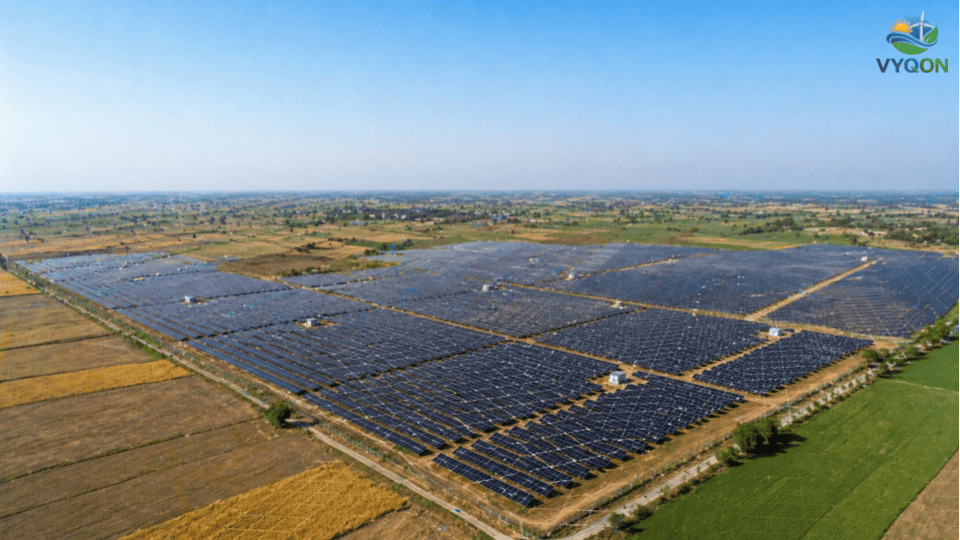
Lead Summary
Uttar Pradesh (UP) has officially surpassed 5,000 MW (5 GW) of installed solar capacity, representing a growth of 1,150% since 2017. This transition from a 400 MW baseline recorded nine years prior has been facilitated by utility-scale developments, agricultural feeder solarization, and a record expansion in the rooftop solar segment. The state’s current infrastructure trajectory aligns with national renewable energy targets and regional industrial investment.
Comparative Growth Statistics (2017–2026)
The following table illustrates the transition in the state’s solar energy profile:
| Year/Metric | Solar Capacity (MW) |
| 2017 Baseline Capacity | 400 MW |
| 2026 Milestone Capacity | 5,000 MW |
The state has recorded an 1,150% increase in capacity during this period. Under the Solar Energy Policy 2022, Uttar Pradesh has established a long-term target of 22,000 MW of solar capacity by 2026-27.
Drivers of Rooftop Solar Expansion
The rooftop solar sector provided a high volume of installations during the most recent fiscal period, contributing to the state’s total capacity.
- FY 2025-26 Performance: In this financial year, the state recorded 3,47,729 rooftop solar plant installations, adding 1,161.756 MW of capacity.
- Monthly Surges: UPNEDA Director Inderjeet Singh attributed the growth in the final quarter to policy implementation and subsidy access. Monthly data for early 2026 shows:
- January 2026: 33,314 installations.
- February 2026: 35,804 installations.
- March 2026: 52,729 installations, adding 173.84 MW in a single month.
- Total Reach: Cumulative data shows 4,48,233 total rooftop installations generating approximately 1,524 MW daily.
- Programmatic Support: Growth is supported by the ‘PM Surya Ghar: Muft Bijli Yojana,’ which provides central and state subsidies for domestic consumers.
Agricultural Solarization: PM-KUSUM Scheme
The state is utilizing the PM-KUSUM scheme to solarize the agricultural sector, focusing on the separation and solarization of dedicated feeders.
- Capacity Allotment: Letters of Agreement (LoAs) have been issued for 1,527.2 MW of solar capacity under PM-KUSUM C-2.
- Feeder Segregation: To facilitate the rollout, Uttar Pradesh Power Corporation Ltd (UPPCL) has already separated approximately 80% of agricultural feeders from domestic ones, ensuring the infrastructure is ready for dedicated irrigation supply.
- Target Metrics: The initiative aims to solarize 5,000 agriculture feeders by 2027 to reach a 2,000 MW capacity.
- Financial Structure: The power purchase price is set at ₹2.99 per unit for 25 years. Projects receive Viability Gap Funding (VGF) of ₹1.55 crore per MW, consisting of ₹1.05 crore in central support and ₹50 lakh in state support.
Utility-Scale and Regional Powerhouses
Large-scale solar assets are concentrated in regions where land use is optimized for energy production.
- Bundelkhand Hub: This region serves as the state’s primary solar hub due to the prevalence of drought-prone and non-arable land unsuitable for traditional farming. The region is targeted for 3,000 MW of capacity, including projects in Jhansi (600 MW), Lalitpur (600 MW), and Chitrakoot (800 MW).
- Bundelkhand Expressway: UPPDA has allocated 1,700 hectares for the 450 MW “Solar E-Way” project, which utilizes land between the main carriageway and the service road.
Strategic Infrastructure and Manufacturing
Industrial investments and model city frameworks are being utilized to stabilize the domestic supply chain and achieve urban energy goals.
- Integrated Manufacturing: SAEL Industries is investing ₹8,200 crore in Greater Noida for an integrated facility producing 5 GW of solar cells and 5 GW of modules using TOPCon technology. Upon operationalization, this facility will bring SAEL’s total manufacturing capacity to 8.5 GW.
- Model City Implementation: Under the Solar Energy Policy 2022, a “Model Solar City” is defined as an urban area achieving a minimum 10% reduction in estimated total demand for conventional energy through renewables.
- Ayodhya Project: Ayodhya’s estimated demand is 198 MW. NTPC Green Energy Limited has established a 40 MW plant to meet the 10% reduction criteria. The plant occupies 165.10 acres of land leased for 30 years at a nominal rate of ₹1 per acre per year. Energy produced will be purchased by UPPCL for 25 years. Infrastructure also includes over 2,500 solar-powered streetlights.
National Market Context
Uttar Pradesh’s standing in the national renewable energy market is defined by its transition speed and scheme adoption.
- National Ranking: The state is currently ranked 9th in India for total clean energy production.
- Scheme Leadership: Uttar Pradesh holds the No. 1 national ranking for the implementation of the PM Surya Ghar: Muft Bijli Yojana.
Technical and Operational Data
Current operational parameters and technical requirements for ongoing solar infrastructure include:
- Green Hydrogen Pilots: A 0.5 MW pilot in Gorakhpur operated by Torrent Power has a production capacity of 9 kg per hour. In Rampur, Zero Footprint Industries is operating a plant with a production capacity of 22.5 kg per hour.
- Land Requirements: PM-KUSUM projects require approximately 4 acres of land per MW of installed capacity.
- Transmission Requirements: Technical assessments indicate the necessity for a Green Energy Corridor with a 4,000 MW capacity to evacuate power from the Bundelkhand region to the state grid.
Leave a Comment