
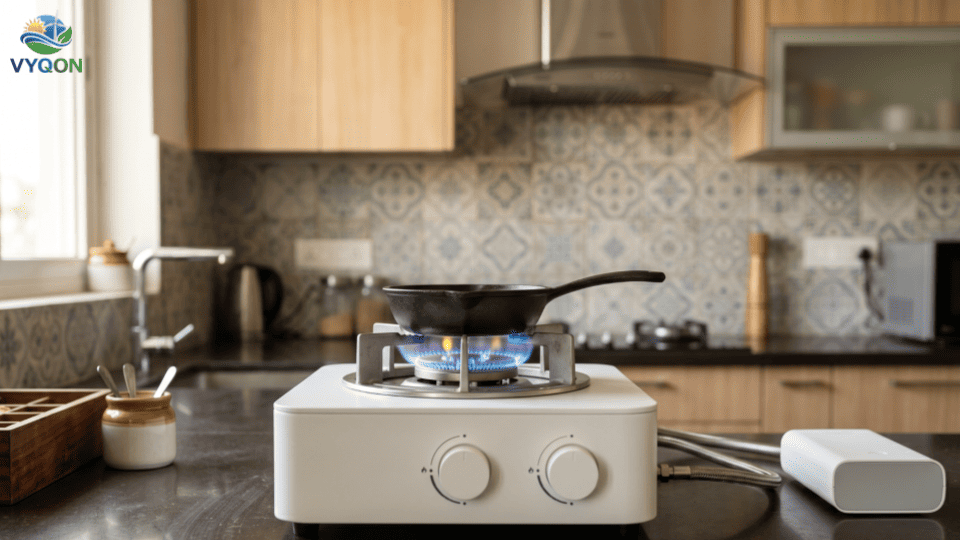
Greenvize SPC Techno Pvt. Ltd. has announced the commercial launch of India’s first plug-and-play hydrogen cooking stove. The “Made-in-India” hardware utilizes an integrated Proton Exchange Membrane (PEM) electrolyser to convert water and electricity into cooking fuel on demand, eliminating the requirement for external LPG cylinders or gas pipelines. This deployment aligns with the National Green Hydrogen Mission and recent Ministry of New and Renewable Energy (MNRE) guidelines regarding decentralized green hydrogen applications.
Technical Specifications and Consumption Metrics
The system is designed for high-efficiency thermal output, utilizing on-site hydrogen generation to mitigate the logistical overhead of fossil fuel procurement. Core operational parameters are detailed in the table below:
| Parameter | Specification |
| Fuel Source | On-site hydrogen production via integrated PEM electrolysis |
| Input Requirements | Integrated inlet port calibrated for 100 ml of deionized or reverse-osmosis (RO) purified water and 1 kWh of electricity |
| Operational Duration | Rated for up to 6 hours of continuous cooking per input cycle |
| Cookware Compatibility | Universal (Compatible with any material, including non-ferrous pots) |
| Emissions Profile | Zero CO₂, zero carbon monoxide, zero soot/smoke; >95% reduction in cooking emissions |
| Air Quality Impact | 0% indoor air pollution; pure water vapor output |
Efficiency Comparison: The system’s 1 kWh consumption represents an 88–91% reduction in energy input compared to standard induction cooking sessions, which typically require 9–12 kWh for a 6-hour duration. Unlike induction technology, the Greenvize hardware maintains universal cookware compatibility, allowing for the use of any vessel material.
Operational Mechanics and System Architecture
The Greenvize unit employs an “On-Demand” generation workflow, which synthesizes fuel at the point of use to avoid the safety complexities of high-pressure storage. The system architecture follows a clinical six-stage progression:
- Water Inlet Knob: A manual interface for the introduction of deionized or RO water into the system.
- PEM Electrolyser: The core unit where water molecules are electrochemically split into hydrogen and oxygen.
- Bubbler: An integrated component utilized for gas conditioning and purification of the hydrogen stream.
- Flame Back Arrester: A critical safety interface through which the gas passes via the Hydrogen Tube to prevent flashback.
- Buffer Tank: A specialized vessel that manages hydrogen storage and pressure stabilization to ensure consistent fuel delivery.
- Catalytic Burner: The final stage where the fuel undergoes controlled combustion.
The catalytic burner is engineered to enable controlled, low-flame or near-flameless heat output. This architecture ensures that fuel is only present within the system during active operation, removing the hazards associated with stored combustible gases.
Safety Features and Flashback Mitigation
The engineering of the Greenvize stove specifically addresses the high burning velocity and diffusivity of hydrogen, factors that traditionally increase the risk of flame instability. The hardware features a “Safety First” architecture characterized by a 3-stage safety protection system integrated into the Flame Back Arrester.
This system is designed to prevent upstream flame propagation, a known risk in hydrogen combustion due to the gas’s narrow thermal boundary layers. Furthermore, the unit is equipped with advanced sensors and safety controls intended to manage component temperatures. These controls monitor for thermal anomalies that could facilitate flashback, ensuring that the combustion reaction remains localized at the catalytic burner surface.
Product Versions, Pricing, and Market Availability
Greenvize has categorized its hardware into three distinct models based on duty cycles and market segments:
- Single Burner Stove: Targeted at home kitchens; priced at ₹1,05,000 + GST.
- Double Burner Stove: Targeted at residential parallel cooking requirements; priced at ₹1,50,000 + GST.
- Commercial Hydrogen Cooking Stove: Targeted at industrial-grade duty cycles, including restaurants, hotels, and canteens; priced at ₹3,50,000 + GST.
The manufacturer has identified several secondary target sectors for the technology, including community kitchens, defence outposts in remote locations, research laboratories requiring clean-flame environments, and institutional canteens.
Deployment and Policy Alignment
Currently in the pilot phase of deployment, the Greenvize hydrogen cooking unit aligns with the MNRE guidelines for innovative pilot projects involving decentralized green hydrogen. These guidelines prioritize the validation of technical feasibility in residential and commercial sectors.
Operational data reported in product literature suggests an estimated daily operating cost of ₹4–5/day. From a sustainability perspective, each unit is projected to contribute to approximately 3 tons of CO₂e savings annually, facilitating carbon abatement in decentralized energy environments.
Leave a Comment