
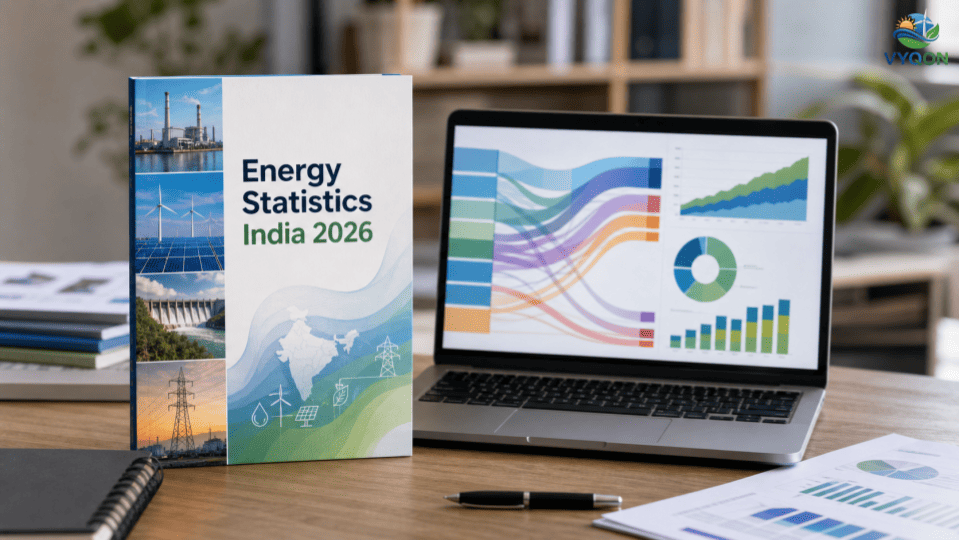
The National Statistics Office (NSO) has released the 33rd edition of the “Energy Statistics India 2026” report, documenting India’s total estimated renewable energy potential at 47,04,043 MW as of March 31, 2025. The publication provides an integrated dataset on reserves, capacity, production, consumption, and trade of energy commodities including coal, petroleum, natural gas, and renewables.
Renewable Energy Landscape and Solar Dominance
The report identifies solar power as the dominant source of India’s renewable energy potential, accounting for approximately 71% of the national total. Estimated solar potential recorded an expansion to 33,43,378 MW as of March 31, 2025, up from 748,990 MW during the 2023-24 fiscal year. Wind power contributes an estimated 11,63,856 MW to the landscape, while Large Hydro potential stands at 1,33,410 MW.
Gross electricity generation from renewable resources reached 4,16,823 GWh in FY 2024-25, representing a Compound Annual Growth Rate (CAGR) of 9.17% since FY 2015-16. This potential is geographically concentrated, with six states accounting for over 70% of the total capacity.
Top 6 States by Renewable Energy Potential
| State | Share (%) |
| Rajasthan | 23.70% |
| Maharashtra | 14.26% |
| Gujarat | 9.10% |
| Andhra Pradesh | 9.10% |
| Karnataka | 8.59% |
| Madhya Pradesh | 8.09% |
Operational Efficiency: Transmission and Distribution Progress
Efficiency in electricity utilization has increased through the reduction of operational losses. Transmission and Distribution (T&D) losses declined to approximately 17% in FY 2024-25, down from roughly 22% in FY 2015-16.
Per-capita energy consumption rose from 15,296 Mega Joules in FY 2015-16 to 18,096 Mega Joules in FY 2024-25. This growth represents a CAGR of 1.89% over the documented period. This data reflects the broadening energy footprint across the population alongside improved grid efficiency.
Sectoral Credit Flow and Economic Expansion
The energy sector recorded a six-fold increase in credit flow, which rose from ₹1,688 crore in 2021 to ₹10,325 crore in 2025. During the same period, the Total Primary Energy Supply (TPES) grew by 2.95% to reach 9,32,816 KToE in FY 2024-25.
Coal remains the dominant energy source within the supply mix. Energy supply from coal and lignite increased from 3,87,761 KToE in FY 2015-16 to 5,52,315 KToE in FY 2024-25. Furthermore, Total Final Consumption (TFC) across end-use sectors surged by 30.41% over the decade, reaching 608,578 KToE in the most recent fiscal year.
Technical Scope and Publication Background
“Energy Statistics India 2026” is the 33rd edition of the annual dataset released by the NSO under the Ministry of Statistics and Programme Implementation (MoSPI). The publication categorizes data across reserves, installed capacity, production, consumption, and trade (imports/exports) for all major energy commodities.
This edition addressed major data gaps by utilizing the Annual Survey of Industries (ASI) database for granular sub-sectoral electricity consumption patterns. The report achieved harmonization among sectoral end-use consumption statistics by standardizing end-use sectors across different commodities. Additional technical inclusions for 2026 include the industry-wise distribution of High-Speed Diesel (HSD) and the first-time incorporation of international aviation and marine bunker data into domestic consumption metrics.
Leave a Comment