
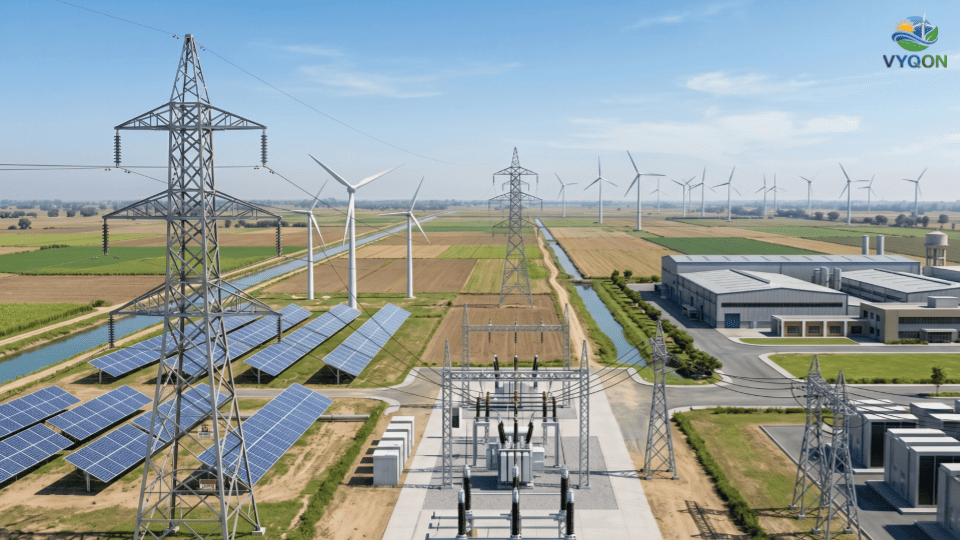
Regulatory Decision Overview
The Punjab State Electricity Regulatory Commission (PSERC), chaired by Viswajeet Khanna along with members Ravinder Singh Saini (Technical) and Ravi Kumar (Legal), has issued the Tariff Order for the financial year (FY) 2026-27 under Petition No. 70 of 2025. This regulatory mandate establishes the financial and operational framework for the state’s primary power utilities, the Punjab State Power Corporation Limited (PSPCL) and the Punjab State Transmission Corporation Limited (PSTCL). The order specifically revises charges for Full Open Access and Partial Open Access consumers, with the new tariff structure remaining in effect from April 1, 2026, to March 31, 2027.
Revised Additional Surcharge Rates and Categories
The Commission has updated the Additional Surcharge rates and consumer definitions to align with the current operational state of the grid and recent legislative amendments.
- Additional Surcharge Rate: An Additional Surcharge of ₹1.13 (~$0.013)/kWh has been approved for Full Open Access consumers.
- Green Energy Open Access: The ₹1.13/kWh rate applies to Green Energy Open Access consumers when they avail power beyond their sanctioned contract demand. Under the 13th Amendment to the Intra-State Open Access Regulations, the definition of “Green Energy open access consumers” has been expanded to explicitly include captive users receiving power from renewable energy-based Captive Generating Plants (CGPs).
- Consumer Classification: Per Regulation 3 of the 10th Amendment, categories are defined as:
- Full Open Access Customer: A consumer connected to the transmission or distribution system who maintains no contract demand with the distribution licensee within the State.
- Partial Open Access Consumer: A consumer connected to the transmission or distribution system who maintains a sanctioned contract demand with the distribution licensee within the State.
Financial Context and Technical Basis for the Reduction
The PSERC identified a financial surplus that allowed for the reduction of surcharges and tariffs, despite PSPCL projecting a revenue deficit of ₹453 crore in its initial filing.
- Average Cost of Supply (ACoS): The ACoS for FY 2026-27 is fixed at ₹6.15 per unit, representing a reduction from the ₹7.15 per unit determined for FY 2025-26.
- Revenue Requirement: The net revenue requirement for FY 2026-27 is set at ₹48,996.28 crore. After adjusting for surpluses, the Commission determined that ₹44,939.50 crore is to be recovered through tariffs.
- Consumer Relief: A total relief of ₹7,851.91 crore has been passed to consumers, stemming from the “true-up” of FY 2024-25 and realized operational efficiency gains.
- Prudence Check on Distribution Losses: A primary factor in the financial surplus was the Commission’s “prudence check” of PSPCL’s loss projections. The Commission rejected the utility’s proposed distribution loss trajectory of 12.75% for FY 2026-27, instead mandating a revised target of 10%. This 2.75% reduction in the loss target significantly lowered the projected power purchase costs.
Supporting Open Access Charges and Regulatory Provisions
The PSERC has revised wheeling charges and energy banking regulations to provide further clarity for Open Access operations during the upcoming fiscal period.
Revised Wheeling Charges for FY 2026-27
| Category of Open Access | Approved Wheeling Charge |
| Long Term/Medium Term Open Access | ₹2,54,092/MW/Month |
| Short Term Open Access | ₹619.72/MWh |
Regulatory Adjustments and Special Levies:
- NRSE Wheeling Provision: For the wheeling of power generated from Non-Conventional Renewable Energy (NRSE) projects for consumption within the State, transmission and wheeling charges are levied at 2% of the energy injected into the State Grid, irrespective of distance.
- Night Hour Waiver: Wheeling charges for Open Access consumers are waived for night hours (6 PM to 6 AM) during the period from May 1, 2026, to June 30, 2026.
- Banking Settlement: Per the 13th Amendment, the energy banking settlement period for Green Energy Open Access consumers runs from June 1 to May 31 of the following calendar year. Banked energy may be carried forward monthly within this period. Any energy remaining unutilized at the end of the settlement period shall lapse without compensation.
- Surplus Power Governance: The treatment of unutilized surplus power is governed by the provisions of the Electricity (Promoting Renewable Energy to Green Energy Open Access) Amendment Rules, 2023.
Leave a Comment