
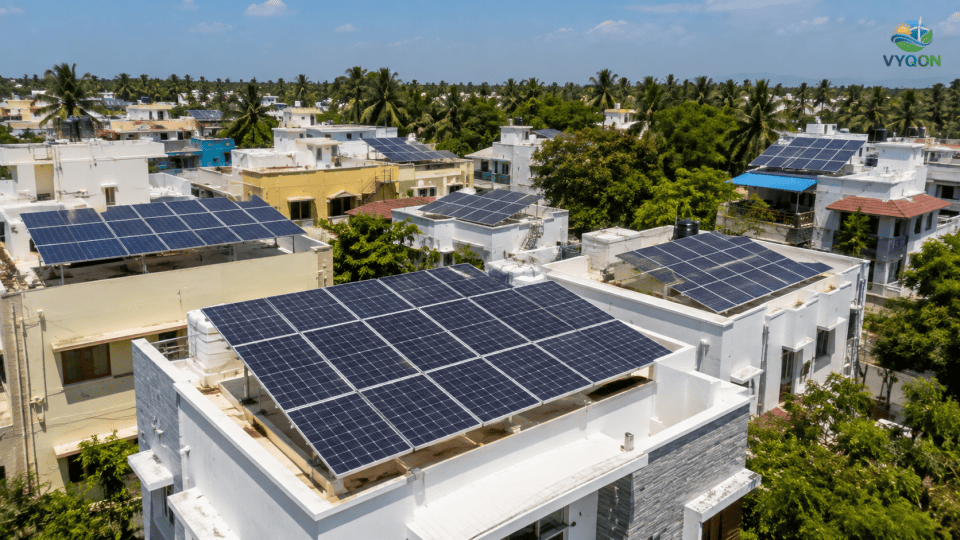
The State Top-Up Announcement
During the presentation of the Revised Budget Estimates for 2026-27 on August 5, 2026, Dr. N. Marie Wilson, the Tamil Nadu Minister for Finance, Planning and Development, officially announced the “Rooftop Solar Subsidy Scheme” for residential consumers. This state-level initiative operates in convergence with the central “PM Surya Ghar: Muft Bijli Yojana,” effectively establishing a combined subsidy ceiling of ₹1,00,000 per household. To support this rollout, the Tamil Nadu Government has earmarked a dedicated state allocation of ₹500 million (₹50 Crore) for the current financial year, aimed at bridging the gap between existing central assistance and total installation costs.
Financial Architecture and Subsidy Slabs
The subsidy framework is structured as a layered incentive, where the state top-up complements the fixed central assistance provided under the PM Surya Ghar scheme. While the central subsidy is capped at ₹78,000 for systems of 3 kW and above, the state’s contribution is designed to hit the ₹1,00,000 total benefit ceiling for high-capacity residential tiers.
Combined Subsidy Structure by Capacity Tier
| System Capacity | Central Subsidy (PM Surya Ghar) | Estimated State Top-Up | Combined Total Benefit |
| 1 kW | ₹30,000 | Pro-rated (TBD by Guidelines) | ₹30,000 + State Top-Up |
| 2 kW | ₹60,000 | Pro-rated (TBD by Guidelines) | ₹60,000 + State Top-Up |
| 3 kW and above | ₹78,000 | ~₹22,000 (To reach ceiling) | ₹1,00,000 (Maximum Ceiling) |
Contextual Note: The ₹500 million state pool is a finite resource. Based on an average top-up of ₹22,000 for 3 kW systems, the allocation is expected to cover approximately 22,000 to 23,000 households. The disbursement follows a first-come, first-served model, meaning eligibility is capped once the initial pool is exhausted.
Technical Standards and Compliance (DCR & ALMM)
To qualify for the converged subsidy, all installations must adhere to the Ministry of New and Renewable Energy (MNRE) mandates regarding component sourcing and quality.
- Domestic Content Requirement (DCR): Both solar cells and solar modules must be manufactured entirely within India. Systems utilizing imported solar cells—even if assembled in Indian modules—are strictly ineligible.
- ALMM Requirement: Modules must be selected from the “Approved List of Models and Manufacturers” (ALMM).
- Certification: Verification requires a mandatory 16-digit digital DCR certificate proving domestic provenance. Imported panels are ineligible for this certificate and face a 40% basic customs duty, making them financially unviable for subsidized projects.
- Warranty: Systems must carry a 25-year performance warranty, with vendors required to provide physical DCR certificates and serial numbers to consumers before installation.
Application Framework and Execution Timelines
The transition from application to commissioning typically spans a three-to-four-month project lifecycle. Domestic consumers must follow this standardized digital procedure:
- Registration: Applicants must register via pmsuryaghar.gov.in, identifying the state distribution company as TANGEDCO or, in specific regional jurisdictions, TNPDCL.
- Identifier Verification: Consumers must use the 9-digit TANGEDCO consumer number (numeric only) found on electricity bills. Use of the alphanumeric service connection number will result in immediate rejection.
- Technical Feasibility: TANGEDCO/TNPDCL engineers conduct a review of sanctioned load and transformer capacity. This phase typically takes 15 to 25 working days.
- Vendor Selection: Installation must be performed by an empanelled vendor. Consumers must ensure the vendor provides DCR documentation prior to the commencement of work.
- Installation & Inspection: Following physical installation, a second window of 15 to 25 working days is required for DISCOM engineers to inspect the system for ACDB/DCDB compliance and earthing.
- Net-Metering & Commissioning: A bidirectional meter is integrated, and a commissioning certificate is issued.
- Direct Benefit Transfer (DBT): The subsidy is generally deposited into the customer’s Aadhaar-linked bank account within 30 days post-commissioning.
Tamil Nadu’s Power Sector Roadmap
The rooftop solar initiative is a strategic response to Tamil Nadu’s current penetration levels. With 320 MW across approximately 88,000 households, the state currently trails leaders such as Gujarat (2,924 MW), Kerala (1,220 MW), Rajasthan (1,097 MW), and Andhra Pradesh (843 MW).
Key 2026-27 Budget Initiatives:
- Infrastructure & Constraints: The budget proposes 178 new substations and the replacement of 40,000 aging transformers. However, new solar connections remain subject to the 90% distribution-transformer capacity cap, a technical constraint in dense urban feeders.
- Free Electricity Entitlement: The government has increased the free electricity entitlement from 100 to 200 units for households with bi-monthly consumption up to 500 units. This policy shift increases the fiscal burden on the state, providing a secondary incentive for the government to move consumers toward self-generation via solar.
- Energy Storage: A new Battery Energy Storage System (BESS) Promotion Policy aims to establish units in Coimbatore, Madurai, North Chennai, Trichy, and Tirunelveli.
- Smart Metering & Mobility: Smart meters are mandated for all Chennai consumers and 50 lakh industrial users. Additionally, 20,000 public EV charging stations are planned over five years.
Official Eligibility and Restrictions
The converged state-central subsidy is governed by the following criteria:
- Eligible: Residential (domestic) consumers. Resident Welfare Associations (RWAs) and Group Housing Societies qualify for common facility solarization at a rate of ₹18,000 per kW (capped at 500 kW).
- Ineligible: Commercial and industrial entities do not qualify for capital subsidies. Off-grid or standalone battery systems are also excluded from the PM Surya Ghar framework.
- Ownership Rights: Applicants must possess clear roof rights or a formal No Objection Certificate (NOC) from the property owner or society.
For your documentation or records, here is the requested “copy-paste” content summarizing the official subsidy details and the corresponding list of official government sources mentioned in the sources.
Official Sources for Application & Verification
The following official government portals are cited as the primary channels for registration, feasibility approval, and scheme guidelines:
National Rooftop Solar Portal (Application & Tracking)
- Link: https://pmsuryaghar.gov.in/
- Role: The single official platform for registering, selecting empanelled vendors, and filing for the PM Surya Ghar subsidy.
Ministry of New and Renewable Energy (MNRE)
- Link: https://mnre.gov.in/
- Role: The central ministry responsible for funding the national subsidy and maintaining the Approved List of Models and Manufacturers (ALMM).
Tamil Nadu Energy Development Agency (TEDA)
- Link: https://teda.in/
- Role: The State Nodal Agency (SNA) in Tamil Nadu that manages installer empanelment and coordinates state-level solar data.
TANGEDCO (Tamil Nadu Generation and Distribution Corporation)
- Link: https://tangedco.gov.in/
- Role: The primary utility responsible for technical feasibility reviews, net-metering installations, and commissioning in Tamil Nadu.
Leave a Comment