
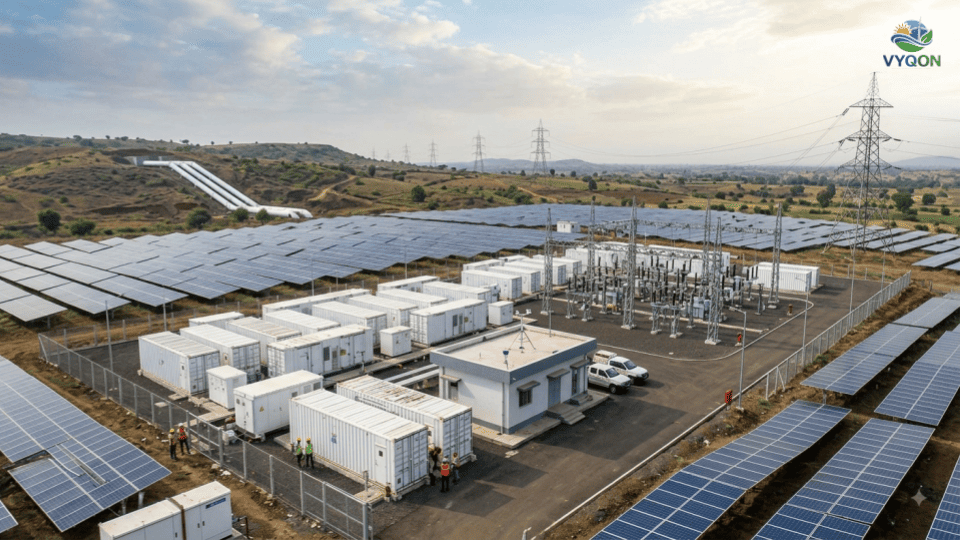
India’s BESS pipeline, ₹5,400 crore VGF support, emerging grid-integration requirements and renewable-plus-storage procurement are accelerating the country’s transition toward a more flexible power system.
India’s energy-storage sector is entering a period of rapid deployment, supported by government funding, expanding procurement and evolving grid-integration measures. During FY 2025–26, 2,668.54 MW/7,785.6 MWh of BESS capacity was added, while a much larger project pipeline is progressing across the country. Around 47 GW of BESS is being considered for integration by 2031–32, highlighting the growing role of storage in India’s renewable-energy expansion.
BESS Pipeline Expands Across the Country
Government data reports 9,653.94 MW/26,729.32 MWh of BESS capacity under construction, with another 19,797.65 MW/61,013.40 MWh at the tendering stage. For Pumped Storage Projects (PSP), 11,620 MW/69,720 MWh is under construction, while an additional 6,580 MW/39,480 MWh has been concurred and is yet to enter construction.
The scale of this pipeline reflects the increasing deployment of storage alongside India’s expanding renewable-energy and transmission infrastructure.
₹5,400 Crore VGF Support for 30 GWh BESS
Financial support remains a major instrument for accelerating battery-storage deployment. The Government of India has approved a ₹5,400 crore Viability Gap Funding (VGF) scheme for 30 GWh of BESS, supported through the Power System Development Fund (PSDF). The scheme provides VGF of up to ₹18 lakh per MWh to improve the viability of large-scale battery-storage projects.
This follows the earlier VGF programme supporting 13,220 MWh of BESS, with an allocation of ₹3,760 crore. Together, the programmes are designed to reduce financial barriers and accelerate utility-scale BESS deployment.
Transmission-related measures are also supporting the sector. Eligible co-located BESS projects can receive a 100% waiver of Inter-State Transmission System (ISTS) charges, subject to applicable conditions and commissioning timelines.
Grid Integration Becomes a Key Priority
As BESS deployment grows, attention is increasingly shifting toward the technical performance of storage assets within the electricity grid.
The Central Electricity Authority has proposed Technical Standards for Connectivity to the Grid Regulations, 2026, covering energy-storage systems and other grid-connected resources. The draft includes provisions related to fault ride-through, reactive-power performance, power quality and grid-support requirements, along with provisions relevant to grid-forming controls and black-start capability for large standalone BESS projects.
These remain draft proposals rather than final nationwide requirements. However, they indicate a broader shift in India’s grid-planning approach, where storage is increasingly considered for its contribution to system performance in addition to its energy-storage capacity.
Renewable Energy and Storage Move Closer Together
India’s renewable-energy procurement is increasingly incorporating storage. MNRE has issued an advisory on co-locating Energy Storage Systems with solar power projects, supporting greater renewable-energy utilisation and grid flexibility.
The procurement landscape is also moving toward Firm and Dispatchable Renewable Energy (FDRE) and renewable projects integrated with storage. Such configurations allow developers to provide renewable electricity with a more controlled delivery profile, including during periods of higher system demand.
This represents a shift from adding renewable generation capacity alone toward securing renewable electricity that can better match power-system requirements.
Long-Term Storage Requirement Continues to Grow
India’s current project pipeline forms part of a much larger long-term requirement. According to the National Electricity Plan 2023, total energy-storage requirement is projected at 82.37 GWh in 2026–27, comprising 47.65 GWh from PSP and 34.72 GWh from BESS.
By 2031–32, the requirement is projected to reach 411.4 GWh, including 175.18 GWh from PSP and 236.22 GWh from BESS. Looking further ahead, India’s overall storage requirement is estimated at approximately 2,380 GWh by 2047, including 1,840 GWh from BESS and 540 GWh from PSP.
The Energy Storage Obligation (ESO) provides an additional demand-side mechanism. The obligation increases from 1% in FY 2023–24 to 4% by FY 2029–30, with an annual increase of 0.5 percentage points. At least 85% of the total energy stored annually must be sourced from renewable energy for fulfilment of the obligation.
Technology and Market Development
India’s storage strategy is also expanding across multiple technology pathways. Government programmes include work on advanced grid-scale storage technologies, sodium-ion batteries, advanced chemistry cells and indigenous storage technologies. The National Programme on Advanced Chemistry Cell Battery Storage has also earmarked 10 GWh for grid-scale stationary storage applications.
At the market level, BESS is increasingly being positioned for renewable integration, peak shifting, ancillary services and other grid applications. The combination of procurement mechanisms, financial support and evolving technical requirements is creating a more structured market for utility-scale storage.
India’s Storage Market Moves Toward Scale
India’s energy-storage sector is entering a significantly larger deployment phase. The addition of 2,668.54 MW/7,785.6 MWh during FY 2025–26, combined with 9.65 GW/26.73 GWh under construction and nearly 19.80 GW/61.01 GWh at the tendering stage, demonstrates the scale of the emerging BESS market.
Alongside this pipeline, ₹5,400 crore of VGF support for 30 GWh, transmission incentives, renewable-plus-storage procurement and evolving grid-connection standards are strengthening the framework for further deployment.
The direction is clear: energy storage is moving from a supporting element of renewable-energy deployment to a core power-system asset. The next phase will depend on how efficiently India converts its project pipeline into operational capacity and integrates BESS and PSP into an increasingly renewable-based electricity system.
Official References
Leave a Comment