
SJVN Limited has announced that the Prime Minister of India, Shri Narendra Modi, and the Prime Minister of Nepal, Shri Balendra Shah, jointly laid the foundation stone (Shilanyas) of the 669 MW Lower Arun Hydro Electric Project in Nepal. The ceremony was held virtually from New Delhi, and SJVN informed the stock exchanges about it in a press release dated 23 November 2026. The estimated cost of the project is ₹5,792.36 crore.
SJVN Lower Arun 669 MW project: key details
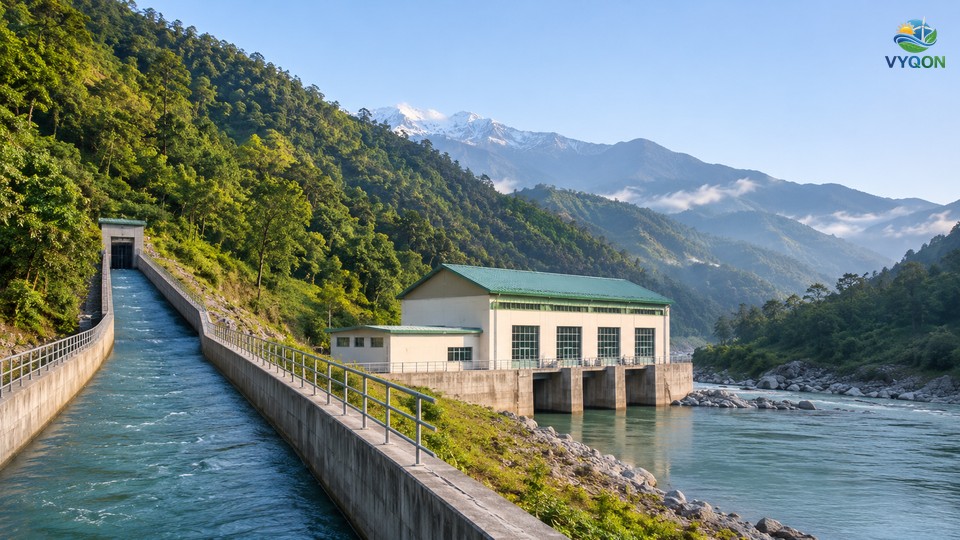
The Lower Arun project is being built on the Arun River in the Sankhuwasabha and Bhojpur districts of eastern Nepal. It is being developed by SJVN Lower Arun Power Development Company Pvt. Ltd. (SLPDC), a wholly owned subsidiary of SJVN. The project will have four generating units of 167.25 MW each, which together make up the 669 MW capacity. It also includes a 17.4 km long head race tunnel and a surface powerhouse.
SJVN expects the project to generate about 2,901 million units of energy a year. The tentative tariff is ₹4.99 per unit. The project is being developed on a Build, Own, Operate and Transfer (BOOT) basis and is targeted for commissioning during financial year 2030-31. According to the company, major construction packages have already been awarded and construction work is under way.
Tandem operation with the 900 MW Arun-3 project
The most distinctive feature of Lower Arun is its link with SJVN’s 900 MW Arun-3 Hydro Electric Project, which sits upstream on the same river. Both projects are designed to run under a Tandem Operation System. Water discharged from Arun-3 will be used again to generate electricity at Lower Arun. SJVN says this arrangement makes the best use of the available water and adds renewable generation without building a separate storage reservoir.
The tandem design explains why the two projects are planned together. Lower Arun sits downstream of the existing Arun-3 project, so the water that has already passed through the Arun-3 turbines is not wasted. For the transmission side of Arun-3, see our earlier report on the commissioning of the 900 MW Arun-3 Nepal hydroelectric project transmission system.
Ceremony and the people involved
SJVN Chairman and Managing Director Shri Bhupender Gupta thanked Prime Minister Modi for his continued guidance and Prime Minister Shah for reposing confidence in SJVN as a development partner. He also thanked the Ministry of Power, the Ministry of External Affairs and other key ministries of the Governments of India and Nepal for their support in expediting the clearances and approvals needed for the project.
A separate event was organised at the Lower Arun project site. It was attended by project employees and by representatives of Nepal’s Ministry of Energy, the Investment Board of Nepal, the District Coordination Committee, local government leaders, the District Forest department, Community Forest User Groups and the local community. SJVN management and employees watched the foundation stone ceremony virtually through live streaming.
How the project reached this stage
The Government of Nepal awarded the project to SJVN through international competitive bidding on 29 January 2021. SJVN signed a Memorandum of Understanding with the Investment Board Nepal on 11 July 2021. The Project Development Agreement was signed on 1 June 2023 in the presence of the Prime Ministers of India and Nepal. SJVN’s own project page notes that the capacity was revised from the 679 MW originally allotted to 669 MW, with annual generation of 2,901 million units in a 90% dependable year.
Benefits for Nepal and the local area
Under the Project Development Agreement, 21% of the energy generated will be provided free of cost to the Government of Nepal. SJVN says the project will also add to Nepal’s revenue through applicable taxes and royalties and support its foreign exchange earnings through cross-border energy trade.
The company expects the project to create significant direct and indirect jobs during construction and operation, and to generate business opportunities in Sankhuwasabha and Bhojpur districts. It also plans local area development work, including the construction and upgrading of schools, healthcare facilities and drinking water supply systems.
What it means for India’s clean-energy sector
For India, Lower Arun is a cross-border hydropower investment by a Navratna central public sector enterprise. Hydropower is a dispatchable source of renewable energy, and projects of this kind add to the regional clean-power capacity that complements India’s growing solar and wind fleet. SJVN’s filing does not say who will buy the electricity or how it will be exported, so those details are not covered here.
SJVN is a joint venture of the Government of India and the Government of Himachal Pradesh and operates under the Ministry of Power. It began with the 1,500 MW Nathpa Jhakri Hydro Power Station and has since expanded into hydro, thermal, solar, wind and power transmission. With the foundation stone laid and major construction packages already awarded, the next milestone is progress on the works towards the FY 2030-31 commissioning target.
Official references
- SJVN Limited, press release “Hon’ble Prime Ministers of India and Nepal Jointly Lay Foundation Stone of SJVN’s 669 MW Lower Arun Hydro Electric Project”, filed with BSE and NSE on 23 November 2026: https://www.bseindia.com/xml-data/corpfiling/AttachLive/28aee9e2-b6fd-4582-a564-0f8b74de6665.pdf
- SJVN Limited, Lower Arun HEP project page: https://sjvn.nic.in/en/lower-arun-hep
Leave a Comment