
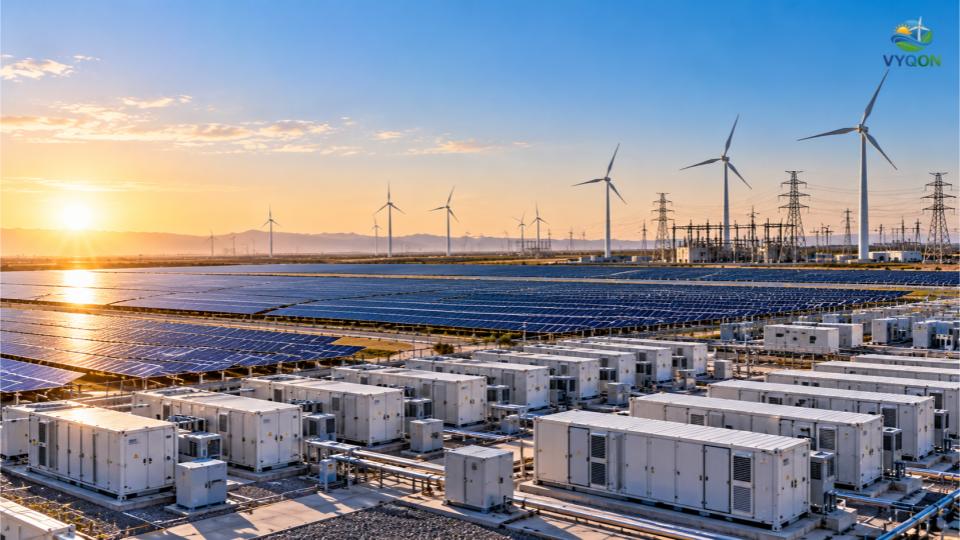
Adani Green Energy Limited reports higher renewable electricity sales, stronger operating earnings and continued portfolio expansion during Q2 FY27, while highlighting battery storage deployment and transmission infrastructure requirements.
Ahmedabad, 22 October 2026: Adani Green Energy Limited (AGEL) has reported a 45% year-on-year increase in revenue from power supply to ₹4,019 crore for the second quarter of financial year 2026–27, supported by renewable electricity sales growth and expansion of its operational solar, wind and hybrid portfolio.
According to the company’s official financial performance announcement released on 21 October 2026, revenue from power supply increased from ₹2,776 crore in Q2 FY26 to ₹4,019 crore in Q2 FY27.
Earnings before interest, taxes, depreciation and amortisation (EBITDA) from power supply increased by 51% to ₹3,835 crore, compared with ₹2,543 crore during the corresponding quarter of the previous year.
The company reported an improvement in its power-supply EBITDA margin from 90.5% to 92.0%.
The results reflect the contribution of additional operational renewable energy capacity and higher electricity sales across the company’s generating assets.
AGEL’s operational renewable generation portfolio reached approximately 20.8 GW by the end of September 2026, representing a 24% increase compared with the previous year.
The latest performance also highlights the growing importance of battery energy storage and transmission infrastructure in supporting large-scale renewable power development.
Revenue and Electricity Sales Strengthen in Q2 FY27
AGEL’s financial performance during the July–September 2026 quarter was supported by an increase in electricity supplied from its operational renewable energy projects.
The company reported quarterly energy sales of 12,090 million units (MU), representing a 33% year-on-year increase.
The rise reflects the contribution of commissioned generating capacity and the operational performance of the company’s existing solar, wind and hybrid installations.
For the first half of FY27, covering April to September 2026, electricity sales reached 25,747 MU, compared with the corresponding period of the previous financial year, representing growth of 32%.
This is equivalent to approximately 25.75 billion units of electricity supplied during the six-month period.
The company’s half-year revenue from power supply increased by 36% to ₹8,299 crore, compared with ₹6,088 crore in H1 FY26.
Meanwhile, EBITDA from power supply rose by 41% to ₹7,957 crore, from ₹5,651 crore a year earlier.
The H1 power-supply EBITDA margin improved from 91.8% to 92.9%, according to AGEL’s reported performance measure.
The company also reported cash profit of ₹4,176 crore during H1 FY27, representing an increase of 35% year-on-year.
These financial indicators should be interpreted according to the company’s reporting definitions. Revenue from power supply is not the same as total consolidated revenue, while the company’s power-supply EBITDA and cash-profit measures are distinct from statutory net profit and free cash flow.
Operational Renewable Energy Portfolio Expands to 20.8 GW
One of the major developments highlighted in the quarterly announcement was the continued growth of AGEL’s operational renewable energy capacity.
The company’s portfolio reached approximately 20.8 GW, representing 24% year-on-year growth.
AGEL reported 4,083 MW of year-on-year greenfield capacity additions, including solar, wind and solar-wind hybrid projects.
Solar installations accounted for the largest share of these additions, with approximately 2,957 MW of new operational capacity.
This included 2,568 MW at Khavda in Gujarat and 389 MW in Rajasthan.
Wind energy additions totalled approximately 805 MW, including 666 MW at Khavda and 139 MW at Mundra in Gujarat.
The remaining 321 MW comprised solar-wind hybrid capacity at Khavda.
These additions illustrate the company’s expansion across different renewable generation technologies.
Solar installations contribute electricity during periods of adequate sunlight, while wind projects can provide generation under different weather and operating conditions.
Hybrid projects combine renewable technologies to create a more diversified generation profile, although their actual output remains dependent on resource availability and equipment performance.
The growing operational portfolio has also increased the importance of maintaining sufficient transmission capacity to deliver renewable electricity to customers.
Khavda BESS Capacity Reaches 6.63 GWh
Battery energy storage remains an important element of AGEL’s renewable energy development strategy.
In its latest results announcement, the company reiterated that installed Battery Energy Storage System (BESS) capacity at Khavda, Gujarat, reached 6,632 MWh, equivalent to approximately 6.63 GWh.
The total includes 3,081 MWh of battery storage capacity added during Q2 FY27.
According to AGEL, its cumulative installed storage capacity accounts for more than half of India’s operational BESS capacity, based on the company’s comparison methodology.
The company also describes the Khavda installation as the world’s largest single-location battery storage deployment.
Importantly, the 6.63 GWh milestone had already been separately announced on 1 October 2026.
Its inclusion in the Q2 financial results provides additional operational context rather than representing a new commissioning announcement on 21 or 22 October.
Battery storage can improve renewable power-system flexibility by storing electricity during periods of available generation and supplying it when required.
For solar-heavy electricity portfolios, storage can help shift part of the energy generated during daylight hours into periods of higher demand.
BESS installations can also support operational requirements such as ramp management, grid balancing and improved utilisation of renewable energy, depending on their technical specifications and commercial arrangements.
AGEL has indicated that its installed BESS capacity could exceed 10 GWh during FY27.
This remains a company outlook statement and should not be interpreted as capacity already installed or commissioned.
Transmission Infrastructure Remains Critical at Khavda
The company’s latest announcement also highlighted the importance of transmission infrastructure in supporting renewable energy expansion.
AGEL is progressing with the development of a large renewable energy complex at Khavda in Gujarat, where solar, wind, hybrid generation and battery storage are being integrated.
The company reported approximately 10.8 GW of operational solar, wind and hybrid capacity across the wider Khavda development, compared with around 7.1 GW a year earlier.
The reported total of 10,752 MW includes 10,002 MW attributable to AGEL’s generation capacity and 750 MW developed for other Adani Group companies.
This distinction is important because the broader Khavda site capacity should not be interpreted as entirely owned by AGEL.
The company continues to pursue its planned 30 GW renewable energy development at Khavda, with the target remaining subject to future construction and commissioning milestones.
Large renewable generation complexes depend on adequate transmission capacity to evacuate electricity efficiently.
When generation expands faster than the supporting transmission network, grid congestion and electricity curtailment can affect the amount of renewable energy delivered.
AGEL has identified transmission readiness as an important consideration and indicated that battery storage is helping provide additional operational flexibility at Khavda.
However, energy storage does not eliminate the need for sufficient grid infrastructure. Electricity must still be transferred through appropriate transmission and distribution arrangements to reach customers.
Capital Expenditure and Financial Position
AGEL reported capital expenditure of approximately ₹17,160 crore during H1 FY27, representing a 38% year-on-year increase.
The investment reflects the financial resources required to develop large-scale renewable generation and supporting infrastructure.
Solar and wind projects involve expenditure on generating equipment, foundations, electrical systems, substations, transmission connections and project implementation.
Battery storage installations introduce additional requirements involving battery systems, power conversion equipment, thermal management and operational controls.
The company also reported a net debt to run-rate EBITDA ratio of 5.6 times.
This provides an indicator of its financing position as it continues expanding operational assets.
For renewable energy developers, sustained growth requires coordination between capital deployment, project execution, electricity sales and debt management.
Although increasing revenue and operating earnings can support financial performance, future results will continue to depend on commissioning progress, electricity generation, financing conditions and transmission availability.
Implications for India’s Renewable Energy Sector
AGEL’s Q2 FY27 performance reflects the growing importance of translating installed renewable capacity into actual electricity generation and commercial supply.
The company’s 45% increase in quarterly power-supply revenue was accompanied by higher electricity sales and continued expansion of its operational portfolio.
These developments demonstrate how additional generating assets can contribute to revenue growth once they enter commercial operation.
However, installed generating capacity alone is not sufficient to determine the performance of a renewable electricity portfolio.
Plant availability, resource conditions, transmission infrastructure and contractual electricity supply arrangements remain important.
The integration of battery storage adds another dimension by enabling greater flexibility in when electricity can be delivered.
AGEL’s operational developments at Khavda highlight the increasing relationship between renewable generation, storage and power transmission.
The company continues to pursue its broader objective of reaching 50 GW of operational renewable energy capacity by 2030.
That figure remains a future corporate target rather than an achieved capacity milestone.
Outlook
Adani Green Energy Limited’s latest financial results demonstrate continued growth in renewable electricity sales and operating earnings during Q2 FY27.
The company’s ₹4,019 crore quarterly power-supply revenue, ₹3,835 crore power-supply EBITDA and 20.8 GW operational renewable energy portfolio represent the central verified developments reported on 21 October 2026.
The results also reaffirm the importance of battery storage, with the previously announced 6.63 GWh Khavda deployment providing additional operational flexibility.
Looking ahead, the company’s performance will depend on continued project commissioning, reliable electricity evacuation, effective capital management and the integration of storage with its growing renewable generation portfolio.
For India’s renewable energy industry, the results highlight a central requirement of large-scale clean-power expansion: new solar and wind capacity must be supported by strong transmission networks, flexible storage resources and sustained operational performance.
Official Sources and References
1. Adani Green Energy Limited — Official Q2 and H1 FY27 Results Announcement, 21 October 2026
Adani Green Energy’s Energy Sales Grew 32% YoY to 25.8 Billion Units, Resulting in EBITDA Growth of 41% in H1 at ₹7,957 Crore.
2. Adani Green Energy Limited — Official Investor Relations
Quarterly financial results, stock-exchange filings and investor presentations.
https://www.adanigreenenergy.com/investors/investor-downloads
3. Adani Green Energy Limited — Official Battery Storage Announcement, 1 October 2026
Adani Green Energy Expands Battery Storage Capacity to 6.63 GWh.
Leave a Comment