
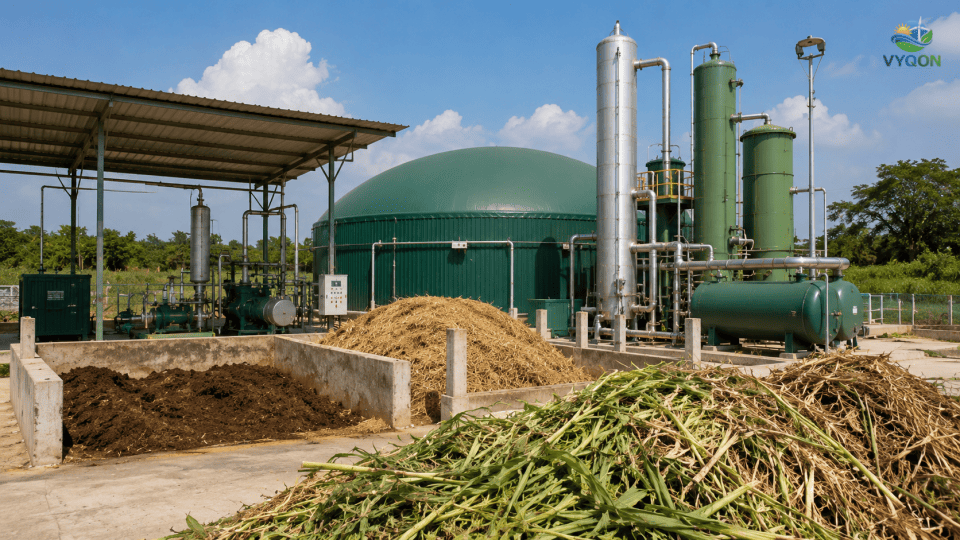
The Union Cabinet, led by Prime Minister Narendra Modi, has authorized a ₹23,731 crore financial outlay for the GOBARdhan – National Circular Bioenergy Scheme to drive a ten-fold increase in domestic bioenergy production by August 2026. The landmark initiative seeks to convert abundant organic waste—including agricultural residue, cattle dung, and municipal solid waste—into clean energy. This unified policy framework is designed to strengthen India’s energy security, displace expensive imports, and foster a robust circular bioeconomy through fiscal incentives and mandatory blending obligations.
Strategic Overview and Strategic Imperatives
The GOBARdhan scheme establishes a long-term administrative structure to transition the Compressed Biogas (CBG) sector from a nascent industry to a primary pillar of India’s energy mix.
Strategic Context and Energy Security India currently imports nearly 50% of its natural gas requirements. This dependency presents a significant geopolitical risk, particularly as the Strait of Hormuz handles approximately 55%–60% of India’s Liquefied Natural Gas (LNG) imports. By targeting a ten-fold expansion in domestic CBG production, the government aims to mitigate maritime bottleneck risks and achieve substantial import substitution.
- Nodal Ministry: Ministry of Petroleum and Natural Gas (MoPNG).
- Implementation Horizon: FY 2026-27 to FY 2035-36 (10-year period).
- Primary Feedstocks: Agricultural residue (paddy straw, mustard stalks), cattle dung, sugar industry press mud, and municipal organic waste.
- Core Objective: Achieving a ten-fold increase in domestic CBG production to displace 10 Million Metric Tonnes (MMT) of fossil fuel consumption.
A Multi-Pronged Strategy: The Six Growth Engines
The framework is built upon “Six Growth Engines” designed to provide market certainty, financial viability, and infrastructure support for the entire CBG value chain.
1. Assured CBG Offtake To provide producers with a guaranteed market, the scheme enforces a mandatory CBG Blending Obligation (CBO) for City Gas Distribution (CGD) entities. The notified blending targets are set at 3% for FY 2026-27, 4% for FY 2027-28, and 5% from FY 2028-29 onwards. This applies to the CNG (Transport) and PNG (Domestic) segments, ensuring long-term demand visibility.
2. Administered Pricing Framework The Cabinet has introduced a fixed procurement price of ₹2,110 per MMBTU for CBG. This represents an approximate energy-equivalent value of ₹100 to ₹105 per kg, subject to specific gas quality and conversion methodologies. This pricing is committed for a minimum 10-year horizon, insulating producers from market volatility and improving project bankability.
3. Capital Support The scheme provides capital assistance of up to ₹2 crore per Ton Per Day (TPD) for greenfield projects. Crucially, this assistance is extended to brownfield expansions and critical value-chain assets, such as biomass aggregation machinery and organic manure processing equipment, reducing the initial capital burden for developers.
4. Pipeline Infrastructure Financial support is allocated for both cluster-based and standalone spur pipelines. These facilitate the connection of rural CBG plants to national trunk grids and CGD networks, significantly lowering gas evacuation costs and expanding market reach.
5. Credit Support A dedicated credit guarantee mechanism provides up to 85% coverage on institutional loans for MSME-based CBG projects. This mechanism is specifically designed to reduce collateral requirements for first-time developers, cooperatives, and women entrepreneurs, thereby increasing the flow of institutional finance.
6. CBG Ecosystem Challenge Fund This fund addresses district-level bottlenecks through funded activities including resource mapping, aggregation infrastructure development, and value addition for organic manure. It aims to build a localized, sustainable supply chain for feedstock and byproducts.
Financial and Operational Benchmarks
The following table summarizes the key data points of the scheme for quick reference:
| Metric | Value |
| Total Scheme Outlay | ₹23,731 Crore |
| Implementation Horizon | 10 Years (FY27 – FY36) |
| Administered Price per MMBTU | ₹2,110 |
| Approximate Price Equivalent | ₹100–₹105 per kg |
| CAPEX Subsidy Cap (Greenfield) | Up to ₹2 Crore / TPD |
| Mandatory Blending Target (FY29+) | 5% |
| MSME Credit Guarantee Coverage | Up to 85% |
Evolution of India’s CBG Policy Ecosystem
The GOBARdhan National Circular Bioenergy Scheme represents a strategic consolidation of previously fragmented initiatives, moving from a four-ministry model to a unified MoPNG-led framework.
- SATAT (Sustainable Alternative Towards Affordable Transportation): The foundational initiative for supply to Oil Marketing Companies.
- Market Development Assistance (MDA): Provides ₹1,500/MT for organic manure (FOM/LFOM). To date, approximately ₹111.72 crore has been disbursed to promote nutrient recycling.
- Biomass Aggregation Machinery (BAM) Scheme: While the BAM scheme has an outlay of ₹564.75 crore, as of March 2026, only ₹248 crore has been sanctioned for 37 projects. This leaves an “unclaimed opportunity” of over ₹316 crore for upcoming developers.
- Current Baseline: As of August 2026, India has 217 commissioned plants producing 0.4 MMSCMD. There are currently 339 plants under active construction, signaling a rapid scale-up.
Projected Economic and Environmental Impact
The 10-year implementation of the scheme is projected to deliver massive multipliers across the national economy and environment:
- Import Substitution: Estimated foreign exchange savings of over ₹40,000 crore by displacing imported LNG.
- Macroeconomic Contribution: A projected GDP multiplier of over ₹75,000 crore.
- Rural Economy: Generation of over 1.5 lakh direct and indirect jobs, creating significant income opportunities for farmers and rural cooperatives.
- Carbon Mitigation: Estimated reduction of 40 million tonnes (MT) of CO2 equivalent emissions and the displacement of 10 MMT of fossil fuel consumption.
- Waste Management: Scientific utilization of millions of tonnes of agricultural residue and municipal organic waste, providing a commercial alternative to field burning.
Regulatory and Compliance Requirements
To access scheme benefits and ensure operational safety, developers must adhere to the following requirements:
- Portal Registration: Mandatory registration on the Unified GOBARdhan Portal (gobardhan.eil.co.in) is required to access subsidies and manage project filings.
- Feedstock Thresholds: Projects must utilize at least 50% biomass (agri-residue) as feedstock or consume a minimum of 3,000 MT of agri-residue per annum.
- Statutory Approvals: All commissioned plants must maintain valid Consent to Operate (CTO) from the State Pollution Control Board and mandatory safety approvals from the Petroleum and Explosives Safety Organization (PESO).
Official Government Sources
- Prime Minister’s Office (PMO): Cabinet approves GOBARdhan, India’s National Unified Scheme for Compressed Biogas, with an outlay of Rs. 23,731 crore
- Ministry of Jal Shakti: GOBARdhan Unified Registration Portal (Department of Drinking Water & Sanitation)
- Ministry of Petroleum and Natural Gas (MoPNG): Compressed Biogas (CBG) Registration Portal
Leave a Comment