
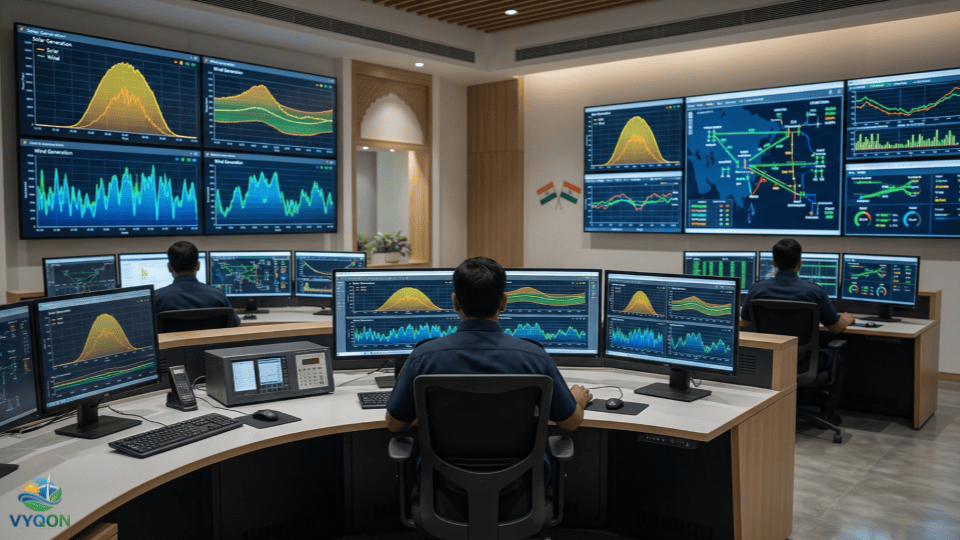
In a pivotal regulatory adjustment, the Central Electricity Regulatory Commission (CERC) has issued a Suo-Motu order (Petition No. 9/SM/2025) transitioning the Deviation Settlement Mechanism (DSM) for wind and solar generators. While the structural shift toward a schedule-based denominator begins in April 2026, the Commission has deferred the actual financial impact of the stricter penalty calculations to April 2027 by maintaining the “X” weighting factor at 100% for the first year. This calibrated reform trajectory aims to mitigate tariff erosion and protect project bankability while progressively aligning renewable energy (RE) with conventional grid discipline to support India’s target of 500 GW of renewable capacity by 2030.
The 2027 Deferral: Context and Rationale
The CERC decision to grant a one-year extension for the current calculation basis follows a formal intervention by the Ministry of New and Renewable Energy (MNRE) and intense pushback from nearly 50 industry stakeholders. Developers argued that the current forecasting landscape in India—stymied by low spatial resolution and significant weather uncertainty—renders a sudden shift to schedule-based penalties financially ruinous for existing assets.
Industry analysts at S&P Global and Bernstein have noted that without this deferral, existing wind plants could have seen deviation costs surge from 1–2% to 5–6% of total revenue. Furthermore, the Commission clarified that while the transition moves forward, implementation remains subject to the outcome of writ petitions currently pending before the Delhi High Court. Notably, the CERC has explicitly stated that no coercive action will be taken against generators while the court’s interim relief continues.
Technical Framework: The ‘X’ Factor and Calculation Shift
The core of the reform is the introduction of the ‘X’ factor, a weighting parameter that transitions the deviation percentage (Dws\%) denominator from “Available Capacity” to “Scheduled Generation.” When X = 100, the calculation rests entirely on Available Capacity (the status quo); when X = 0, the generator is treated as a conventional seller, settled entirely against its schedule.
The transition formula is defined as:
Dws\% = 100 \times \frac{(Actual Injection – Scheduled Generation)}{(X\% \text{ of Available Capacity}) + (100-X)\% \text{ of Scheduled Generation}}
To prevent sudden shocks to Internal Rates of Return (IRR), the CERC abandoned its original proposal of a flat 20% annual reduction in favor of a differentiated, technology-specific glide path. This reflects the reality that solar generation is inherently more predictable than wind.
Phased Reduction Trajectory of the ‘X’ Factor
| Financial Year | Solar & Solar-Hybrid Value of ‘X’ (%) | Wind Value of ‘X’ (%) |
| 2026–27 | 100% | 100% |
| 2027–28 | 90% | 95% |
| 2028–29 | 75% | 85% |
| 2029–30 | 55% | 65% |
| 2030–31 | 30% | 35% |
| 2031 onwards | 0% | 0% |
Operational Changes: Tightening of Tolerance Bands
Concurrent with the ‘X’ factor transition, the CERC is narrowing the revenue-neutral tolerance bands effective April 1, 2026. This change reduces the volume within which generators can deviate without attracting commercial penalties:
- Solar and Solar-Hybrid Projects: Band narrows from ±10% to ±5%.
- Wind Projects: Band narrows from ±15% to ±10%.
Deviations exceeding these tightened limits will attract higher penalties, effectively forcing developers to choose between investing in superior forecasting technology or absorbing higher operational costs.
Grid Security and Market Rationalization
The CERC’s rationale centers on the “shared responsibility” of grid stability. As renewable penetration increases, even minor forecasting errors can necessitate expensive reserve deployment and ancillary service interventions. The regulator argues that the current framework unfairly shifts these balancing costs to distribution companies (discoms) and, ultimately, end-consumers.
To navigate this tightening regime, the Commission emphasizes “aggregation” at pooling stations. Data analysis from Prayas (Energy Group) suggests that pooling at the station level can reduce total penalties by 30–65% by smoothing out localized weather fluctuations. Generators are encouraged to leverage Regional Energy Management Centres (REMCs) to improve these collaborative scheduling practices.
Impact on Future Projects and the “100 MW Cliff”
The regulatory landscape shifts significantly for new capacity. Projects with tendering or bid submission dates on or after April 1, 2026, will be treated “at par” with General Sellers from day one. This alignment introduces a significant regulatory risk: the 100 MW deviation cap.
For mega-projects exceeding 1000 MW, the “±10% or 100 MW, whichever is less” rule for General Sellers creates a “cliff” where the 100 MW cap becomes far stricter than the 10% allowance. This likely incentivizes a shift in capital allocation toward solar-plus-storage or hybrid models over standalone wind, as developers seek to dampen variability.
Additionally, to protect grid security during high-frequency events, an interim measure has been operationalized: sellers will receive “zero payment” for any over-injection when system frequency is at or above 50.05 Hz. While industry data suggests this impacts less than 1% of total generation, it reinforces the Commission’s intent to prioritize system frequency over generator revenue.
Leave a Comment