
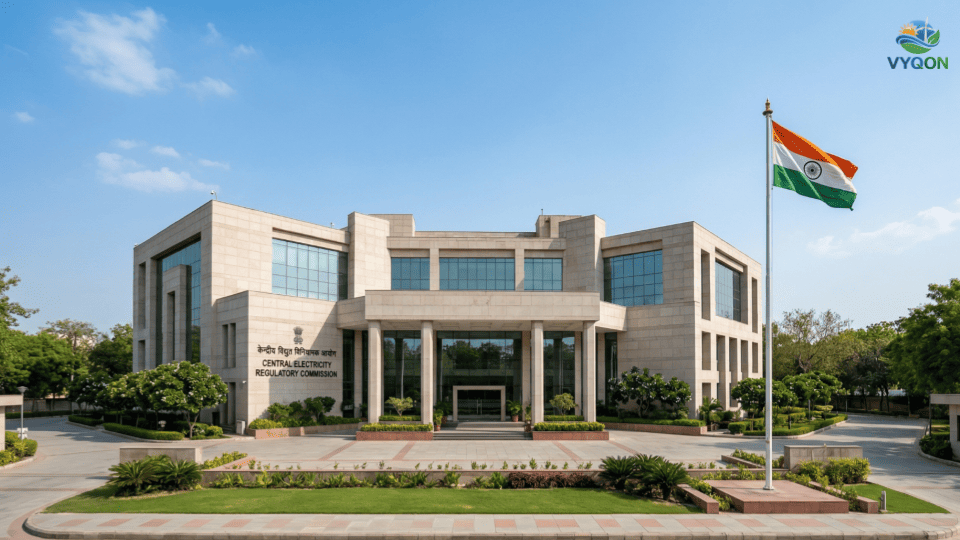
In an order dated March 27, 2026, the Central Electricity Regulatory Commission (CERC) dismissed an interlocutory application for interim relief filed by Adyant Power Private Limited (APPL) in its dispute with the Central Transmission Utility of India Limited (CTUIL). The case examines whether a subsidiary can utilize a Power Purchase Agreement (PPA) held by a group company to satisfy regulatory requirements for grid connectivity conversion.
Project and Case Overview
| Feature | Details |
| Petitioner | Adyant Power Private Limited (APPL), a subsidiary of Hexa Climate Solutions Private Limited (HCSPL) |
| Respondent | Central Transmission Utility of India Limited (CTUIL) |
| Project Details | 200 MW hybrid renewable energy project (101 MW solar and 99 MW wind) |
| Connectivity Point | Mandsaur Pooling Substation, Madhya Pradesh |
| Initial Route | Land Bank Guarantee (Land BG) Route |
| Primary Regulation | CERC (Connectivity and General Network Access to the inter-State Transmission System) Regulations, 2022 (GNA Regulations) |
The Core Dispute: Route Conversion and Group Subsidiaries
The dispute originated from APPL’s request to convert its grid connectivity from the “Land BG Route” to the “PPA Route.” Under the original Land BG route, the petitioner was mandated to submit physical land documents by a deadline of February 27, 2026. Failure to meet this requirement would permit CTUIL to initiate the revocation of the granted connectivity.
To justify the conversion, the petitioner relied on a 100 MW PPA executed between a group company, Hexa Energy MH10 Private Limited (HEMPL), and the Solar Energy Corporation of India (SECI). The petitioner contended that GNA Regulations 15.1 and 11A(5) provide “group-level flexibility,” allowing subsidiaries within the same corporate umbrella to share compliance documents and project execution responsibilities. Furthermore, the petitioner argued that CTUIL’s restrictive interpretation failed to account for “modern business practices,” wherein large renewable energy groups utilize different subsidiaries to manage distinct phases of project development.
The respondent, CTUIL, objected to this approach, maintaining that connectivity is granted to a specific legal entity rather than a corporate group. The respondent argued that under Regulation 11A(4), the “Connectivity Grantee” and the PPA or Letter of Award (LoA) holder must be the same legal entity. Because APPL held the connectivity while HEMPL held the PPA, CTUIL asserted that the petitioner remained bound by the land document submission requirements of the Land BG route.
Summary of Legal Reasoning and CERC’s Ruling
The Commission evaluated the petitioner’s claims based on an interpretation of the GNA Regulations to determine if the criteria for interim protection were met.
Interpretation of “Utilization of Connectivity” The Commission held that “utilization of connectivity” as defined in Regulation 15.1 refers strictly to the physical injection or drawal of power from the grid. The Commission concluded that this provision does not extend to administrative or regulatory compliance functions, such as the sharing of a PPA between separate legal entities to meet eligibility criteria.
Eligibility for Conversion Regarding the eligibility for route conversion, the Commission ruled that Regulation 11A(4) requires the “Connectivity Grantee” to be the same legal entity that holds the PPA or LoA. Since APPL and HEMPL are distinct legal entities, the Commission found that the PPA held by HEMPL could not be used to satisfy the conversion requirements for connectivity granted to APPL.
Responsibility for Compliance The Commission clarified the scope of Regulation 11A(5), noting that while group entities may assist in project execution, the regulatory responsibilities—including land acquisition, financial closure, and PPA execution—remain the sole obligation of the specific grantee. The Commission held that these compliance requirements must be met by the single executing entity and cannot be distributed across multiple subsidiaries.
Decision on Interim Relief The Commission concluded that the petitioner had misinterpreted the regulatory framework and failed to establish a prima facie case for relief. Consequently, the Commission declined to restrain CTUIL from taking “coercive action,” including the potential revocation or cancellation of connectivity due to the non-submission of required land documents.
Current Status of the Petition
While the request for interim protection was denied, the main petition (Petition No. 109/MP/2026) remains pending before the Commission for final adjudication. The ruling permits CTUIL to proceed with regulatory enforcement actions in accordance with the GNA Regulations if the petitioner fails to submit the necessary land documents within the stipulated timelines.
Leave a Comment