
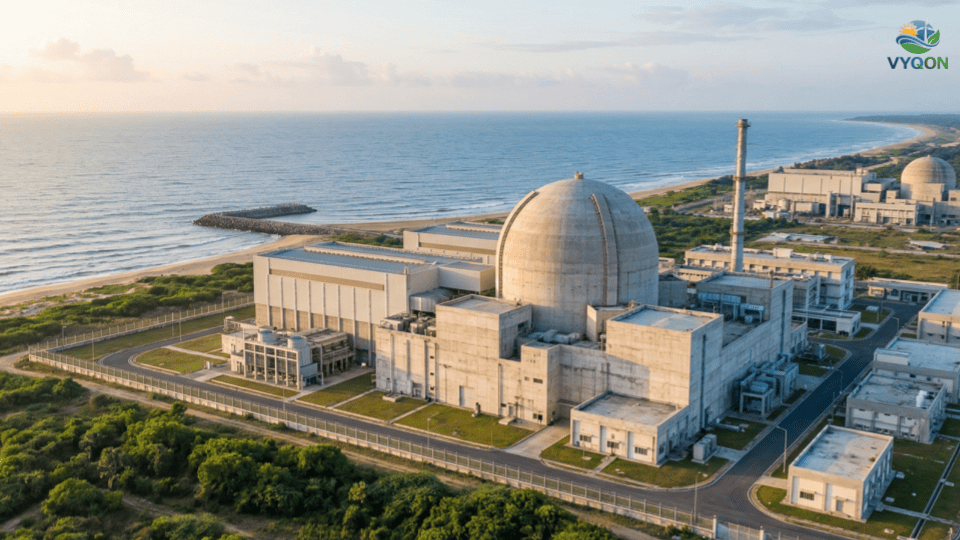
Achievement of First Criticality
On April 6, 2026, at 8:25 PM, India achieved a definitive milestone in its nuclear energy trajectory as the Prototype Fast Breeder Reactor (PFBR) attained its first criticality. Located at the Kalpakkam Nuclear Complex in Tamil Nadu, this event marks the initiation of a sustained and controlled nuclear fission chain reaction, signifying the transition from the construction phase to the operational commissioning phase. The 500 MWe facility was indigenously designed by the Indira Gandhi Centre for Atomic Research (IGCAR) and constructed by Bharatiya Nabhikiya Vidyut Nigam Limited (BHAVINI) under the oversight of the Department of Atomic Energy (DAE). This achievement formalizes India’s entry into the second stage of its Three-Stage Nuclear Power Programme, positioning the nation as one of only two countries globally, alongside Russia, to operate a commercial-scale fast breeder reactor.
Technical Architecture and Core Specifications
The PFBR is a pool-type, sodium-cooled fast reactor designed for high thermodynamic efficiency and optimized fuel utilization. The reactor core utilizes a homogenous concept with two fissile enrichment zones (21% and 28% PuO2) to achieve power flattening across the 181 fuel subassemblies.
Main Characteristics of the PFBR
| Parameter | Specification |
| Thermal Power | 1250 MWt |
| Electric Output / Overall Efficiency | 500 MWe / 40% |
| Fuel System | Uranium-Plutonium Mixed Oxide (MOX) / PuO2-UO2 |
| Core Dimensions | 1000 mm (Height) x 1900 mm (Diameter) |
| Coolant / Primary Circuit Layout | Liquid Sodium / Pool Type |
| Primary Inlet / Outlet Temperature | 670 K (397°C) / 820 K (547°C) |
| Steam Temperature / Pressure | 763 K / 16.6 MPa |
| Structural Material | SS 316 LN |
| Design Plant Life | 40 Years |
| Number of Shutdown Systems | 2 (Independent and Diverse) |
Coolant Systems and Transmutation Mechanism The reactor employs liquid sodium, chosen for its high thermal inertia and ability to operate at high temperatures (820 K outlet) without the requirement for high-pressure containment. The “breeding” capability is achieved through nuclear transmutation: the MOX core is surrounded by a blanket of fertile Uranium-238. Fast neutrons interacting with this blanket convert the fertile material into fissile Plutonium-239. This closed fuel cycle allows the reactor to produce more fuel than it consumes. Furthermore, the reactor is designed to eventually utilize Thorium-232 in the blanket, transmuting it into Uranium-233 to provide the essential fissile feed for Stage III of the national program.
Strategic Context: India’s Three-Stage Nuclear Doctrine
The PFBR is the vital technological “bridge” required to bypass India’s resource constraints, characterized by modest uranium reserves (approx. 50,000 tonnes) and vast thorium reserves (approx. 500,000 tonnes).
- Stage I: Pressurised Heavy Water Reactors (PHWRs): Utilization of natural uranium to generate power and produce plutonium as a byproduct.
- Stage II: Fast Breeder Reactors (The PFBR): Utilization of Stage I plutonium to breed additional fissile material. This stage facilitates the transmutation of thorium into Uranium-233.
- Stage III: Thorium-Based Reactors: Large-scale deployment of reactors fueled by Uranium-233, leveraging thorium to ensure multi-century energy security.
Legislative and Economic Framework The strategic importance of this milestone is underscored by the Sustainable Harnessing and Advancement of Nuclear Energy for Transforming India (SHANTI) Act, 2025. This legislation modernizes India’s nuclear legal framework and, for the first time, enables limited private participation in the nuclear sector under strict regulatory oversight. This shift is intended to accelerate the “Nuclear Energy Mission,” which received an initial budgetary allocation of Rs 20,000 crore for the development of indigenous nuclear technologies.
Safety Architecture and Regulatory Oversight
The Atomic Energy Regulatory Board (AERB) granted clearance for criticality only after multi-layered safety evaluations. The PFBR adheres to a “Defense-in-Depth” philosophy, incorporating inherent safety features and engineered safeguards.
- Reactivity Control: The reactor possesses inherent stability via negative temperature (-2.75 pcm/deg C) and power (-0.8 pcm/MW) coefficients of reactivity.
- Shutdown Systems: Two independent, fast-acting systems are utilized:
- 9 Control and Safety Rods (CSR): Used for power control and shutdown.
- 3 Diverse Safety Rods (DSR): Specifically for shutdown, featuring a Curie point magnetic switch that triggers a fail-safe rod drop if temperatures reach 873 K.
- Structural Integrity: The design employs the “Leak Before Break” (LBB) concept for critical components, such as the primary pump discharge pipe, ensuring that any potential compromise is detected via sodium leak sensors long before a catastrophic failure occurs.
- Decay Heat Removal: The Safety Grade Decay Heat Removal (SGDHR) system consists of four independent loops (8 MW each) that utilize natural convection of air and sodium, requiring no external power.
- Core Catcher: A dedicated structure located below the grid plate designed to contain a 7-subassembly meltdown and withstand an energy release of 100 MJ under a hypothetical Core Disruptive Accident (CDA).
Global Standing and Long-Term Targets
With the PFBR’s criticality, India solidifies its position as a global leader in advanced fast neutron technology. This milestone is a cornerstone of the national roadmap to achieve 100 GW of nuclear capacity by 2047.
As part of a multi-pronged fleet approach, the DAE is also fast-tracking Small Modular Reactors (SMRs), with a target of having five indigenously designed SMRs operational by 2033. These initiatives, including the development of the Bharat Small Modular Reactor (BSMR-200), are critical to meeting India’s commitment to reach Net Zero emissions by 2070 by providing reliable, low-carbon baseload power.
Operational Roadmap: Timeline to Grid Synchronization
Following the attainment of criticality, the PFBR will undergo a rigorous commissioning sequence before commercial operation:
- Low Power Physics Experiments: Validation of core physics, flux distribution, and control rod worth under controlled conditions.
- Power Escalation: A phased increase in thermal output to monitor thermodynamic variables and validate the 40% cycle efficiency.
- Grid Synchronization: The final step involves synchronizing the 500 MWe turbo-generator with the southern regional grid.
The PFBR will serve as the operational reference for the future fleet of commercial fast breeder reactors, securing India’s transition toward a self-reliant, thorium-based energy future.
Leave a Comment