
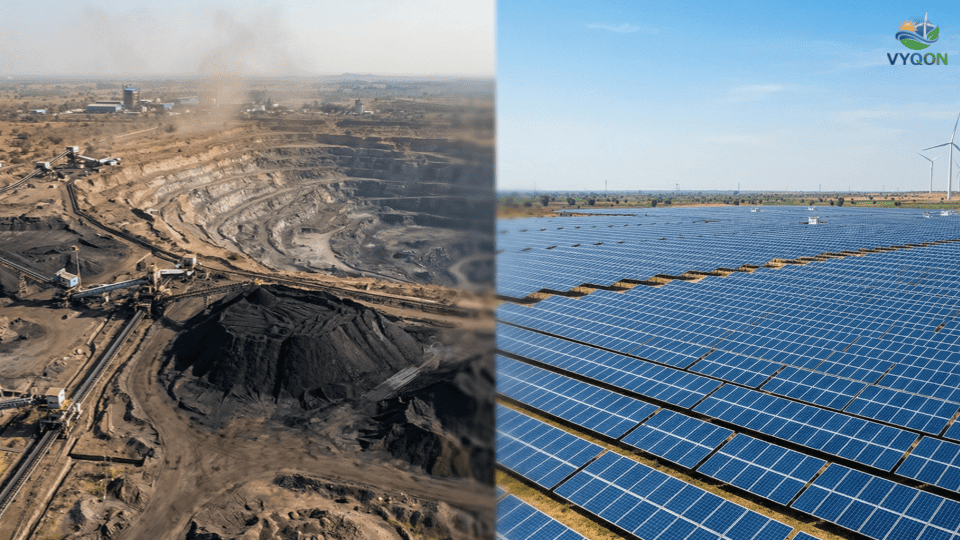
Coal India Limited (CIL) has accelerated its strategic transition from a “pure-play” coal miner to a diversified energy major, finalizing two pivotal renewable energy joint ventures (JVs) in Uttar Pradesh and Rajasthan between February and March 2026. This multi-GW roadmap represents a decisive effort to de-carbonize the balance sheet and mitigate stranded asset risk as the state-owned miner pursues internal net-zero objectives. By securing board approvals and formalizing incorporations for these large-scale projects, CIL is positioning itself to lead the clean energy expansion required to meet India’s national climate targets.
Technical Breakdown of the 2026 Joint Ventures
The following table contrasts the technical and financial structures of the two primary joint ventures established to facilitate CIL’s renewable energy development:
| Feature | Uttar Pradesh JV | Rajasthan JV (CRAUL) |
| Partner Entities | UP Rajya Vidyut Utpadan Nigam Limited (UPRVUNL) | Rajasthan Rajya Vidyut Utpadan Nigam Limited (RRVUNL) |
| Equity Split | 51:49 (CIL:UPRVUNL) | 74:26 (CIL:RRVUNL) |
| Project Scope | Solar, Floating Solar, Wind, and Pumped Storage Projects (PSP) | Solar, Wind, and Pumped Storage Projects (PSP) |
| Financial Milestones | Board approval granted in February 2026 | Official incorporation in March 2026 with ₹10 lakh initial capital |
Deep Dive: Expanding the Footprint in Rajasthan
The partnership in Rajasthan is spearheaded by the subsidiary CIL Rajasthan Akshay Urja Ltd. (CRAUL), which is currently developing a flagship 875 MW solar PV project. To facilitate the necessary debt funding for this capital-intensive installation, the CIL Board approved a corporate guarantee of up to ₹3,160 crore in March 2026. This guarantee covers 100% of the debt requirement, enabling the subsidiary to raise funds for project capital expenditure on an arm’s-length basis.
This development builds upon a 2024 Memorandum of Understanding (MoU) which identified five proposed projects totaling 4,100 MW. While the immediate focus remains on the 875 MW solar project, the joint venture’s broad mandate includes a 2,000 MW solar park, wind projects in Jaisalmer, and a critical 200 MW Pumped Storage Project (PSP) at Jawahar Sagar. Under the agreement, RRVUNL is responsible for land acquisition and offtake guarantees, while CRAUL manages financing and execution.
Strategic Scope: Uttar Pradesh and Integrated Projects
The Uttar Pradesh joint venture has been chartered with a comprehensive mandate to manage the full lifecycle of renewable assets, including development, construction, and long-term operation and maintenance (O&M). By the end of December 2025, the state’s clean energy footprint exceeded 6.6 GW, with solar contributing over 3.8 GW to that total. The CIL-UPRVUNL partnership aims to significantly augment this capacity through both traditional and emerging technologies.
Strategic focus areas in Uttar Pradesh include:
- Floating Solar: Ongoing regional activity is exemplified by a current tender for a 20 MW floating solar plant at Chilwa Taal in Gorakhpur, signaling immediate operational momentum.
- Pumped Storage Projects (PSP): Leveraging existing infrastructure, the venture is evaluating the feasibility of using de-coaled mines as reservoirs for hydro-electricity generation to provide grid stability.
- Lifecycle Management: The JV is tasked with integrated maintenance to ensure high availability across the state’s growing renewable portfolio.
Financial Trajectory and Capital Expenditure
Coal India’s investment in solar initiatives has surged during the 2025-26 financial year (FY26). According to regulatory filings, solar capital expenditure reached ₹961 crore by January 2026, achieving 132% of the progressive capex target of ₹729 crore.
Key financial indicators from the FY26 reports show:
- Surge in Investment: The FY26 expenditure is 2.33 times the ₹412 crore spent during the previous year.
- Installation Cost Efficiency: The cost of solar installation has fallen to a range of ₹4 crore to ₹4.5 crore per MW, a significant reduction from the historical range of ₹5.5 crore to ₹6 crore per MW.
- Near-Term Capacity: CIL and its subsidiaries anticipate increasing total installed renewable capacity to 675 MW by the end of the current fiscal year, supported by major projects in Gujarat.
Corporate Diversification and Net-Zero Targets
These joint ventures are cornerstones of CIL’s broader corporate strategy to transition into a net-zero entity by installing 3,000 MW of renewable capacity by FY28. This pivot is not limited to solar and wind; the company is also pursuing high-impact solutions such as a $2.92 billion (₹250 billion) green hydrogen and ammonia project in partnership with AM Green.
The AM Green project aims to produce 1.8 million metric tons of green ammonia annually, utilizing a hybrid facility of up to 3 GW of solar and 2 GW of wind. This initiative is explicitly linked to the National Green Hydrogen Mission, reinforcing CIL’s role in India’s national goal of achieving 500 GW of non-fossil energy capacity by 2030. By aggressively de-carbonizing its operations, CIL is transforming from a traditional miner into a diversified energy leader.
Leave a Comment