
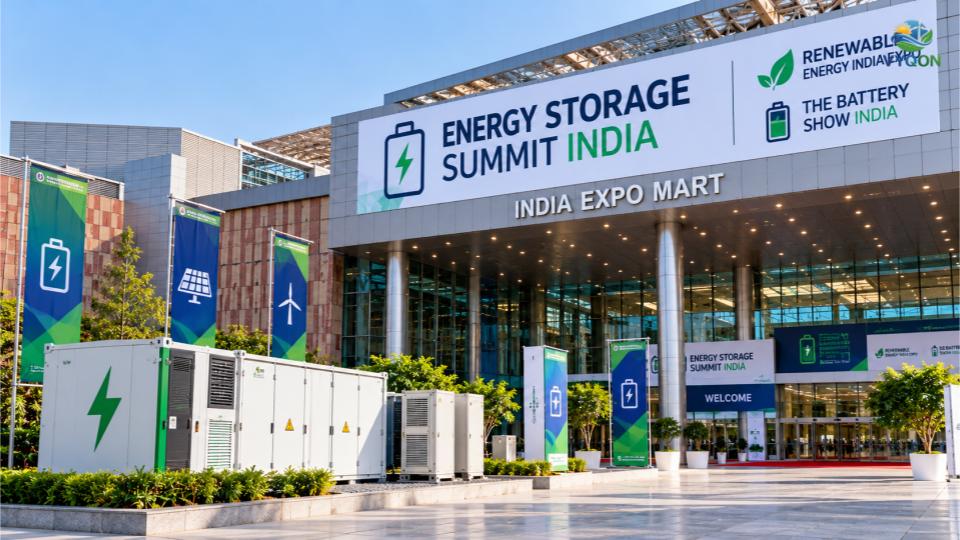
The three-day Energy Storage Summit India 2026 begins on 22 October at India Expo Mart, Greater Noida, bringing developers, utilities, financiers and technology providers together to examine battery project execution, grid connectivity, financing and domestic manufacturing.
Greater Noida, 22 October 2026: Energy Storage Summit India 2026 is scheduled to begin at India Expo Mart, Greater Noida, Uttar Pradesh, on 22 October, bringing together key participants from India’s battery energy storage and renewable electricity sectors.
Organised by Solar Media, part of Informa Markets, the conference will continue until 24 October 2026. The event marks the second Indian edition of the summit and is co-located with the Renewable Energy India Expo 2026 and The Battery Show India.
The conference will focus on a major challenge facing India’s rapidly expanding energy storage sector: converting planned and awarded Battery Energy Storage System (BESS) capacity into commercially operational projects.
According to the organiser’s official programme, the discussions will address project financing, grid connectivity, battery manufacturing, procurement risks, technical standards and the commercial performance of energy storage systems.
The conference’s theme, “Unlocking Grid Capacity and Driving Energy Storage Development in India,” reflects growing industry attention towards the infrastructure and financial requirements needed for large-scale storage deployment.
As India’s solar and wind generation capacity expands, battery storage is becoming increasingly relevant for electricity balancing, peak-demand management and the reliable integration of renewable energy into the grid.
India’s BESS Market Moves from Procurement to Implementation
India has witnessed substantial growth in battery storage procurement activity, supported by government policies, competitive bidding programmes and increasing demand for flexible electricity resources.
However, awarding a BESS project through a competitive tender is only one stage of development.
A project must subsequently secure financing, obtain the necessary approvals, finalise equipment procurement, establish grid connectivity and complete construction before it can deliver electricity storage services.
These requirements can create significant challenges, particularly for projects with demanding implementation schedules and long-term performance obligations.
The Energy Storage Summit India’s opening-day programme includes a dedicated panel titled “From Award to Grid: Making India’s Storage Pipeline Deliver.”
According to the official agenda, the session will examine how developers coordinate land availability, equipment procurement, financing, electricity offtake and grid connectivity.
Scheduled participants include representatives associated with the Solar Energy Corporation of India, BSES Rajdhani Power Limited and Aditya Birla Renewables.
The discussion is intended to examine why certain projects progress successfully towards commissioning while others experience delays.
Such challenges are important because contracted storage capacity does not become an operational electricity resource until the installation has completed the necessary testing, synchronisation and commissioning requirements.
For India’s renewable energy industry, the transition from tender announcements to reliable project delivery is becoming an increasingly important measure of progress.
Government Projections Highlight India’s Growing Storage Requirements
The policy background provides important context for the summit.
According to the Ministry of New and Renewable Energy (MNRE), the Central Electricity Authority’s National Electricity Plan projects a total energy storage requirement of 82.37 GWh in FY2026–27.
This includes 47.65 GWh of pumped storage and 34.72 GWh of battery energy storage.
By FY2031–32, the projected requirement rises substantially to 411.4 GWh, comprising 175.18 GWh of pumped storage and 236.22 GWh of BESS.
These figures represent projected electricity-system requirements rather than installed or commissioned storage capacity.
The distinction is important because future storage requirements depend on the expected generation mix, electricity demand patterns and the flexibility needed to operate the grid reliably.
Solar electricity generation is concentrated during daylight hours, while electricity consumption often remains substantial during the evening.
Wind generation also changes according to weather conditions and seasonal patterns.
Energy storage can help manage these variations by absorbing electricity when generation is available and delivering it during periods when electricity is required.
However, different storage technologies and configurations provide different services.
A battery designed to discharge for two hours serves a different energy-shifting requirement from a four-hour or eight-hour system, even when their power ratings are identical.
The summit will provide an opportunity to discuss how storage duration, operating requirements and commercial arrangements should evolve alongside India’s renewable electricity portfolio.
Project Financing and Commercial Bankability
Financing is one of the major subjects included in the conference programme.
Battery projects require substantial initial investment in battery cells, modules, racks, power conversion systems, transformers, thermal management, safety infrastructure and grid connectivity.
Project financing must also account for long-term operating costs, equipment degradation, maintenance, insurance and battery replacement requirements.
The official agenda includes discussions on what lenders require before financing battery storage projects in India.
A scheduled session titled “What It Takes to Get a Battery Project Funded in India Right Now” will examine commercial feasibility, lender expectations, warranty requirements and long-term performance risks.
Additional discussions will consider debt, equity and blended-finance arrangements suitable for different categories of storage projects.
Commercial structures can vary significantly.
Standalone storage projects may receive payments for making contracted capacity available, while renewable energy projects integrated with batteries may be designed to meet firm or dispatchable power supply obligations.
Other storage installations may depend on market-linked electricity revenues or arrangements with commercial and industrial consumers.
The financial risks associated with these business models are not identical.
Lenders and investors must assess the reliability of revenue arrangements, counterparty obligations, operating assumptions and the technical performance of the storage equipment.
Consequently, the lowest quoted storage tariff or capacity charge does not independently establish that a project is financially viable throughout its operating life.
Viability Gap Funding Supports Storage Development
Government support mechanisms remain important to India’s energy storage development.
According to an official Ministry of Power statement issued on 3 August 2026, a Viability Gap Funding (VGF) programme supports 13.22 GWh of BESS capacity under implementation, with a budgetary allocation of ₹3,760 crore.
The government has also approved another VGF programme for the development of 30 GWh of battery energy storage capacity, with financial support of ₹5,400 crore from the Power System Development Fund.
These programmes are intended to support the development of storage infrastructure and improve the commercial feasibility of eligible projects.
However, supported scheme capacity should not be confused with operational storage capacity.
A funding allocation or project award does not mean that the corresponding battery systems have already entered commercial service.
Individual projects must still complete financing, construction, equipment testing and grid-connection requirements.
The Ministry of Power has also introduced regulatory and market measures supporting the development of energy storage systems, including procurement guidelines and provisions relating to storage participation in the electricity sector.
The summit’s discussions are expected to examine how such policy measures influence project economics, financing decisions and implementation timelines.
Grid Connectivity and Commissioning Challenges
Grid connectivity is another central issue for battery storage deployment.
A BESS facility requires an appropriate electrical connection to charge and discharge electricity safely and efficiently.
The installation must be designed around the capacity and operating requirements of the relevant electricity network.
Important technical elements include transformers, switchgear, protection systems, metering infrastructure and power conversion equipment.
Storage projects may also require detailed coordination with transmission or distribution utilities and electricity system operators.
The organiser’s agenda includes a panel titled “What It Actually Takes to Commission a Battery Project in India Today.”
The session will examine construction delays, grid-connection requirements, financing assumptions and other challenges that can arise after a project has been awarded.
These issues are especially relevant for battery installations developed alongside large solar and wind projects.
Co-located storage can provide an opportunity to use existing renewable energy infrastructure more effectively, depending on the electrical configuration and commercial structure.
However, the availability of a solar or wind connection does not automatically guarantee that additional battery charging and discharging capacity can be accommodated.
Engineering studies and the applicable connectivity requirements remain essential.
The effective integration of BESS will therefore depend on coordination among developers, utilities, equipment suppliers and grid operators.
Domestic Battery Manufacturing and Supply-Chain Development
The conference programme also addresses India’s battery manufacturing capabilities and supply-chain requirements.
Battery cells remain a critical component of grid-scale storage systems, influencing project cost, operating performance and long-term reliability.
Developers must evaluate cell chemistry, equipment quality, supply availability, thermal behaviour and warranty conditions when selecting storage technologies.
International procurement can expose projects to changes in equipment prices, shipping arrangements and currency movements.
Domestic manufacturing and assembly could help develop a more resilient supply chain, although the availability of locally manufactured equipment must be assessed against technical specifications, cost competitiveness and production timelines.
The official agenda includes a session on building India’s battery supply chain, focusing on manufacturing capacity, procurement strategies and the commercial viability of different sourcing arrangements.
The government’s Advanced Chemistry Cell Production Linked Incentive programme provides additional policy context for domestic battery manufacturing development.
According to the Ministry of Power, the scheme has an approved outlay of ₹18,100 crore for establishing 50 GWh of advanced chemistry cell manufacturing capacity, with 10 GWh earmarked for grid-scale stationary storage applications.
However, manufacturing targets and approved incentives are not equivalent to verified commercial production.
Actual domestic cell availability will depend on successful facility development, qualification and manufacturing operations.
Safety, Technology and Long-Term Performance
Battery safety and operational reliability are also expected to feature prominently during the summit.
Grid-scale storage systems contain substantial quantities of stored electrical energy and require appropriate measures for monitoring, protection and thermal management.
Battery Management Systems (BMS), thermal control equipment, fire-detection arrangements and operational procedures are important components of a comprehensive safety strategy.
The summit agenda includes discussions on standards, safety and the requirements for expanding India’s operational BESS fleet.
Long-term performance is another commercial consideration.
Battery degradation, operating temperatures, charging patterns and discharge cycles can affect usable energy capacity over time.
Developers and lenders must therefore evaluate equipment warranties, maintenance responsibilities and performance guarantees when assessing project risk.
The programme also includes discussions on longer-duration storage technologies and the role of alternatives to conventional lithium-ion battery systems.
These technologies may address different electricity-system requirements, but their commercial readiness and suitability must be assessed individually.
Outlook: Delivering Reliable Storage Capacity
Energy Storage Summit India 2026 comes at a significant stage in the development of India’s battery storage industry.
The event’s scheduled discussions highlight an important transition from announcing storage tenders towards financing, constructing and operating reliable battery installations.
Over the three-day programme, developers, utilities, financiers, manufacturers and technical specialists are expected to examine the commercial and engineering requirements needed to accelerate deployment.
For India’s renewable energy sector, effective storage development will depend on more than the amount of capacity awarded through competitive procurement.
Successful implementation will require dependable equipment, realistic financing structures, safe system design, appropriate grid connections and reliable long-term performance.
The Greater Noida summit provides an industry platform to examine these issues and strengthen cooperation across the storage value chain.
No new project award, investment agreement or commissioned battery capacity should be attributed to the summit until separately confirmed through official announcements.
The central significance of the event lies in its focus on turning India’s growing battery storage development pipeline into operational electricity-system infrastructure.
Official Sources and References
1. Energy Storage Summit India 2026 — Official Organiser Website
Conference dates, venue, theme, second-edition information and co-located exhibitions.
2. Energy Storage Summit India 2026 — Official Conference Agenda
Scheduled sessions covering project commissioning, finance, grid connectivity, domestic manufacturing and storage technologies.
3. Ministry of New and Renewable Energy — Energy Storage Systems Overview
Official Central Electricity Authority projections for energy storage requirements in FY2026–27 and FY2031–32.
https://mnre.gov.in/en/energy-storage-systemsess-overview
4. Ministry of Power / Press Information Bureau — 3 August 2026
Modernisation of the Power Sector and Reliable Electricity Supply.
Official information on BESS viability gap funding, domestic battery manufacturing support and transmission development.
https://www.pib.gov.in/PressReleasePage.aspx?PRID=2293896&lang=2®=48
5. Ministry of Power / Press Information Bureau — 27 July 2026
Grid Stability and Energy Storage.
Official information regarding projected storage requirements, regulatory measures and electricity-grid integration.
https://www.pib.gov.in/PressReleasePage.aspx?PRID=2290015&lang=1®=3
Leave a Comment