
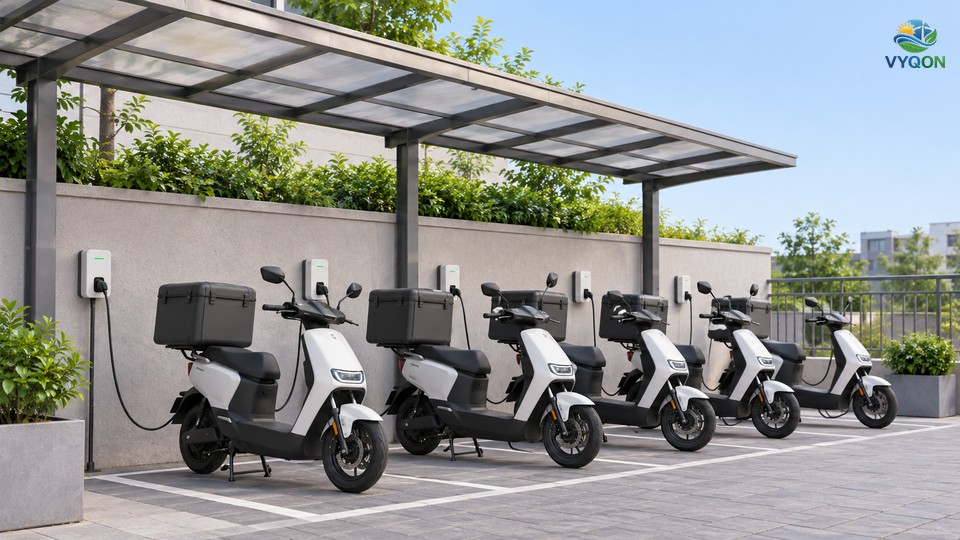
Flipkart has doubled its last-mile electric vehicle (EV) fleet to 42,000 vehicles this festive season, up from more than 20,000 in 2025, the company said in an announcement dated 23 November 2026. The Flipkart electric fleet expansion is part of the e-commerce group’s commitment to a fully electric last-mile delivery fleet by 2030 under the Climate Group’s EV100 initiative.
How the Flipkart electric fleet is split
Electric two-wheelers serving Flipkart Minutes, the company’s quick-commerce service, account for about 77% of the fleet. These vehicles have grown in step with quick commerce across cities, the company said. Another 20% of the EVs operate across the rest of Flipkart’s delivery network. The fleet grew most in Bengaluru, Mumbai, Chennai, Pune and Gurugram.
The jump from over 20,000 to 42,000 vehicles in about a year builds on the 2025 festive-season level: in June 2026 the company said its EV fleet had doubled over the past year and crossed 20,000 vehicles during that season. In an August 2025 article, Flipkart said it had reached 10,000 electric vehicles in its last-mile fleet in November 2024. These are company-reported figures; Flipkart has not disclosed a breakdown by vehicle model or supplier.
What delivery partners told Flipkart
Alongside the fleet figure, Flipkart published the results of a survey of over 9,400 delivery partners, whom it calls Wishmasters. The survey covered riders of both EVs and internal combustion engine (ICE) vehicles and looked at what shapes the decision to switch.
The main finding was that intent to switch is nearly four times higher among respondents who have tried an EV. Among EV riders, 59% cited cost savings as a key motivation, while charging access remains an operational need. Among ICE riders, 55% said financial support such as EMI loans, down-payment assistance or a daily EMI option would encourage them to switch.
Awareness of government incentives was higher among EV riders (58%) than non-EV riders (37%), which the company said suggests that rider education matters. Flipkart said it supports Wishmasters through training, awareness drives, nationwide EV roadshows and digital learning on the incentives and financing options available to them. It also organised an EV Mela in Bengaluru, bringing together manufacturers including Ampere, Bajaj, Hero Vida and Motovolt alongside financing institutions.
EV Assist and charging access
Two enablers sit behind the fleet growth. The first is EV Assist, a digital marketplace Flipkart launched earlier this year that connects Wishmasters with electric two-wheeler rental providers, so a rider can adopt an EV without buying a vehicle upfront. In its June 2026 announcement, Flipkart said riders can compare rental options by city and weekly budget, register interest with only a name and mobile number, and connect with verified mobility providers who also handle maintenance and servicing. The platform is available in English, Hindi, Bengali and Kannada, and the company said it has seen strong demand in Delhi NCR, Patna and Bengaluru.
The second is charging. Flipkart said it is working with YUMA, one of India’s largest battery-swapping companies, and other ecosystem partners on charging infrastructure across its hubs and micro fulfilment centres. Eight battery-swapping stations are operational in Bengaluru, with plans to extend to other metro cities.
Background: Flipkart’s EV100 commitment
Flipkart began its fleet electrification in 2018 with electric bikes, followed by electric vans in 2019, according to the company’s own account of its electric mobility journey. It became the first e-commerce marketplace in India to join the Climate Group’s EV100 initiative, a global programme that brings together companies committed to accelerating the shift to electric vehicles. The company has also said it has piloted electric trucks on mid-mile routes, including NCR-Jaipur and NCR-Agra, an early step towards decarbonising the wider logistics network beyond the last mile.
In its announcement, Rajneesh Kumar, Chief Corporate Affairs Officer, Flipkart Group, said: “Our delivery partners decide whether electric works, and they tell us it comes down to cost, charging and financing.” He added that the company would keep building the effort with its Wishmasters and partners.
What it means for India’s clean-energy sector
Last-mile delivery is one of the most visible places where electric two-wheelers are replacing petrol vehicles, because riders cover many short trips a day and their running costs matter directly to their income. A fleet of 42,000 electric vehicles in a single company’s network adds steady demand for electric two-wheelers, rental fleets, battery-swapping stations and charging points in the major metro cities.
The survey findings also point to where the market still needs work. Riders who have tried an EV are far more likely to switch, but charging access and financing remain barriers for those on petrol vehicles. That makes rental platforms, battery swapping and easier financing as important to adoption as the vehicles themselves. Electric two-wheelers used in quick commerce draw their power from the grid, so growth in this fleet also raises the importance of reliable charging and swapping infrastructure at delivery hubs and micro fulfilment centres.
Flipkart did not disclose the investment behind the expansion, the share of the fleet owned by the company versus rented or supplied by partners, or the timeline for the remaining cities. The next milestone to watch is how quickly the fleet grows towards the 2030 goal of a fully electric last-mile network.
Official references
1. Flipkart Stories, “Flipkart Doubles Its Last-Mile Electric Fleet in a Year; Switch Intent Is Nearly 4X Higher Among Riders Who Have Tried an EV”, 23 November 2026: stories.flipkart.com
2. Flipkart Stories, “Flipkart Launches EV Assist to Make Electric Mobility More Accessible for Delivery Partners”, 5 June 2026: stories.flipkart.com
3. Flipkart Stories, “100% electric mobility: Flipkart drives towards sustainability with EV100”, 14 August 2025: stories.flipkart.com
Leave a Comment