
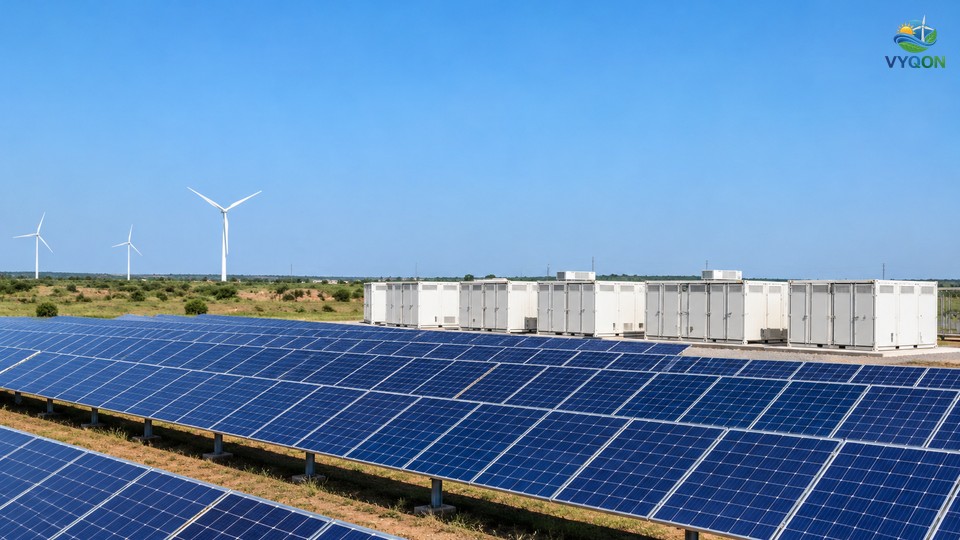
Crisil Ratings has upgraded its rating on the long-term bank facilities of Juniper Green Energy Limited (JGEL) to Crisil AA-/Stable from Crisil A+/Stable. The Juniper Green Energy Crisil rating action, dated 23 November 2026 in Mumbai, also lifts the total bank loan facilities rated to Rs 761.68 crore, up from Rs 118 crore. The company disclosed the rating rationale to the stock exchanges on 23 November 2026.
What Crisil changed
Along with the upgrade, Crisil moved from a standalone view of JGEL to a consolidated one. It says this reflects the strong financial, managerial and operational links between JGEL and its special purpose vehicles (SPVs), as well as the parent’s support philosophy towards them. The consolidated view covers JGEL and its wholly owned subsidiaries, which share a common management and treasury.
The rated amount has two parts: a Rs 678.44 crore term loan from the Indian Renewable Energy Development Agency Limited, maturing on 30 June 2046, and a proposed long-term bank loan facility of Rs 83.24 crore. Both carry the Crisil AA-/Stable rating. The rating history shows A/Stable in 2023, A+/Stable in 2024 and 2025, and now AA-/Stable. This is Crisil’s opinion on the company’s credit profile, not a statement by the company, and not investment advice.
Why the rating went up
Crisil points to healthy growth in operational capacity, a timely execution record on sizeable projects, a comfortable debt service coverage ratio (DSCR), and the Rs 1,800 crore initial public offer (IPO) completed in August 2026. The IPO proceeds were largely used to reduce leverage, and the promoters hold 85.9% after the IPO.
As of September 2026, JGEL had about 2.1 GW of operational capacity and 0.6 GWh of installed battery energy storage system (BESS) capacity, against 1.3 GW and 0.1 GWh in March 2026. Operating earnings before interest, tax, depreciation and amortisation (Ebitda) rose to Rs 574 crore in the first half of fiscal 2027 from Rs 254 crore in the first half of fiscal 2026.
The whole generation capacity is tied up in 25-year power purchase agreements (PPAs), spread across more than three states and seven counterparties. Crisil also notes that the operating solar and wind assets have performed at or above P90 levels for the past three years. P90 is a conservative estimate that a plant is expected to meet or beat in nine years out of ten. Liquidity is described as strong, with cash and equivalents of Rs 2,104 crore as of September 2026.
A large pipeline under construction
JGEL has about 2.5 GW of PPA-signed solar and wind capacity under construction, along with 3.5 GWh of BESS. The portfolio is largely firm and dispatchable renewable energy (FDRE) projects, followed by hybrid projects, and is expected to be commissioned over about the next 1.5 years. Crisil expects total capacity to reach about 4.7 GW (AC) and 10 GWh of BESS by the end of fiscal 2028. The company plans to add 1.3-1.5 GW a year, with planned capital expenditure of Rs 25,000-30,000 crore over the next three years. For earlier milestones, see VYQON’s report on Juniper Green’s BESS and solar commissioning.
Crisil expects growth in internal accruals to fund a substantial part of the equity requirement. It also expects the average DSCR to stay at 1.3-1.4 times, and the net debt to operating Ebitda ratio to fall from 15.5 times as of March 2026 to 7-8 times over the medium term.
Risks Crisil flags
The rating is partly held back by execution, funding and operational risks tied to the large capacity plan, particularly the FDRE projects. These must meet strict demand-fulfilment requirements, with penalties, usually 1.5 times the PPA tariff, if they fall short. Generation from recently commissioned FDRE capacity remains to be monitored.
Crisil sees mitigants: progress on land acquisition, grid connectivity and financial closure for the PPA-signed projects, and the group’s practice of commissioning BESS ahead of the matching solar and wind capacity. Generation sustainably above the P90 benchmark and faster deleveraging could lift the rating, while weaker generation, higher debt-funded capex, material time or cost overruns, or stretched receivables could pull it down.
About the company
JGEL is promoted by Juniper Renewable Holdings Pte. Ltd, which is 75.01% held by AT Capital Group and 24.99% by Vitol Group. The company has about 50 projects across three states in India.
What it means for India’s clean-energy sector
A higher rating usually widens the pool of lenders, although Crisil’s note does not state any effect on borrowing costs. For India’s renewable developers, the Juniper Green upgrade shows how lenders view hybrid and FDRE projects: Crisil rewards long-term PPAs, a delivery record and lower leverage after a listing, while flagging that these complex projects carry execution and operating risk.
The pace of build-out is also notable. Capacity is expected to go from about 2.1 GW to about 4.7 GW within roughly two years, with storage rising from 0.6 GWh to 10 GWh. That reflects the sector’s move towards solar and wind paired with storage to supply round-the-clock power.
Leave a Comment