
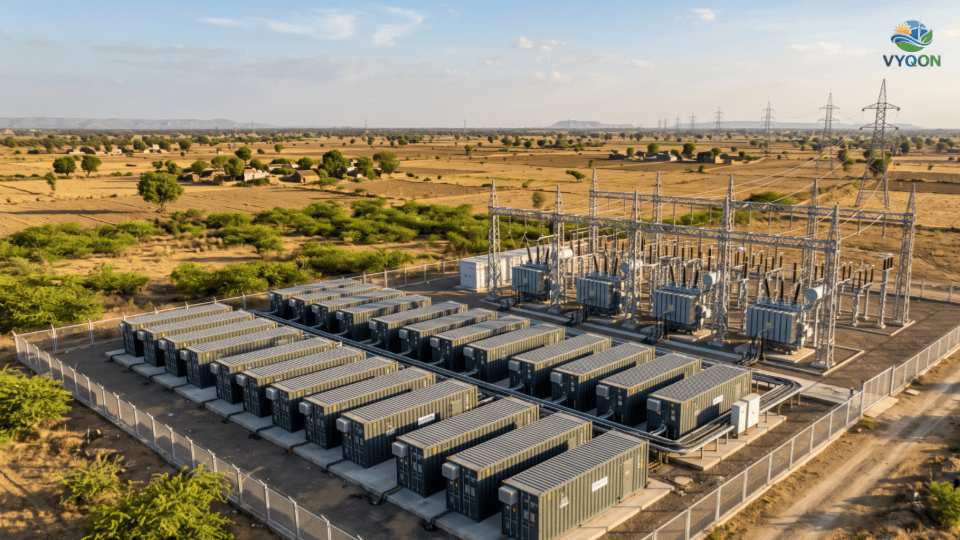
Gujarat Urja Vikas Nigam Limited (GUVNL) has finalized the award for its Phase-IX standalone Battery Energy Storage System (BESS) tender, signaling a maturation of the Indian storage market and an aggressive shift toward grid-scale flexibility. In an auction characterized by remarkable procurement velocity—concluding on August 12, 2026, less than two months after its June issuance—NLC India Renewables Limited and Sun Drops Energia Limited emerged as the primary victors.
The discovered lowest tariff of ₹2,31,989 per MW per month underscores a profound “cost revolution” in the sector. This pricing reflects a continuing downward trajectory in BESS economics, which has seen storage costs plummet by approximately 79% over the last three years. What was once a niche, subsidy-dependent technology is rapidly becoming a commercially competitive cornerstone of the Indian power grid.
Auction Results and Corporate Strategy
The auction was decided by a razor-thin ₹1 margin, highlighting the fierce competitive intensity in the current BESS landscape. While NLC India Renewables Limited secured its full 275 MW capacity as the L1 bidder, Sun Drops Energia Limited was awarded the remaining 175 MW capacity.
GUVNL Phase-IX Auction Results
| Successful Bidder | Allocated Capacity (MW) | Winning Tariff (₹/MW/Month) |
| NLC India Renewables Limited | 275 MW | ₹2,31,989 |
| Sun Drops Energia Limited | 175 MW | ₹2,31,990 |
The allocation to Sun Drops Energia, a wholly-owned subsidiary of KPI Green Energy incorporated in May 2019, is particularly notable. While Sun Drops originally quoted for 410 MW, GUVNL utilized the “bucket-filling” method to award the remaining 175 MW, a strategic move to diversify the pool of developers and mitigate project concentration risk. For Sun Drops, this award validates the management’s decision to bet on BESS as its “next growth engine,” leveraging the parent company’s massive land and execution infrastructure to transition from a solar-focused EPC to a utility-scale storage provider.
Technical Mandates: Driving LFP Dominance
The technical specifications outlined by GUVNL are designed to ensure high-fidelity, industrial-grade performance. These benchmarks favor the Lithium Iron Phosphate (LFP) chemistry, which currently holds a 37% cost advantage over Nickel Manganese Cobalt (NMC) variants while offering superior thermal safety and longer cycle life.
- Operational Intensity: Systems must support two full charge-discharge cycles per day to manage peak and off-peak fluctuations.
- Performance Benchmarks: A mandatory 0.5 C-rate capability and a minimum guaranteed annual availability of 95% are required.
- Efficiency Standards: Developers must maintain a minimum AC-to-AC round-trip efficiency (RtE) of 85% on a monthly basis.
- Indigenous Localization: In a push for supply-chain sovereignty, all Energy Management System (EMS) software must be indigenously developed in India.
- Quality Assurance: The use of refurbished battery cells is strictly prohibited, ensuring that only new, high-integrity assets are integrated into the state grid.
Financial Framework and Viability Gap Funding
The projects operate under a Build-Own-Operate (BOO) model, supported by a 12-year Battery Energy Storage Purchase Agreement (BESPA). A critical component of this tender is the financial support through Viability Gap Funding (VGF) under the Power System Development Fund (PSDF).
Reflecting the technology’s increasing commercial viability, the VGF support level has been set at ₹18 lakh per MWh. This represents a significant reduction from previous outlays of ₹46 lakh/MWh, indicating that BESS is nearing a subsidy-free inflection point. Under the contract terms, GUVNL provides the charging power from the Gujarat Energy Transmission Corporation (GETCO) network at no cost to the developer, while the State Load Dispatch Center (SLDC) retains control over dispatch instructions. This off-taker responsibility for charging power drastically improves the internal rate of return (IRR) for developers, offsetting high initial capital intensity.
Grid Integration and Evacuation Infrastructure
The 450 MW of BESS capacity will be distributed across 10 strategic substations in Gujarat to ensure localized grid stability. The chosen sites—Choraniya AIS, Virpore AIS, Veloda AIS, Moti Gop, Motipaneli, Otha, Sagapara, Visavadar, Savarkundla, and Dhrangadhra—possess cumulative evacuation infrastructure supporting approximately 800 MW. This provides significant operational headroom, allowing GUVNL to scale storage assets at these nodes as renewable penetration increases.
Competitive Landscape and Market Evolution
The Phase-IX auction saw a wide spectrum of bidders, including established giants and emerging players. The list of participants who did not secure capacity—Madhav Infra Project, Stockwell Solar Services, Advaid Energy Transition, JGRJ Six Renewable Pvt. Ltd., Rajesh Power Service, Coal India Ltd., and Zodiac Ltd.—highlights the high bar for entry.
Industry analysts and research bodies like IEEFA have recently flagged execution risks associated with the entry of “inexperienced firms” in recent BESS tenders, which has led to project cancellations elsewhere. However, the Gujarat results suggest that bidding intensity is finally normalizing. Aggressive, commercially unviable bids are being weeded out in favor of developers with proven execution capabilities. Furthermore, the 20% local content mandate in project procurements ensures that the “Made in India” push remains central to the state’s energy transition.
Industry Impact: The Essential Infrastructure Backbone
The conclusion of the Phase-IX auction marks a pivotal step toward Gujarat’s role in India’s target of 500 GW of renewable capacity by 2030. By providing on-demand storage for the state’s DISCOMs, these standalone BESS units will facilitate the seamless integration of intermittent wind and solar power. In the current energy paradigm, BESS is no longer an optional add-on; it has become the essential flexible infrastructure backbone required to maintain grid stability during both peak and off-peak periods in a high-renewable future.
Official Citations & Reference Resources
- NLC India Limited (NLCIL)(A Navratna Central Public Sector Enterprise, Government of India)
- Official Corporate Portal: NLC India Limited Official Website
- Governance & Compliance Disclosures: NLCIL Investor Relations & Financials
- Environmental, Social & Governance (ESG) Framework: NLCIL Corporate Social Responsibility (CSR) Policy
- Information Security & Privacy Policy: NLCIL Cyber Security & Data Privacy Policy
- Gujarat Urja Vikas Nigam Limited (GUVNL)(Government of Gujarat Power Utility)
- Phase-IX Standalone BESS Tender Bidding Portal: Bharat Electronic Tender Solutions (ETS Portal)
- Ministry of Corporate Affairs (MCA)(Government of India)
- National Corporate Filing Portal: Ministry of Corporate Affairs (MCA) Portal
Leave a Comment